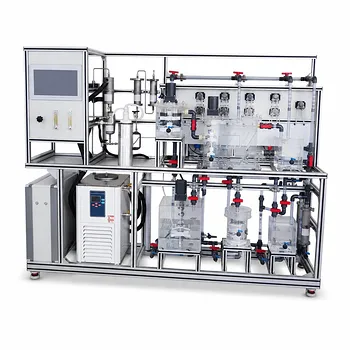
Pilot plants offer a direct, hands-on method to demonstrate the removal of hazardous hydrogen sulfide (H₂S) and hydrogen cyanide (HCN) from foul water. By integrating a chemical scrubber with a steam stripper, students and researchers can observe how a selective reaction neutralizes the lethal cyanide before the acid gases are thermally separated. This setup transforms textbook theory into tangible practice, revealing the critical interplay between reaction kinetics, mass transfer, and process safety that defines industrial wastewater treatment.
The definitive way to teach these processes is through a sequential unit operations pilot plant: first, foul gas is contacted with a sodium polysulfide scrubber to convert HCN into the safer thiocyanate; then, the remaining mixture enters a stripping column where steam and acid drive off H₂S. This approach not only demonstrates the core separation principles but also embeds the indispensable safety logic—cyanide must be chemically locked before thermal stripping.
Unpacking the Core Process: Reaction Before Separation
The pilot plant’s design flows from a non-negotiable safety requirement. Hydrogen cyanide is extremely toxic as a free gas; you cannot simply heat the stream and hope to vent it. The demonstration must first show a chemical conversion step, followed by a physical separation step.
Why Sodium Polysulfide is the First Line of Defense
The foul water stream contains both dissolved H₂S and HCN. The gas mixture from this water is initially passed into a wet scrubber containing a sodium polysulfide (Na₂Sₓ) solution. Here, a targeted liquid-phase reaction takes over.
The polysulfide reacts selectively with the cyanide ions, converting them into thiocyanate (SCN⁻). This reaction is the heart of the safety demonstration because thiocyanate is significantly less volatile and less acutely toxic. This step shows students that effective environmental treatment is often not about simple stripping, but about chemically transforming the most dangerous pollutant into a manageable form before any heating occurs.
How Steam Stripping Completes the Separation
Once the cyanide has been rendered non-volatile as thiocyanate, the process can safely target the hydrogen sulfide. The liquid stream then enters a stripping column, a vertical vessel designed for intimate gas-liquid contact.
Live steam is injected at the bottom of the column. As the steam rises, it heats the foul water and lowers the partial pressure of dissolved gases, effectively “stripping” them out of solution. To enhance ammonia separation (if present) and maintain the correct equilibrium for H₂S, sulfuric acid is injected. This shift in pH is a pivotal control variable that students can directly manipulate to see how it alters the off-gas purity and the efficiency of the stripping process.
Designing the Pilot Plant for Maximum Educational Impact
A well-designed unit operations pilot plant is more than just connected vessels; it is a platform for testing hypotheses and visualizing invisible physics. To demonstrate these specific reactions, the plant must integrate key analytical and control features.
Instrumentation and Real-Time Analysis
The educational value multiplies when students can measure what is happening inside the columns. The pilot plant should be equipped with sampling ports and inline analyzers. By performing titrations—for example, determining total alkalinity, sulfides, and carbonates—students can calculate the exact species distribution at various points.
This chemical profiling is essential for evaluating the mass transfer efficiency of the scrubber. It lets them monitor how quickly the sodium polysulfide solution is becoming exhausted. This transforms the scrubber from a magical black box into a quantifiable reactor where the rate of scrubbing is directly linked to the remaining chemical potency of the solution.
Demonstrating Multi-Phase Mass and Heat Transfer
The stripping column is a classic example of three-phase complexity involving a liquid (foul water), a gas (steam and stripped H₂S), and the column’s solid packing material. The pilot plant allows students to study the volatile weak electrolytes in action.
As the gas stream cools slightly or as steam condenses, H₂S and NH₃ dissolve and react in the liquid film. This demonstrates the tight coupling of heat transfer and mass transfer. By adjusting the steam flow rate or the reboiler temperature, researchers can instantly see how the system’s equilibrium shifts, turning abstract thermodynamic models into observable trends in outlet gas composition.
Integrating the Process Safety Narrative
The pilot plant itself is a lesson in industrial hygiene. The entire sequence—from the initial polysulfide scrubber to the acid-dosed stripper—must be designed with leak-proof seals, fume hood enclosures, and emergency scrubbers on the vent lines. Walking students through the material of construction (resistant to wet H₂S corrosion) and the monitoring of pressure drops across the columns ingrains the real-world consequences of handling these chemicals, preparing them for the rigorous safety protocols of a refinery or chemical plant.
Understanding the Trade-offs
No process is free of limitations, and a robust pilot demonstration must also highlight these challenges to be truly complete.
The Complexity of Real Foul Water
Industrial foul water never contains just H₂S and HCN. It is a cocktail of mercaptides, carbonates, phenols, and suspended solids. A simplified pilot demonstration might miss the fouling tendencies that plug column packing or the side reactions that consume polysulfide, creating a gap between academic purity and plant reality. A deep understanding requires spiking the feed with realistic contaminants to demonstrate these inefficiencies.
Safety Versus Speed in Cyanide Handling
The sodium polysulfide step is safe but slow and chemically intensive. There is an inherent trade-off between scrubbing residence time and throughput. If the gas flow rate is too high, the cyanide-polysulfide reaction will not go to completion, and traces of HCN could escape into the steam stripper. The pilot plant forces a direct confrontation with this design constraint: you must size the scrubber not just for mass transfer, but for the fundamental kinetics of the cyanide reaction.
The Corrosion Environment
The combination of wet H₂S, sulfuric acid, and steam creates a notoriously corrosive environment. Pilot plants made from standard stainless steel will quickly show signs of sulfide stress cracking. This is a powerful, albeit destructive, lesson. It forces a discussion about metallurgy selection (such as using austenitic stainless steels or duplex steels) and the true total cost of ownership, where material longevity is as critical as chemical efficiency.
Making the Right Choice for Your Demonstration Goal
The way you configure the pilot plant depends on whether the primary objective is teaching fundamentals, conducting research, or simulating a specific industrial process.
- If your primary focus is teaching basic mass transfer: Start with a simpler steam stripper using a model system (like H₂S and ammonia with a pH agent) before introducing the polysulfide chemistry. This isolates the physical separation variables.
- If your primary focus is industrial safety training: The full sequential process is mandatory. Emphasize the inline cyanide monitoring before the stripper inlet, and run scenario-based failures (e.g., polysulfide pump failure) to drill emergency responses in a controlled setting.
- If your primary focus is process optimization and research: Integrate multiple analytical points to perform a full species mass balance across both the scrubber and stripper. Use this data to model reaction kinetics and refine parameters like solvent circulation rates and thermal energy input, directly mirroring industrial gas purification challenges.
By bridging the gap between a hazardous chemical reality and a controlled laboratory environment, these pilot plants do more than just clean water—they build the foundational judgment needed to design inherently safer and more efficient chemical processes.
Summary Table:
| Process Step | Mechanism | Key Value / Learning Outcome |
|---|---|---|
| 1. Wet Scrubber | Sodium polysulfide converts toxic HCN to non-volatile thiocyanate ($SCN^-$) | Teaches selective chemical reaction kinetics & safety-first process design |
| 2. Stripping Column | Steam injection & acid dosing strip out H2S gas | Demonstrates multi-phase mass/heat transfer & pH equilibrium control |
| 3. Safety Systems | Leak-proof seals, fume hoods & emergency scrubbers | Trains students and researchers in industrial hygiene & safe gas handling |
Bring Industrial Process Reality to Your Institution with LABPARK
Looking to elevate your hands-on curriculum or accelerate your research? LABPARK provides premium Educational and Vocational Unit Operations Pilot Plants in chemical engineering, bioprocess & biotech, and environmental & water treatment tailored for universities, research institutes, and enterprises.
Our advanced pilot plants enable you to:
- Visualize Complex Physics: Demonstrate real-world mass transfer, heat transfer, and chemical kinetics.
- Teach Process Safety: Train operators on hazardous gas handling (such as $H_2S$ and $HCN$) using industry-grade safety designs.
- Bridge Theory and Practice: Give students and researchers hands-on experience with industrial-scale controls and instrumentation.
Ready to design the ideal pilot plant for your lab? Contact LABPARK today to discuss your custom specifications with our engineering experts!
Related Products
- Absorption and Desorption Educational Unit Operations Pilot Plant
- Multi-Functional Drying Educational Unit Operations Pilot Plant
- Fixed-Bed Chemical Reaction and Gas Dust Tar Removal Unit Operations Pilot Plant
- Natural Product Extraction Unit Operations Training Pilot Plant
- Rising and Falling Film Evaporation Educational Unit Operations Pilot Plant
People Also Ask
- How to demonstrate physical vs chemical absorption using a pilot plant? A practical lab guide.
- Why are liquid-phase mass transfer rates in pilot plants comparable to gas-phase rates? Key Insights
- Why is interface composition critical in absorption pilot plants? Bridging Theory & Practice
- How to Calculate HTU & NTU for Pilot Plant Packing Height: A Complete Guide
- How do absorption pilot plants assist students in calculating mass transfer coefficients and sizing column parameters?