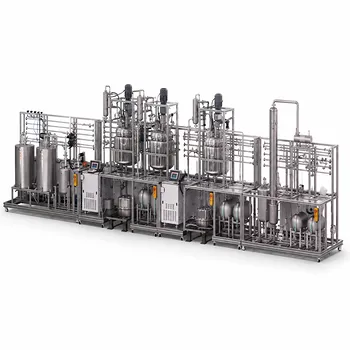
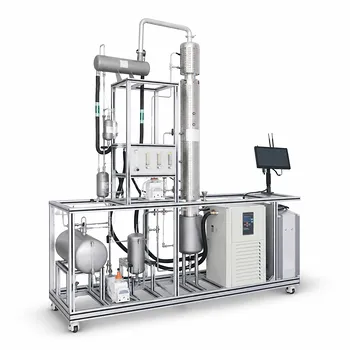
Heat pump distillation and multi-effect distillation can be physically demonstrated using specially configured pilot plants. These miniaturized industrial systems allow students and researchers to run real separations, see the energy flows, and quantify the savings. By integrating a compressor to recycle latent heat or connecting multiple columns at cascading pressures, a pilot plant turns textbook diagrams into operational proof of modern energy-saving technologies.
Pilot plants bridge the gap between theory and reality. They prove that advanced energy-saving concepts like heat pump and multi-effect distillation are not just equations—they are practical, measurable, and controllable processes that dramatically cut utility consumption.
Configuring a Pilot Plant for Heat Pump Distillation
The core idea is to capture the heat released during condensation and reuse it to drive vaporization. A pilot plant demonstrates this by directly altering the thermal pathway.
The Mechanical Vapor Recompression (MVR) Setup
The most direct configuration uses a compressor on the overhead vapor line. Instead of condensing the vapor with cooling water, the compressor raises its pressure and temperature. The superheated vapor then flows to the reboiler, where it condenses and releases its latent heat to boil the column bottoms. This single loop showcases how external heating utility can be almost eliminated—you are essentially paying for the compressor’s electrical work, not for steam.
The External Refrigerant Cycle Configuration
For broader demonstration, a pilot plant can use a separate refrigerant loop. The refrigerant absorbs heat in the overhead condenser (evaporating at low pressure and low temperature), then gets compressed to a high pressure and high temperature. It discharges that heat in the column’s reboiler (condensing) before expanding back to the low-pressure side. This setup allows students to study a classic heat pump cycle independent of the process chemistry and is ideal for separations where the overhead vapor is not a suitable working fluid.
The Process Fluid Cycle (Self-Working) Configuration
An even more integrated option uses the actual process stream. For example, a side stream of high-pressure bottoms liquid is flashed through an expansion valve, creating a cold, low-pressure liquid that provides cooling in the condenser. Alternatively, compressed overhead vapor can be returned directly to the reboiler as described in the MVR setup. This teaches students how to analyze and compare Coefficient of Performance (COP) and compressor power when the working fluid is intimately tied to the separation itself.
Demonstrating Multi-Effect Distillation in a Pilot Plant
Multi-effect distillation splits the total pressure drop across several columns to create a cascade of useful temperature differences.
Cascading Pressure and Temperature
A pilot plant that demonstrates multi-effect operation will have two or more distillation columns in series, each operated at a progressively lower pressure. The overhead vapor from the first (highest-pressure) column condenses in the reboiler of the second (lower-pressure) column. Because the second column boils at a lower temperature, the condensing vapor from the first column provides the necessary driving force. Only the first effect needs an external heat source; the subsequent effects are powered by recovered vapor, directly slashing overall utility demand.
Modular Columns for Flexible Teaching
By using modular glass or pilot-scale columns with adjustable feed positions and reflux ratios, students can reconfigure the train to explore the effect of pressure staging. They can see that the temperature in the reboiler of the second effect is maintained by the condensation from the first, not by an external steam supply—a physical demonstration that reinforces the energy cascade principle.
The Educational Value of Physical Demonstration
The true power of a pilot plant lies in making invisible energy flows tangible and measurable.
Measuring Real Performance Data
Students collect real-time data on flow rates, temperatures, pressures, and concentrations. They then perform mass and energy balances and compare the calculated theoretical energy requirement for a single column against the measured combined utility consumption of the heat-pump or multi-effect setup. This exposes heat loss, pump inefficiencies, and the real-world gap between ideal thermodynamics and actual operation.
Calculating the Coefficient of Performance (COPh)
In the heat pump setups, students can directly calculate the COPh—the ratio of thermal energy delivered to the reboiler to the electrical energy consumed by the compressor. A measured COPh of 5, for instance, shows that the heat pump delivers five times more heating than the equivalent electrical heating would. This number becomes a powerful, intuitive metric for process design.
Comparing with Conventional Distillation
The pilot plant can be operated first in a conventional mode (using external steam for the reboiler and cooling water for the condenser) and then switched to a heat-pump or multi-effect configuration for the same separation. Students can then directly compare utility consumption, separation efficiency, and operating cost, turning an abstract textbook comparison into a hands-on case study.
Understanding the Trade-offs and Practical Limitations
No technology is without constraints. A well-designed pilot plant demonstration also teaches the boundaries of applicability.
The Narrow Temperature Lift Penalty
Heat pump distillation is most efficient when the condenser and reboiler temperatures are close together—typically when separating close-boiling compounds. If the temperature lift is large, the compressor work soars, and the COP drops dramatically. The pilot plant can illustrate this by comparing refrigerant choices or by introducing a test mixture with a wide boiling range.
High System Sealing Requirements
Introducing a compressor or vacuum cascading demands excellent sealing to prevent contamination from lubricants or air ingress. Students learn that these energy-saving technologies add mechanical complexity and maintenance demands that must be accounted for in a real plant.
Increased Capital Cost and Control Complexity
While both methods slash operating costs, they require additional capital equipment (compressors, extra columns, vacuum systems) and more sophisticated process control. The pilot plant shows why the economic decision often hinges on the price of energy versus the cost of hardware. Integrating Model Predictive Control (MPC) into the pilot plant further reveals the challenge of maintaining stability when heat recycling creates tight feedback loops.
Not a Universal Fit
Multi-effect distillation is best suited for large-scale, continuous operations where the capital investment in multiple columns is justified. The pilot scale can demonstrate that for small, batch operations, the complexity may outweigh the energy savings. Similarly, heat pump distillation is less attractive when a process already has a cheap source of waste heat available.
Making the Right Choice for Your Learning or Research Goal
The best demonstration depends on what you want to teach. Select your pilot plant configuration accordingly.
- If your primary focus is fundamental thermodynamic education: Start with an external refrigerant cycle heat pump. It cleanly separates the heat pump principle from the distillation process, making COP calculations straightforward and the cycle visible.
- If your primary focus is advanced process integration: Use a process fluid cycle (MVR) and a two-effect distillation train. This forces students to consider working fluid properties, pressure staging, and the coupling of multiple unit operations.
- If your primary focus is industrial relevance and R&D: Incorporate modular columns, real-time optimization (RTO), and Model Predictive Control. This demonstrates how advanced energy-saving technologies must be paired with smart control to handle disturbances and maintain efficiency at scale.
- If your primary focus is rapid comparison and cost analysis: Operate the same pilot plant in conventional, heat pump, and multi-effect modes back-to-back. Direct measurement of steam, cooling water, and electricity consumption for the same separation will create an unforgettable data set.
The most powerful pilot plant is not a static piece of equipment—it is a flexible platform that makes the physics of energy recovery visible, measurable, and unforgettable.
Summary Table:
| Technology | Configuration Principle | Key Benefit | Ideal For |
|---|---|---|---|
| Mechanical Vapor Recompression (MVR) | Compressor raises overhead vapor pressure/temp to heat the reboiler | Eliminates external heating steam utility | Teaching compressor dynamics & COPh |
| External Refrigerant Cycle | Separate refrigerant loop transfers heat from condenser to reboiler | Decouples thermal loop from process chemistry | Fundamental thermodynamic demonstration |
| Multi-Effect Distillation | Series of columns operating at cascading, decreasing pressures | Vapor from high-pressure stage heats the next | Illustrating system-wide energy integration |
Bring Industrial Innovation to Your Lab with LABPARK
Are you looking to bridge the gap between thermodynamic theory and industrial reality? LABPARK provides state-of-the-art Educational and Vocational Unit Operations Pilot Plants in chemical engineering, bioprocess & biotech, and environmental & water treatment for universities, research institutes, and enterprises.
Our advanced, modular distillation pilot plants allow your students and researchers to physically configure, operate, and analyze energy-saving processes like MVR and multi-effect distillation with real-time data collection.
Ready to elevate your engineering training facility? Contact LABPARK today to request a quote or custom solution!
Related Products
- Carbon Dioxide Hydrogen Methanol Synthesis Educational Unit Operations Pilot Plant
- Multi-Reactor Educational Pilot Plant for Reaction Engineering Unit Operations
- Ethyl Acetate Synthesis Unit Operations Pilot Plant for Practical Training
- Multi Pump Fluid Transport Process Piping Unit Operations Training Pilot Plant
- Natural Product Extraction Unit Operations Training Pilot Plant
People Also Ask
- How do temp & pressure affect methanol synthesis pilot plants? Optimize equilibrium and catalyst performance.
- Why is a purge system necessary when operating a gas recirculation loop in a methanol synthesis pilot plant? (Guide)
- Why do modern methanol pilot plants operate at lower pressures? Catalyst & Feed Requirements Explained
- What are the operational requirements for catalyst activation? Safe Methanol Pilot Plant Operation
- Why is the chemical plant startup schedule crucial? De-risk scale-up with pilot plants.