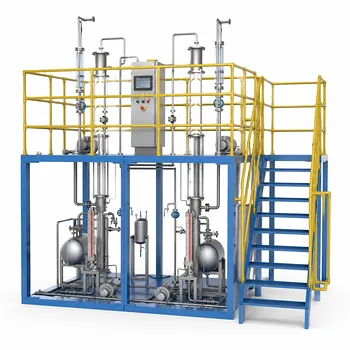
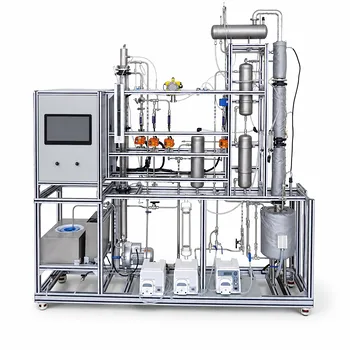
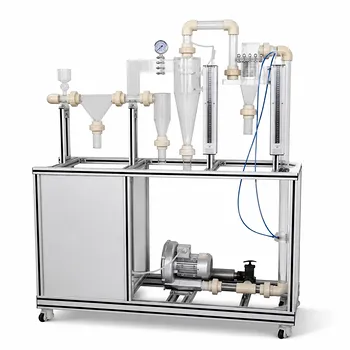
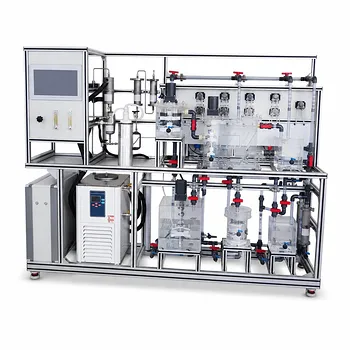
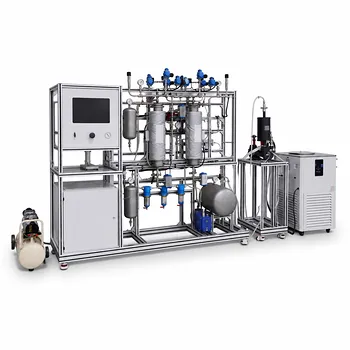
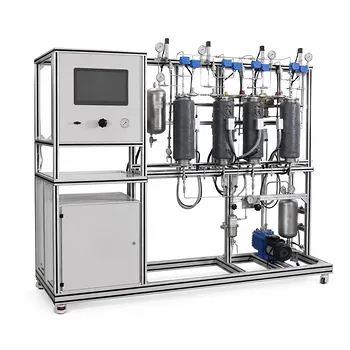
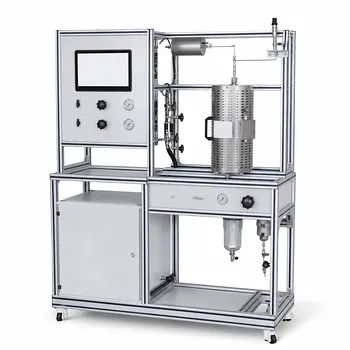
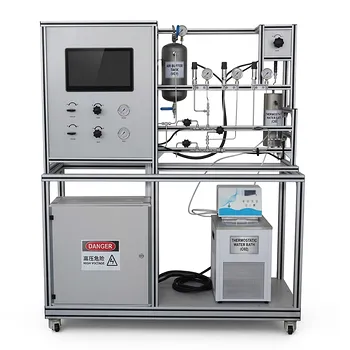
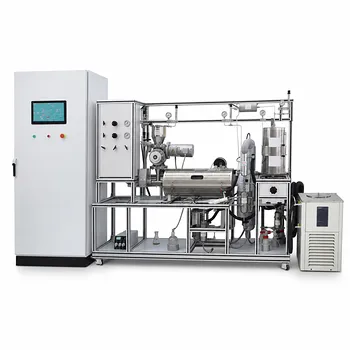
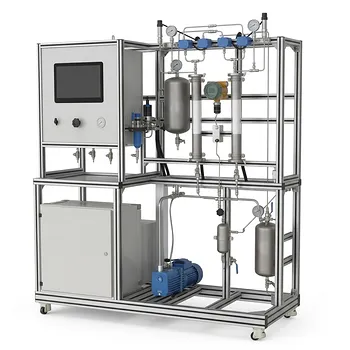
Imagine adjusting a valve and watching the core reaction chemistry of wood transform before your eyes. Unit operations pilot plants turn abstract chemical engineering concepts into a tangible, hands-on experiment where you can teach the thermodynamics and reaction kinetics of biomass gasification into syngas. By precisely controlling the steam-to-biomass ratio, operating temperature, and residence time, students directly measure the syngas output—$CO$ and $H_2$—and perform real-time energy balances. This approach conclusively bridges the gap between static textbook equations and the dynamic, heat-managed reality of thermochemical conversion.
Biomass gasification in a pilot plant makes thermodynamics and kinetics come alive through controlled experimentation. Learners see exactly how the endothermic steam reforming reaction ($\Delta H = 74~\text{kJ/mol}$) is driven by exothermic partial oxidation ($\Delta H = -113~\text{kJ/mol}$), and they quantify reaction rates by manipulating temperature and feed composition while analyzing syngas with integrated sensors. The plant is a living laboratory for energy integration, mass balances, and the practical measurement of reaction orders.
From Abstract Equations to a Measurable, Controllable Flame
Chemical engineering curricula often present thermodynamics and kinetics as a set of disjointed formulas. Pilot-scale gasification plants shatter that abstraction by forcing students to manage heat flow, composition, and reaction extent in one integrated system.
Confronting the Core Reaction Directly
The primary steam gasification reaction, with biomass modeled as $CH_{1.5}O_{0.7}$, is endothermic: $$CH_{1.5}O_{0.7} + 0.3H_2O \rightarrow CO + 1.05H_2 \quad (\Delta H = 74~\text{kJ/mol})$$ In the pilot plant, students must supply this heat. They quickly learn that an external heater alone is not how industrial units operate—instead, the reactor heating system simulates partial oxidation ($\Delta H = -113~\text{kJ/mol}$), where a small amount of oxygen is admitted to burn a portion of the biomass or product gases. The plant becomes a canvas where you control the heat balance directly.
Visualizing Energy Integration, Not Just Calculating It
Because the reactor temperature must be held steady, students execute real-time energy balances that couple the exothermic combustion with the endothermic gasification. They measure flue gas temperatures, steam superheat, and reactor bed temperatures, then compare them to predicted adiabatic flame temperatures and equilibrium shifts. This makes concepts like heat of reaction and thermodynamic feasibility immediately tangible, not just a sign convention on paper.
The Thermodynamic Playground: Equilibria, Yields, and Phase Transitions
Thermodynamics in gasification is about more than a single $\Delta H$. The pilot plant enables exploration of chemical equilibrium, phase behavior, and the effect of operating pressure—critical elements for producing clean syngas.
Mapping the Steam-to-Biomass Sweet Spot
By varying the steam-to-biomass ratio while monitoring syngas composition via online gas chromatographs or infrared analyzers, students see how the water-gas shift and steam reforming equilibria shift. Too little steam leads to tar and char; too much quenches the reaction. This directly illustrates Le Chatelier’s principle and the thermodynamic limits of conversion.
Comparing Model Predictions with Hard Data
Students first run thermodynamic simulations—such as Gibbs free energy minimization—to predict syngas composition at a given temperature. Then they run the pilot plant and compare. The gaps between theory and experiment (due to mass transfer limitations, tar hold-up, heat losses) become a powerful lesson in non-ideality and the transition from molecular-level physics to real process engineering.
Handling the Realities of Phase Change
Biomass contains moisture, and the gas stream exits hot and loaded with condensable tars. The pilot plant’s downstream units—heat exchangers, scrubbers, and knock-out pots—force students to perform vapor-liquid equilibrium calculations for tar and water condensation. This cements thermodynamic principles around vapor pressure, dew points, and the energy demands of quenching.
Unlocking the Kinetics: The Speed of Syngas Formation
Reaction kinetics answers “how fast.” In the pilot plant, that becomes a measurable, visual phenomenon.
Isolating Rate Dependencies Through Controlled Experiments
With dosing pumps for steam and mass flow controllers for biomass feed, an operator can systematically alter reactant concentration and temperature while keeping residence time constant. The instantaneous change in syngas production rate ($v = \Delta c/\Delta t$) directly yields reaction orders and rate constants. Students can test whether the rate law is first order in steam or biomass, and how that aligns with the proposed mechanism of char gasification.
Extracting Activation Energy from a Real Reactor
By running the same steam-to-biomass ratio at multiple reactor temperatures and recording the conversion rate, students apply the Arrhenius equation to real, often noisy, data. They see the non‑Arrhenius behavior caused by mass transfer limitations at high temperatures, bridging the gap between pure kinetic theory and transport‑limited reactions.
Using Residence Time as a Kinetics Knob
Pilot plants that include a tubular flow reactor or a continuous stirred‑tank (CSTR) design allow manipulation of space time. By measuring conversion at different residence times (changing feed rate while keeping reactor volume constant), learners construct experimental $X$ versus $\tau$ curves and fit them to integral rate equations. This is the same methodology used to design commercial gasifiers.
Understanding the Trade‑offs
While pilot-scale gasification is a superb teaching tool, it is not a perfect kinetic or thermodynamic probe. Recognizing these limitations builds the mature engineering judgment students will need in industry.
Heat and Mass Transfer Disguise True Kinetics
In any real reactor, heat and mass transfer resistances can mask the intrinsic chemical kinetics. A pilot gasifier is no exception. Students may measure an activation energy that reflects pore diffusion in the char rather than the surface reaction. This is a critical lesson: the observed rate is the slowest step in the sequence, and a pilot plant must be interpreted with care.
Kinetic Isolation is Challenging
Secondary reactions—tar cracking, water‑gas shift, methanation—occur simultaneously. Isolating the rate of a single step is nearly impossible without specialized analytic techniques. The pilot plant teaches the art of simplifying assumptions and the design of experiments that minimize confounding reactions, but the data is always a composite.
Cost, Safety, and Operational Complexity
A high‑temperature, steam‑fed gasifier is expensive to build and run. Safety interlocks for steam, flammable syngas, and hot surfaces are mandatory. Curricula must allocate significant time to operator training and hazard analysis, which can shrink the hours available for pure thermodynamics or kinetics labs.
Scale‑Dependent Behavior
A pilot plant seldom exhibits the same thermal efficiency or tar yields as a commercial unit. Students must learn to extrapolate from bench‑scale data using dimensionless numbers and engineering correlations—a skill that raw thermodynamic and kinetic equations alone cannot teach.
Making the Right Choice for Your Educational Goals
The design of your gasification pilot plant and the way you run it must match your primary teaching objective. Focus your capital and lab time accordingly.
- If your primary focus is thermodynamics: Equip the plant with robust temperature, pressure, and gas composition sensors. Run steady‑state experiments to build detailed energy and mass balances. Use steam‑to‑biomass variation to map equilibrium shifts.
- If your primary focus is reaction kinetics: Choose a tubular reactor configuration with precise temperature control and the ability to alter residence time independently. Implement online gas analysis for rapid rate measurements and use transient step‑change experiments to determine rate laws.
- If your primary focus is process integration: Include controlled partial oxidation capability and a heat recovery loop. Have students optimize the exotherm‑endotherm coupling and calculate overall energy efficiency.
- If your primary focus is bridging theory to industrial reality: Add a tar scrubber and a shift reactor section. These downstream units force thermodynamic and kinetic reasoning about condensation, catalyst deactivation, and overall carbon conversion.
Hands‑on pilot‑scale gasification does more than teach equations—it builds the intuitive, battle‑tested understanding of thermodynamics and kinetics that every successful process engineer needs.
Summary Table:
| Pedagogical Focus | Key Principles Explored | Experimental Approach |
|---|---|---|
| Thermodynamics | Heat balance, equilibrium shifts, phase transitions | Vary steam-to-biomass ratio, measure syngas yield |
| Reaction Kinetics | Rate laws, activation energy, residence time | Alter feed rates & temperature, track conversion |
| Process Integration | Energy coupling, safety, scale-up dynamics | Run partial oxidation, manage heat recovery loops |
Bring Chemical Engineering Theory to Life with LABPARK
Bridge the gap between textbook equations and hands-on reality. LABPARK provides premium Educational and Vocational Unit Operations Pilot Plants in chemical engineering, bioprocess & biotech, and environmental & water treatment.
Specifically engineered for universities, research institutes, and enterprises, our pilot plants empower students and researchers to safely master complex thermodynamics, reaction kinetics, and process scaling.
Ready to upgrade your teaching or research lab? Contact us today to request a custom pilot plant solution.
Related Products
- Fixed-Bed Chemical Reaction and Gas Dust Tar Removal Unit Operations Pilot Plant
- Bio-fermentation Ethanol Production Practical Training Unit Operations Pilot Plant
- Dual-Mode Gas Absorption and Desorption Unit Operations Training Pilot Plant
- Natural Product Extraction Unit Operations Training Pilot Plant
- Carbon Dioxide Absorption and Desorption Educational Pilot Plant for Carbon Capture Studies
People Also Ask
- When to transition from PID to adaptive control in pilot plants? Key process indicators.
- How do deviations in estimating latent heat impact pilot plant thermal systems? Avoid hardware mis-sizing.
- Why Compare Predicted and Experimental Excess Enthalpy? Key to Accurate Pilot Plant Scale-up
- How to study gasification in pilot plants? Compare exit gas composition & efficiency
- Why Use PTFE & Hastelloy in Chemical Pilot Plants? Prevent Corrosion & Ensure Safety