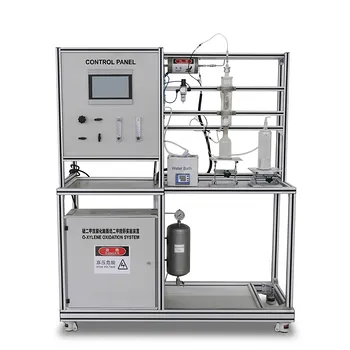
Nanocatalyst scale-up is where groundbreaking lab chemistry meets real-world production—and pilot plants provide the rigorous proving ground. These scaled-down industrial systems allow researchers and students to move beyond flask-scale synthesis and study the full thermodynamic, kinetic, and economic picture under continuous-flow conditions. By running nanostructured catalysts in reactor modules that precisely control temperature, pressure, and flow, users can measure conversion rates, selectivity, pressure drops, and deactivation patterns in a setting that directly mirrors commercial operations. The result is a hands-on, data-rich environment that teaches essential scale-up methodology while generating the empirical evidence needed to design, de-risk, and cost-justify full-scale nanocatalyst processes.
Pilot plants transform theoretical promises into actionable engineering data. They bridge the yawning gap between nanoscale material properties and macroscale reactor behavior by forcing students and researchers to confront the real challenges of heat transfer, mixing, catalyst bed integrity, and economic scalability—challenges that no textbook can fully replicate.
The Scale-Up Challenge: From Nanograms to Tons
Bridging the Gap Between Laboratory Synthesis and Industrial Reality
A nanocatalyst that delivers 95% selectivity in a 50 mL round-bottom flask rarely performs the same way when scaled to a 10-meter reactor. Lab-scale experiments often ignore pressure drop across a packed bed, the impact of flow maldistribution, and the influence of hot spots on catalyst sintering. Pilot plants reintroduce these macroscale transport phenomena, allowing researchers to observe how fluid dynamics, heat transfer, and mixing characteristics shift as volume increases—and how those shifts influence the nanostructured catalyst’s effectiveness.
The Unique Demands of Nanocatalysts
Nanoscale catalysts derive their superior activity from extreme surface-area-to-volume ratios and engineered active sites. However, those same features make them uniquely sensitive to agglomeration, attrition, and poisoning during continuous operation. A pilot plant study can reveal how nanoparticles behave under sustained flow and thermal stress, providing critical data on catalyst longevity, regeneration cycles, and the mechanical stability of the catalyst bed—factors that are invisible in batch lab work but dictate commercial viability.
Pilot Plants as Living Laboratories for Research
Measuring Critical Performance Indicators
A pilot-scale catalytic reactor turns key performance indicators (KPIs) into measurable numbers. Researchers can directly compare engineered nanocatalysts against conventional materials by recording conversion rates, product selectivity, and byproduct formation under identical process conditions. Because pilot plants control flow rate, temperature, and pressure precisely, they generate reproducible datasets that allow rigorous statistical analysis of reaction kinetics. This is where the promise of high-yield, low-energy nanocatalysts is either validated or debunked under the unforgiving eye of mass and energy balances.
Understanding and Mitigating Catalyst Deactivation
One of the most valuable insights a pilot plant provides is the time-resolved deactivation profile. By monitoring pressure drop buildup and activity decline over hundreds of hours, researchers can identify whether deactivation stems from coking, sintering of the nanoparticles, or leaching of active metal species. Pilot-scale operation makes it feasible to test regeneration strategies (such as controlled oxidation cycles) and to design guard beds or optimized operating windows, directly informing the full-scale process design.
Validating Predictions with Empirical Data
Modern process design leans on computational fluid dynamics and kinetic modeling, but these tools cannot fully predict commercial reactor behavior. As highlighted in established design principles, commercial reactor size and performance must be verified and adjusted using pilot plant data. A unit ops pilot plant provides the empirical ground truth needed to calibrate models, validate scale-up heuristics, and uncover unforeseen interactions—such as unexpected hot spots that deactivate nanosites. This feedback loop between model and experiment is the cornerstone of safe, profitable scale-up.
Teaching the Next Generation of Chemical Engineers
Hands-On Experience in Process Optimization
When students run a pilot-scale reactor loaded with a nanocatalyst, they are forced to balance multiple competing objectives: maximizing conversion while minimizing pressure drop, maintaining a stable temperature profile, and managing run time before deactivation sets in. This tangible experience in multi-variable optimization cannot be replicated via simulation alone. The pilot plant teaches the art of adjusting setpoints, troubleshooting upsets, and interpreting real-time data—skills that form the backbone of industrial chemical engineering.
Applying Process Economics and Scale-Up Heuristics
Investment estimation for scaling up is often taught using the capacity ratio exponent (n ≈ 0.6). By operating a pilot unit, students collect the actual throughput and cost data needed to apply such formulas. They can calculate the capital cost of moving from a 1 kg/h pilot reactor to a 1000 kg/h commercial plant, developing an intuitive grasp of economies of scale while also recognizing the hidden cost drivers—like the price of noble metal nanoparticles and the complexity of catalyst recovery. This transforms abstract economic theory into a concrete decision-making tool.
Aligning with Industry’s Predictive Engineering Shift
Industry is moving toward scale-down techniques and predictive engineering to minimize expensive trial-and-error runs. Educational pilot plants mirror this trend by providing a platform where students can practice constructing dimensionless scaling groups, analyzing dynamic similarity, and modeling transport phenomena. When a student uses pilot data to predict full-scale reactor performance and then critically evaluates the limitations of that prediction, they are learning the exact competency that modern chemical companies demand.
Understanding the Trade-offs and Limitations
The Cost and Complexity of Pilot Plant Operation
Pilot plants are not low-cost tools. They demand significant utility infrastructure, specialized safety systems, and trained personnel. For nanocatalyst research, the cost of producing kilograms of consistent nanomaterials to load a pilot bed can be a project-stopper. Universities must carefully weigh whether the data generated—often essential for industrial partnerships—justifies the operational expense and maintenance burden.
The Limits of Scale-Down: When Miniaturization Fails to Capture Full-Scale Behavior
A pilot reactor cannot perfectly mimic a commercial unit. Its higher surface-area-to-volume ratio changes heat transfer characteristics, potentially masking thermal runaway risks. Wall effects become dominant in small-diameter beds, altering fluid velocity profiles and making it difficult to interpret pressure drop data. If researchers treat pilot results as a direct template for a 100× larger reactor without accounting for these differences, they risk making costly design errors.
The Risk of Operator Bias and Non-Representative Conditions
Pilot plant data is only as good as the experimental protocol. Running a nanocatalyst test at artificially low space velocities or with idealized feeds (no contaminants, no trace poisons) can produce optimistic performance numbers that fail in the real plant. Students and researchers must be taught to challenge their own data, to incorporate real feedstocks, and to run long enough to see the onset of deactivation—otherwise the exercise creates false confidence rather than genuine insight.
Making the Right Choice for Your Goal
How you deploy a unit operations pilot plant should depend entirely on your primary objective. The same equipment can serve vastly different ends if you design experiments with intention.
- If your primary focus is fundamental research on nanocatalyst performance: Prioritize continuous-flow runs with real-time analytics to map kinetics, selectivity, and deactivation. Use the pilot plant to generate the empirical kinetic data that no laboratory batch reactor can reliably deliver.
- If your primary focus is educational training and workforce development: Design modular experiments that force students to perform mass and energy balances, apply scale-up economics, and troubleshoot pressure drop anomalies. Emphasize the comparison between conventional and nanostructured catalysts to make the structural advantage tangible.
- If your primary focus is cost estimation and economic feasibility: Operate the pilot plant at conditions that closely mimic the target commercial environment while systematically varying throughput. Use the capacity ratio method alongside detailed cost tracking to build an investment case that industrial partners will trust.
The pilot plant is the bridge between a promising nanoparticle and a profitable chemical process—but only when you walk that bridge with an engineer’s skepticism, a scientist’s curiosity, and a clear-eyed understanding of what the data truly represents.
Summary Table:
| Focus Area | Challenges Solved | Key Deliverables & Outcomes |
|---|---|---|
| Research & Development | Catalyst sintering, deactivation, and fluid dynamics issues. | Accurate conversion rates, deactivation profiles, and scale-up validation data. |
| Education & Training | Gap between theoretical modeling and real-world process limits. | Hands-on optimization experience, economic scaling skills, and predictive modeling. |
| Process Economics | High cost of nanomaterials and reactor design uncertainties. | Accurate capacity ratio scaling, cost-justification, and reduced industrial risk. |
Bridge the Gap from Lab to Industry with LABPARK
Are you looking to elevate your research capabilities or provide students with hands-on industrial training? LABPARK provides state-of-the-art Educational and Vocational Unit Operations Pilot Plants in chemical engineering, bioprocess & biotech, and environmental & water treatment.
Designed specifically for universities, research institutes, and enterprises, our pilot plants deliver the precise thermodynamic, kinetic, and economic data needed to de-risk processes, optimize scaling, and train the next generation of engineers.
Contact LABPARK Today to discuss your pilot plant requirements and get a customized solution for your facility!
Related Products
- Carbon Dioxide Hydrogen Methanol Synthesis Educational Unit Operations Pilot Plant
- Multi Pump Fluid Transport Process Piping Unit Operations Training Pilot Plant
- Methanol Synthesis and Catalyst Performance Evaluation Educational Unit Operations Pilot Plant
- Multi-Reactor Educational Pilot Plant for Reaction Engineering Unit Operations
- Ethyl Acetate Synthesis Unit Operations Pilot Plant for Practical Training
People Also Ask
- How do temp & pressure affect methanol synthesis pilot plants? Optimize equilibrium and catalyst performance.
- Why is a purge system necessary when operating a gas recirculation loop in a methanol synthesis pilot plant? (Guide)
- Why do modern methanol pilot plants operate at lower pressures? Catalyst & Feed Requirements Explained
- What are the operational requirements for catalyst activation? Safe Methanol Pilot Plant Operation
- Why is the chemical plant startup schedule crucial? De-risk scale-up with pilot plants.