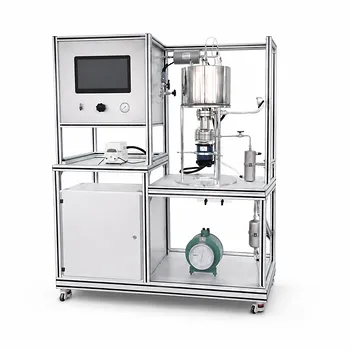
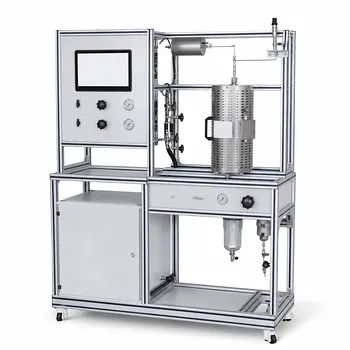
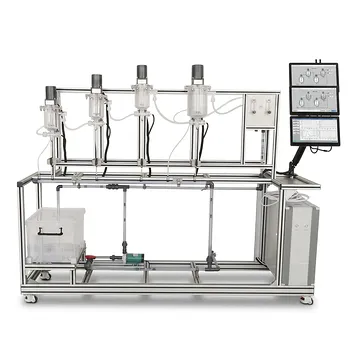
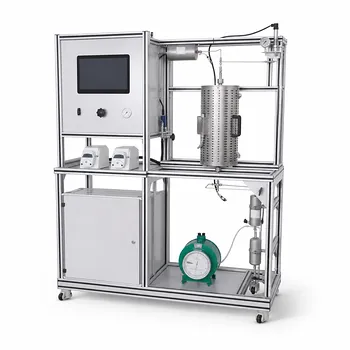
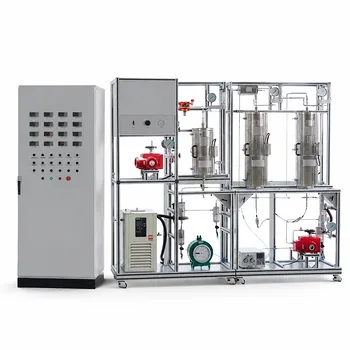
The key to bridging the gap between reaction engineering theory and industrial practice lies in the hands-on operation of unit operations pilot plants. These scaled-down chemical processes empower students to move beyond idealized textbook equations. By running real reactions—such as the alkylation of benzene with ethylene—students physically measure feed rates and analyze the chemical composition of reactor outputs. From this real-world data, they directly calculate reactant conversion and product selectivity, gaining an intuitive, practical understanding that no lecture slide can deliver.
The core value of a chemical reaction pilot plant is that it forces students to confront imperfect data, side reactions, and dynamic operating conditions. This transforms the calculation of conversion and selectivity from a purely academic exercise into a tangible, data-driven skill. Students learn not just to solve for a number, but to diagnose a process, interpret analytical results, and understand how operating parameters dictate reactor performance and economics.
From Theory to Practice: The Pilot Plant as a Living Process
A textbook problem provides a complete set of perfect numbers. A pilot plant does not. This is its greatest teaching strength. Students must actively build the data foundation for their calculations, confronting real-world challenges like flow meter drift, analysis noise, and unanticipated byproducts.
The Data-Gathering Imperative
In a pilot-scale catalytic reactor performing benzene alkylation, students set the ethylene and benzene feed rates using flow controllers. After the reactor reaches steady state, they collect the liquid output mixture. Using gas chromatography (GC) or other analytical instruments, they measure the concentrations of benzene, the desired ethylbenzene, and the side product diethylbenzene. This raw analytical data replaces theoretical conversion percentages and forces the student to verify data quality before any calculation begins.
Applying the Material Balance
Once compositions are known, the material balance becomes a practical tool, not a theoretical construct. Students must account for the mass flowing into and out of the reactor. They calculate the molar flow rate of the limiting reactant (often ethylene) at the inlet and at the outlet. The conversion is then derived directly from the measured, not assumed, values. This immediate feedback loop—adjust a valve, see the GC trend change, recalculate conversion—cements the principle that conversion is a dynamic variable controlled by the operator.
Calculating Conversion: Making the Limiting Reactant Tangible
Conversion is rarely a simple plug-and-chug exercise outside the classroom. The pilot plant teaches students to identify the limiting reactant in a fluid stream and to cope with incomplete reaction and material losses.
Identifying the Limiting Reactant in a Running Process
In a textbook, the limiting reactant is declared. In a pilot plant, students examine the inlet mass flows and stoichiometric ratios. For the water-gas shift reaction ((CO + H_2O \rightleftharpoons CO_2 + H_2)), they might see a CO flow that is deliberately limited relative to steam. They learn to calculate which component would be consumed first based on the actual, measured molar feed rates. This active identification is a critical skill for any process engineer.
The Core Calculation from Measured Data
Students then compute the fractional conversion ((f)) using the fundamental definition: fractional conversion = moles of reactant reacted / moles of reactant fed. In a continuous stirred-tank reactor (CSTR), they measure the outlet concentration of the limiting reactant. The difference between the inlet molar flow and the outlet molar flow gives the moles reacted. This direct measurement of (f) as a function of residence time, temperature, and feed ratio transforms an abstract formula into a performance indicator they can physically control.
Determining Selectivity: Unmasking the Hidden Cost of Side Reactions
High conversion is meaningless if most of the product is unwanted. Selectivity is the metric that connects reactor design directly to downstream separation costs and process profitability, and the pilot plant makes this connection painfully clear.
The Definition in Action
Selectivity ((S)) is typically defined as moles of desired product formed / moles of undesired product formed. In the benzene alkylation pilot plant, the desired product is ethylbenzene, and the undesired product is diethylbenzene. After the analytical lab reports the concentrations, students calculate (S). When they observe a high selectivity of, say, 9:1, they see a clean reactor effluent. When they run at a higher temperature and see selectivity drop to 5:1, they physically observe the larger diethylbenzene peak on the chromatogram and understand that more byproduct will now require costly distillation separation.
Yield as the Integrated Verdict
To cement the full picture, students calculate the yield (Y) = moles of desired product formed / moles that would have formed if the limiting reactant reacted completely with no side reactions. Yield combines conversion and selectivity into a single efficiency metric. A pilot plant experiment demonstrates that pushing conversion too high by raising temperature can simultaneously collapse selectivity, ultimately lowering yield. This is an economic lesson far more powerful than any equation alone.
The Dynamics of Control: How Operating Parameters Drive Results
A pilot plant’s control panel is a living sensitivity analysis. Students turn knobs and see the conversion and selectivity recalculated in real time, building a deep, intuitive feel for process dynamics.
Temperature and Pressure Impacts
Students can run a fixed-bed alkylation reactor at two different temperature profiles. At a lower temperature, the GC shows high selectivity for ethylbenzene but modest conversion. As they raise the temperature, conversion climbs sharply, but the diethylbenzene peak grows disproportionately. They learn that selectivity is often a function of competing activation energies and that an optimal temperature balances these kinetic trade-offs. Pressure adjustments, meanwhile, can shift equilibrium-limited reactions like the water-gas shift, directly impacting the maximum attainable conversion.
Residence Time and Feed Ratios
On a CSTR pilot plant, adjusting the feed pump rate changes the space velocity. Students plot conversion as a function of residence time and see the classic asymptotic curve, learning that extremely long residence times provide diminishing returns and can increase the risk of unwanted secondary reactions. Similarly, altering the steam-to-CO ratio in the water-gas shift unit shows Le Chatelier’s principle in action: an excess of one reactant pushes the equilibrium conversion of the limiting reactant higher. This hands-on experimentation transforms thermodynamic principles into practical optimization strategies.
Understanding the Trade-offs and Common Pitfalls
While pilot plants are unmatched teaching tools, their educational value hinges on confronting their inherent limitations—not hiding from them. An honest discussion of these trade-offs builds a truly professional engineering mindset.
Scale-Down Is Not Data Perfection
A pilot plant reactor has a different surface-area-to-volume ratio than an industrial unit, which can distort heat transfer and fluid dynamics. Students must learn that conversion and selectivity numbers measured on a pilot scale provide directional guidance, not an exact recipe for a 10,000-liter reactor. The critical skill is interpreting the trend, not memorizing the number.
The Analytical Bottleneck
Offline GC analysis introduces a time delay that can disconnect action from feedback. If a sample is taken improperly, the entire calculation of selectivity is compromised. This teaches the crucial but often overlooked lesson of sampling protocol, sample preservation, and analytical validation. A perfect conversion number built on bad analytical data is a dangerous professional habit. Integrating online sensors (like in-line Raman spectroscopy) can mitigate this lag, but introduces its own calibration and drift challenges that students must manage.
Safety and Operational Discipline
Pilot plants operate with real chemicals at elevated temperatures and pressures. The need for strict safety protocols teaches students that process optimization is never just an equation; it exists within a constraint of safe operating limits. This adds a layer of responsible judgment to the calculation of conversion goals—you cannot simply push a reactor to its theoretical maximum if it breaches a safety or material limit.
Making the Right Choice for Your Educational Goal
The optimal use of a pilot plant depends entirely on the specific learning outcome you intend to achieve. Different reactor configurations and experimental designs will emphasize different aspects of the conversion-selectivity calculation.
- If your primary focus is reinforcing the mathematical fundamentals of kinetics and stoichiometry: Start with a simple CSTR or plug-flow reactor running a well-characterized, single-phase reaction. Have students collect concentration-time data, determine rate constants graphically, and then calculate conversion and selectivity from their derived rate laws, validating those predictions against direct measurements.
- If your primary focus is teaching industrial process realism and the economic impact of side reactions: Use a catalytic packed-bed reactor conducting a reaction with clear byproduct pathways, like the alkylation of benzene to ethylbenzene. Require students to propose an operating temperature and pressure strategy that maximizes an economic objective function based on both conversion and selectivity, forcing them to balance the two.
- If your primary focus is on data acquisition, process control, and statistical analysis: Integrate online analytical sensors with the pilot plant. Challenge students to design an experiment, collect high-resolution data streams, and apply statistical methods to determine the confidence intervals on their calculated conversion and selectivity under varying control schemes.
Pilot plants are not just larger versions of laboratory glassware; they are an environment where the ambiguity of real operations forces engineers to become true problem-solvers and critical thinkers. By measuring conversion and selectivity from the messy, dynamic output of a physical reactor, students build the muscle memory to diagnose, optimize, and design processes that work not just on paper, but in the plant.
Summary Table:
| Metric | Definition / Calculation | Educational Value in Pilot Plants |
|---|---|---|
| Reactant Conversion | Moles of reactant reacted / Moles of reactant fed | Teaches limiting reactant identification and real-world material balances. |
| Product Selectivity | Moles of desired product / Moles of undesired product | Illustrates the cost of side reactions and downstream separation trade-offs. |
| Reaction Yield | Moles of desired product / Max theoretical product | Combines conversion and selectivity into a single economic process metric. |
Bring Hands-On Reaction Engineering to Your Lab
Bridge the gap between textbook theory and industrial reality. LABPARK provides state-of-the-art Educational and Vocational Unit Operations Pilot Plants in chemical engineering, bioprocess & biotech, and environmental & water treatment. Designed specifically for universities, research institutes, and enterprises, our systems empower students to master reactor dynamics, process control, and real-world chemical calculations.
Ready to elevate your laboratory training? Contact LABPARK today to explore our custom pilot plant solutions.
Related Products
- Multi-Reactor Educational Pilot Plant for Reaction Engineering Unit Operations
- Fixed-Bed Chemical Reaction and Gas Dust Tar Removal Unit Operations Pilot Plant
- Fixed Bed Gas Solid Catalytic Reaction Educational Pilot Plant
- Internal Circulation Gradient Free Catalytic Reaction Educational Pilot Plant
- Micro-Scale Gas-Solid Catalytic Reaction Educational Pilot Plant
People Also Ask
- How do educational unit operations pilot plants address safety and waste management when scaling up?
- How do educational unit operations pilot plants bridge theory and design? Bridge the Engineering Gap
- Why Compare Predicted and Experimental Excess Enthalpy? Key to Accurate Pilot Plant Scale-up
- How to study gasification in pilot plants? Compare exit gas composition & efficiency
- Why Use PTFE & Hastelloy in Chemical Pilot Plants? Prevent Corrosion & Ensure Safety