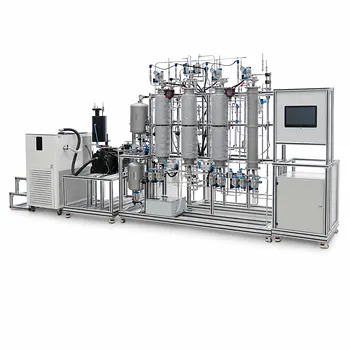
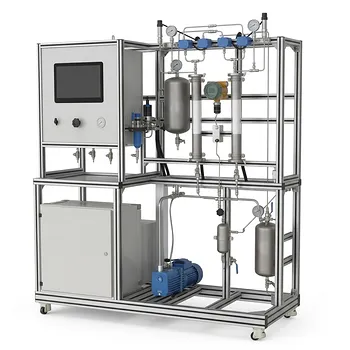
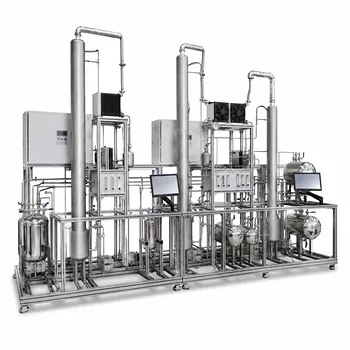
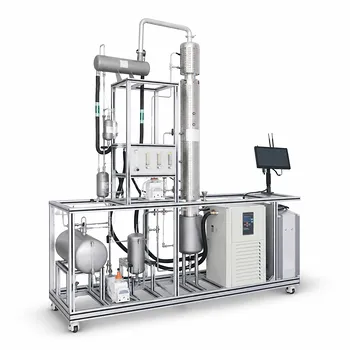
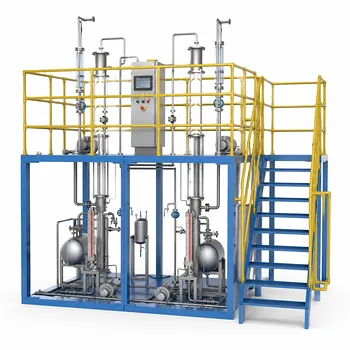
Configuring a pilot plant to separate the ethyl acetate-ethanol-water mixture comes down to one core integration: you must couple a distillation column with a decanter to exploit the system’s natural liquid-liquid phase split. This heterogeneous azeotropic distillation approach bypasses the thermodynamic barrier of the ternary azeotrope by condensing the overhead vapor and physically separating the resulting organic and aqueous phases. The organic-rich layer is then fed to a rectification column to produce high-purity ethyl acetate, while the aqueous layer is recycled to recover ethanol.
For the ethyl acetate-ethanol-water system, the most direct and pedagogically powerful configuration is a distillation-decanter-rectification loop. The ternary azeotrope (83.2% ethyl acetate, 9% ethanol, 7.8% water, boiling at 70.2°C) cannot be broken by simple distillation, but condensing and decanting the distillate splits it into an ethyl acetate-rich top phase and an ethanol-water bottom phase. This setup enables both visual observation of phase separation and rigorous mass balance studies—a definitive bridge between theory and practice.
Understanding the Multi-Component Azeotropic Challenge
Before laying out the configuration, it is essential to recognize what makes the ethyl acetate-ethanol-water system a classic teaching example. The mixture forms one ternary azeotrope and three binary azeotropes, creating a complex phase diagram with distinct distillation boundaries. Standard rectification fails because the vapor and liquid compositions equalize (relative volatility α→1), preventing further purification.
The Thermodynamic Barrier
In any azeotropic mixture, a single distillation column can only push the product composition up to the azeotropic point. For this system, straight distillation yields either the ternary azeotrope as the overhead or leaves a pure component as bottoms—but never all three components cleanly separated.
Why Heterogeneous Behavior is the Key
The ethyl acetate-ethanol-water system is special because its condensed ternary azeotrope spontaneously splits into two liquid phases. This liquid-liquid equilibrium (LLE) opens a separation window not available in homogeneous azeotropes. By physically separating the phases, you can isolate ethyl acetate from the lighter organic layer and recover ethanol from the aqueous layer using additional distillation steps.
The Core Pilot Plant Configuration: Distillation + Decanter + Rectification
The most effective demonstration of this separation uses a heterogeneous azeotropic distillation train. The configuration is deliberately modular and visually accessible, so operators can trace every mole through the system.
Walkthrough of the Process Flow
Step 1 – Initial Distillation. The feed (a mixture of ethyl acetate, ethanol, and water) enters a distillation column. The column is operated to take the ternary azeotrope as the overhead distillate. The bottoms product, depending on the feed composition, can be enriched in water or ethanol.
Step 2 – Condensation and Phase Separation. The vapor stream, now at the ternary azeotrope composition, is fully condensed and cooled. It flows into a decanter (phase separator) where it spontaneously splits. The top phase is organic-rich (primarily ethyl acetate with some ethanol and water), and the bottom phase is aqueous-rich (ethanol and water with some ethyl acetate).
Step 3 – Organic Phase Rectification. The organic phase is pumped to a rectification column. Here, high-purity ethyl acetate (up to 99.5%) is drawn as the bottoms or as a side stream, while the overhead returns the ternary azeotrope back to the condenser-decanter loop.
Step 4 – Aqueous Phase Ethanol Recovery. The aqueous phase from the decanter is sent to a separate recovery column or recycled to the main column’s feed. This stream is stripped to produce a concentrated ethanol product and water as the bottoms.
Key Pilot Plant Components
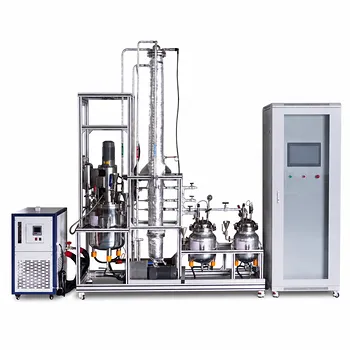
- Transparent Glass Columns: These are non-negotiable for an educational pilot plant. They allow students to watch vapor-liquid hydraulics, weeping, and flooding, and to physically see phase separation in the decanter.
- Precision Temperature Sensors: Placed at multiple tray locations, the reboiler, and the condenser. Real-time data reveals the approach to azeotropic conditions and validates thermodynamic models.
- Reflux Control and Product Draw-Off: Automated valves coupled with flow meters enable precise reflux ratio settings. This is critical to stabilizing the decanter interface level and maintaining steady-state phase split.
- Decantation Vessel with Interface Control: A glass vessel with overflow weirs or level sensors. The interface between the organic and aqueous phases must be held constant to ensure consistent product compositions.
Extending the Demonstration: Modular, Multi-Column Setups
A modern pilot plant is rarely a single column. Modular designs allow researchers to explore alternative separation strategies for the same ethyl acetate-ethanol-water challenge, demonstrating the full toolkit of industrial azeotropic separation.
Pressure-Swing Distillation for Ethanol-Water
If the goal is to show ethanol-water separation without an entrainer, a second distillation column operating at a different pressure can be integrated. Lowering the pressure shifts the ethanol-water azeotrope. For instance, dropping from 101.33 kPa to 13.33 kPa moves the azeotropic ethanol mole fraction from 0.894 to 0.992, allowing a two-column pressure-swing cycle to produce anhydrous ethanol.
Hybrid Pervaporation Integration
A highly energy-efficient configuration couples a distillation column with a pervaporation (PV) unit. The distillation column concentrates the ethanol-water mixture to near its azeotropic point; the distillate then enters a PV module containing hydrophilic membranes (e.g., zeolite membranes). Water selectively permeates, yielding absolute ethanol on the retentate side. This hybrid setup visually demonstrates how membrane technology bypasses thermodynamic limits while cutting overall energy consumption.
Extractive and Reactive Distillation to Overcome Boundaries
When the feed’s composition is pinned in an unfavorable distillation region, a third component can be introduced to alter relative volatilities. A pilot plant can be fitted with:
- Extractive distillation module: A high-boiling solvent (e.g., glycerol) is fed near the top of the column to extract ethanol, shifting the vapor-liquid equilibrium.
- Reactive distillation: A reactant (e.g., an organic acid) reacts with ethanol to form a higher-boiling ester, effectively removing ethanol from the azeotropic mixture in situ.
Both techniques allow the operator to visually and computationally observe how the distillation boundaries are broken.
Understanding the Trade-offs
No single configuration is perfect. Educators and researchers must balance pedagogical clarity, safety, and operational cost.
Operational Complexity vs. Visibility
A transparent glass column with a simple decanter loop offers unbeatable visual insight but is limited to low pressures and temperatures. If the goal is to study high-pressure or cryogenic separations, stainless steel columns with sight-glass sections must be used, sacrificing some visibility for industrial relevance.
Energy Consumption
Heterogeneous azeotropic distillation with a decanter recycles large internal flows. The organic phase rectification column and the aqueous recovery column both require significant heating and cooling duties. In a pilot-scale setting, this energy demand translates into longer stabilization times and higher utility costs. Alternative hybrid setups (distillation-pervaporation) can demonstrate significant energy savings but introduce membrane fouling and replacement costs as new learning points.
Product Purity vs. Yield
Achieving 99.5% ethyl acetate is possible but often requires very high reflux ratios and precise decanter temperature control. If the educational objective is mass balance closure rather than ultimate purity, a less stringent goal reduces run time and lets students focus on the phase-split principle.
Making the Right Choice for Your Pilot Plant Goal
How you configure the pilot plant depends entirely on what you want to teach or research.
- If your primary focus is visual pedagogy and fundamental understanding: Use a transparent glass column with a single decanter loop. This configuration makes phase separation and mass balances tangible, while the ethyl acetate-ethanol-water system serves as an ideal, industrially relevant case study.
- If your primary focus is energy efficiency and advanced hybrid separation: Integrate a pervaporation unit downstream of the distillation column. Students can directly compare energy demands and product purity with the purely thermal decanter-based process.
- If your primary focus is demonstrating the breaking of distillation boundaries: Add a second column for pressure-swing distillation or retrofit the column with an extractive distillation section, introducing a safe solvent like glycerol. This shows how to alter the phase equilibrium itself.
- If your primary focus is complete system flexibility: Build a modular pilot plant where columns, decanters, and membrane units can be repositioned. Quick-connect fittings and reconfigurable pipework let you teach heterogeneous distillation today and extractive distillation tomorrow with minimal downtime.
With the right configuration, a pilot plant becomes more than a piece of equipment—it transforms into a laboratory for solving real separation challenges, where theory, thermodynamics, and hands-on operation converge in a single, brilliant demonstration.
Summary Table:
| Separation Method | Core Components | Key Pedagogical & Technical Benefit |
|---|---|---|
| Heterogeneous Distillation | Column + Decanter | Visualizes liquid-liquid phase split; ideal for mass balance |
| Pressure-Swing Distillation | Multi-pressure Columns | Demonstrates shifts in binary azeotropes without solvents |
| Hybrid Pervaporation | Column + Membrane Unit | Highlights high-efficiency water removal and energy savings |
| Extractive & Reactive | Column + Solvent Feed | Shows how entrainers/reactions shift phase boundaries |
Scale Up Your Separation Research with LABPARK
Are you looking to bridge the gap between thermodynamic theory and hands-on practice in your lab?
LABPARK provides premium Educational and Vocational Unit Operations Pilot Plants in chemical engineering, bioprocess & biotech, and environmental & water treatment. Tailored for universities, research institutes, and enterprises, our modular, transparent, and highly customizable pilot plants empower your students and researchers to master complex separations like the ethyl acetate-ethanol-water system.
- Flexible & Modular Designs: Easily reconfigure setups for pressure-swing, extractive, or reactive distillation.
- Clear Educational Value: Transparent glass columns for direct visualization of hydraulics and phase splits.
- Industrial-Grade Data Acquisition: Precision sensors and automated controls prepare users for real-world operations.
Contact LABPARK today to design your custom pilot plant!
Related Products
- Multi-Functional Special Distillation Educational Pilot Plant
- Gas-Solid Heterogeneous Separation Demonstration Educational Unit Operations Pilot Plant
- Multifunctional Membrane Separation Educational Pilot Plant with Ultrafiltration, Nanofiltration, Reverse Osmosis
- Multi-Functional Membrane Separation Educational Pilot Plant for Unit Operations Lab
- Bio-fermentation Ethanol Production Practical Training Unit Operations Pilot Plant
People Also Ask
- Why does simple distillation yield higher efficiency than flash distillation? Key thermodynamic differences.
- How does double temperature difference control improve distillation pilot plants? Stabilize purity.
- How to Integrate Spectroscopy in Distillation Pilot Plants for Advanced Process Control
- How to Verify Distillation Boundary Lines & Composition Regions with Pilot Plants
- Why is the acentric factor important in pilot plants? Fluid property prediction.