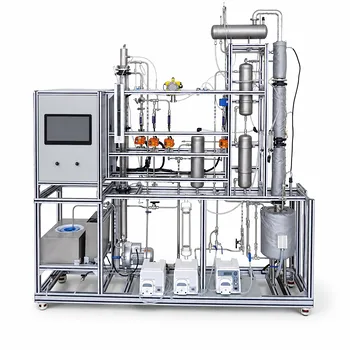
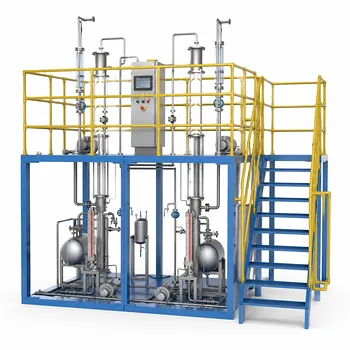
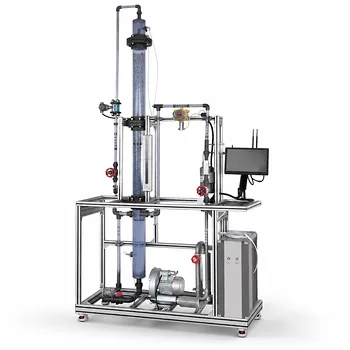
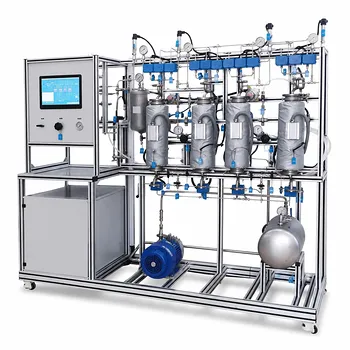
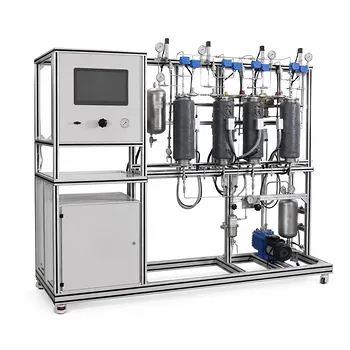
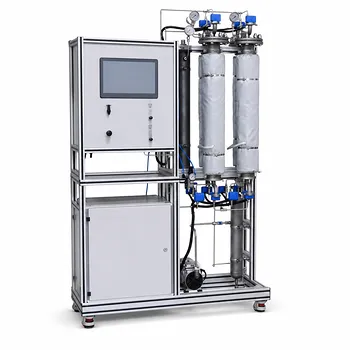
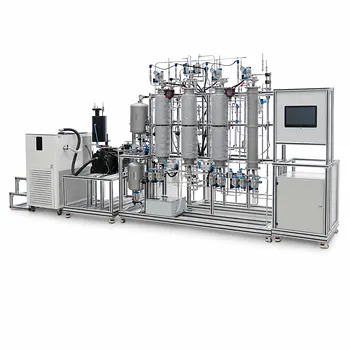
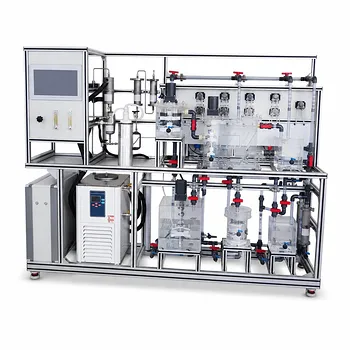
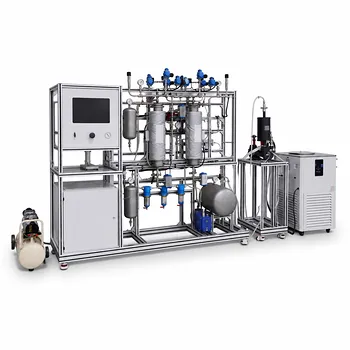
To transparently contrast physical and chemical absorption, you configure a standard gas absorption pilot plant with the ability to run the same target gas through two distinct solvent systems under controlled, comparable conditions.
Equip a packed or tray column with gas and liquid concentration sensors, flow meters, and temperature probes. Then, run a benchmark experiment by absorbing a gas like CO₂ first into pure water, then into an alkaline solution (e.g., NaOH). By calculating the mass transfer coefficients from the measured inlet and outlet concentrations, you directly quantify how the chemical reaction consumes dissolved solute, collapses equilibrium partial pressure, and sharply accelerates absorption.
A well-instrumented absorption column that allows you to switch between a purely physical solvent and a reactive solvent while measuring gas concentrations, flow rates, and the thermal profile makes the enhancement mechanism tangible. The jump in the mass transfer coefficient and the appearance of a reaction heat wave clearly separate the two processes, turning an abstract principle into a measurable engineering outcome.
Understanding the Two Absorption Mechanisms
Physical and chemical absorption share the same column hardware, but their driving forces and rate limitations differ fundamentally. The primary design task is to make that invisible difference visible through instrumentation and solvent selection.
Physical Absorption: A Solubility-Driven Process
Physical absorption relies solely on the physical solubility of the gas in the liquid. A gas like CO₂ dissolves into water following Henry’s Law, with an equilibrium partial pressure that rises with concentration.
No chemical reaction occurs; the process is typically isothermal with minimal heat effects. The rate is limited by the gas-phase diffusion and the concentration gradient across the liquid film.
Because solubility is strongly pressure- and temperature-dependent, physical absorption demonstrations must highlight how raising pressure or lowering temperature increases uptake.
Chemical Absorption: Reaction-Enhanced Mass Transfer
Chemical absorption introduces a reactive component in the liquid phase—such as NaOH or an amine—that chemically binds the dissolved solute. This reaction consumes the solute in the liquid film, drastically reducing its equilibrium partial pressure at the interface.
The result is a steeper concentration driving force and a lower mass transfer resistance, which dramatically increases the overall absorption rate. The process is often exothermic, generating a measurable temperature rise along the column.
By presenting these two mechanisms in the same column, students see not just a difference in outlet gas concentration, but a qualitative shift in the column’s thermal behavior and capacity.
Essential Pilot Plant Instrumentation for a Comparative Demonstration
To isolate the effect of the reaction, the pilot plant must capture more than just inlet and outlet conditions. The right sensors turn column hydraulics into numerical evidence of the enhancement.
Core Sensors and Measurement Points
The minimum configuration includes:
- Gas analyzers at the column inlet and outlet (e.g., CO₂ infrared sensor) to measure the absorbed fraction.
- Liquid flow meters and control valves to set and maintain a precisely known liquid-to-gas (L/G) ratio.
- Temperature probes installed at multiple axial positions along the column to detect the exothermic front of chemical absorption.
- Pressure sensors to maintain and log operating pressure, critical for physical absorption demonstrations.
Quantifying the Performance Gap
With inlet/outlet gas concentrations and flow rates, you calculate the overall volumetric mass transfer coefficient ((K_Ga)) for each solvent system.
This single parameter collapses the combined effects of mass transfer resistance and reaction acceleration. Seeing a 5–10× increase in (K_Ga) when switching from water to caustic solution makes the enhancement tangible.
Step-by-Step Configuration for a Comparative Experiment
Designing the demonstration sequence is about deliberate choices that expose the underlying physics and chemistry without letting uncontrolled variables confuse the result.
Selecting Solvent-Gas Systems for a Clear Contrast
Physical absorption benchmark: Absorb CO₂ into deionized water. The system obeys Henry’s Law, and the absorption efficiency will be modest unless pressure is elevated or temperature is reduced.
Chemical absorption demonstration: Absorb CO₂ into a dilute sodium hydroxide (NaOH) solution or a 5–10 wt% monoethanolamine (MEA) solution. The gas chemically reacts, producing carbonate species and releasing heat.
Operating Conditions That Highlight the Difference
For physical absorption, run the column at ambient pressure and two different temperatures (e.g., 15 °C and 35 °C) to show how solubility drops with rising temperature. If the unit can be pressurized, demonstrate the pressure effect while keeping the liquid rate constant.
For chemical absorption, operate at near-ambient pressure and low temperature (20–40 °C) to simulate typical industrial gas scrubbing. Monitor the column’s temperature profile in real time—the temperature bulge where reaction is most intense moves with the liquid rate and cannot appear in the water-only run.
Measuring What Matters: Mass Transfer Coefficients and Reaction Heat
Collect steady-state data for both systems at identical gas feed concentrations and total molar flow rates. Calculate the apparent (K_Ga) for each.
Simultaneously, plot the axial temperature rise for the reactive solvent. The combined dataset proves that the absorption rate skyrockets not because of better hydrodynamics, but because the chemical reaction effectively eliminates the liquid-side mass transfer resistance.
Understanding the Trade-Offs and Practical Pitfalls
Running a side-by-side demonstration is educationally powerful, but it comes with operating challenges that must be managed to ensure safe, repeatable results.
Safety and Material Compatibility
Alkaline solutions like NaOH or amines are corrosive and pose skin and eye hazards. The pilot plant must use compatible materials (stainless steel grades, PTFE gaskets) and include emergency shower/eyewash stations.
Heat of reaction can cause local temperature spikes; the column must be able to dissipate heat or the exotherm must be small enough to avoid flashing or decomposition.
Complexity and Clean-Up
Chemical solvents leave precipitated salts or degraded amine products that can foul packing and require thorough cleaning between runs. If the goal is rapid turnover, a dedicating a separate liquid loop for the reactive solvent can prevent cross-contamination.
For physical absorption, reaching significant uptake often requires high-pressure or refrigerated operation, increasing utility costs and equipment complexity. An amine-based chemical absorption column can operate safely at atmospheric pressure, making it often more practical in educational settings.
Interpretative Nuances
A higher outlet liquid temperature does not automatically prove enhanced absorption—poor liquid distribution can create hot spots. Careful placement of temperature probes and repeatability checks are essential.
Also, mass transfer coefficients calculated for chemical systems are “apparent” values that lump together reaction kinetics and physical transport. Clarifying this distinction is part of the learning objective.
Making the Right Choice for Your Training Goal
The configuration you choose should match the learning outcomes and industrial context you want to emphasize.
- If your primary focus is demonstrating fundamental mass transfer principles: Run a simple water vs. dilute NaOH system at ambient pressure, focusing on the stark (K_Ga) difference and the first appearance of reaction heat.
- If your primary focus is industrial carbon capture or acid gas removal training: Use an amine solution (MEA or MDEA) to show realistic process conditions, including solvent loading and the need for downstream regeneration.
- If your primary focus is process design and scale-up: Incorporate variable pressure control and demonstrate physical absorption under higher pressure, then switch to chemical absorption to highlight the capital cost/utility trade-off.
Ultimately, a flexible absorption pilot plant designed to run both physical and reactive solvents under identical column hydraulics transforms a unit operations lab into a vivid proof that chemical reactions are not just a chemistry lesson—they are a measurable lever for mass transfer intensification.
Summary Table:
| Feature | Physical Absorption | Chemical Absorption |
|---|---|---|
| Driving Force | Physical solubility (Henry's Law) | Chemical reaction & solubility |
| Thermal Effect | Isothermal (minimal heat change) | Exothermic (measurable temp rise) |
| Common Solvents | Water | NaOH or Amine (MEA) solutions |
| Mass Transfer Rate | Limited; lower KGa | Highly accelerated; 5–10x higher KGa |
| Key Variables | High pressure, low temperature | Reaction kinetics, liquid flow rate |
Elevate Your Chemical Engineering Training with LABPARK
Are you looking to provide hands-on, industry-relevant training for gas absorption and mass transfer processes?
LABPARK provides state-of-the-art Educational and Vocational Unit Operations Pilot Plants in chemical engineering, bioprocess & biotech, and environmental & water treatment. Designed specifically for universities, research institutes, and enterprises, our pilot plants deliver:
- Precision Instrumentation: Real-time concentration, flow, and temperature tracking for clear analytical results.
- Robust & Safe Designs: Built with corrosion-resistant materials and industrial-grade safety features.
- Versatile Configurations: Easily switch between physical and chemical processes to demonstrate key thermodynamic principles.
Ready to upgrade your laboratory or training facility? Contact LABPARK today to discuss your custom pilot plant specifications and request a detailed quote.
Related Products
- Carbon Dioxide Absorption and Desorption Educational Pilot Plant for Carbon Capture Studies
- Absorption and Desorption Educational Unit Operations Pilot Plant
- Dual-Mode Gas Absorption and Desorption Unit Operations Training Pilot Plant
- Multimodal Absorption and Desorption Pilot Plant for Unit Operations Training
- Packed Bed Absorption Educational Unit Operations Pilot Plant
People Also Ask
- How does operating pressure influence the transition between absorption and desorption in a CO2 pilot plant?
- How do temperature variations affect CO2 transport models in pilot plants? Model vs Reality
- What unit operations are critical for CCUS training pilot plants? Build hands-on engineering expertise.
- How do electrolytes affect phase equilibrium in absorption pilot plants, and how to calculate it?
- Why is critical surface tension key in column internals? Optimize gas absorption pilot plant efficiency