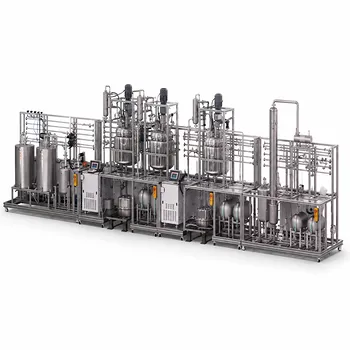
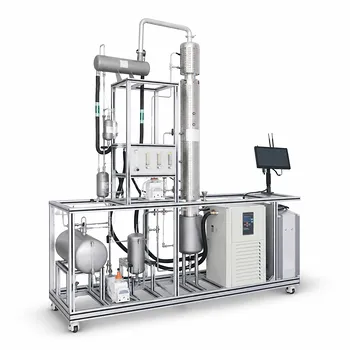
The most profound lesson a pilot plant teaches isn't how to make something bigger—it’s that scale is not just a number. Unit operations pilot plants give students the ability to observe how heat, mass, and momentum transport change nonlinearly with scale, validate predictive models against real empirical data, and decode the multivariate process signatures that actually determine product quality. This hands-on immersion directly addresses the industry’s hardest scale-up challenge: moving from discovery chemistry to a reproducible, economically viable commercial process without endless trial-and-error.
Scale-up fails when we treat it as linear. Pilot plants let students confront the real, nonlinear breakdowns—in mixing, heat transfer, and impurity accumulation—that make a gram‑scale success utterly meaningless on the metric‑ton scale. The result is an engineer who thinks in physical constraints, not just batch records.
Why Scale Humbles Every Assumption
The Breakdown of Simple Geometric Similarity
Laboratory glassware hides the brutal fact that surface‑area‑to‑volume ratio crashes as equipment grows. In a round‑bottom flask, heat removal is trivially easy; in a plant‑scale reactor, exotherms can run away because heat generation scales with volume while cooling scales with area. A pilot plant runs in the intermediate regime where students see this inflection point firsthand. They learn that mixing, mass transfer, and thermal homogeneity are not guaranteed—they must be engineered.
Univariate Charts Are Dangerous Liars
In a teaching pilot plant, students quickly discover that matching a single “golden” temperature or stirring speed from the bench does not reproduce product quality. The supplementary references highlight a critical skill: mapping quality in a multivariate space. Students gather time‑series data from pilot‑scale sensors and use latent variable methods to capture the underlying process signature. They internalize that scale‑up demands a holistic view of mass and energy balances, not one‑factor‑at‑a‑time optimism.
From Correlation to Causation: Building the Predictive Mindset
Validating Mathematical Models with Real Noise
Modern industry has moved toward predictive engineering, relying on mathematical models and scale‑down simulators to minimize expensive industrial pilot runs. The primary reference stresses that educational pilot plants align training with this shift. Students run experiments specifically designed to challenge a model—introducing a step change in feed rate or a controlled fouling simulation—and compare real data to their predictions. They learn that models are only as trustworthy as the validation experiments behind them, and that a pilot plant is the safest place to collect that proof.
Deliberate Upsets and Failure Mode Discovery
A pilot plant is the last sanctuary where you can safely break the process. Students can investigate what happens when a cooling loop fails, when an impurity spiked into a recycle stream accumulates, or when a catalyst begins to coke. This hands‑on risk assessment teaches them to identify latent failure modes that would be financially catastrophic at full scale. It transforms academic theory into the professional instinct for “what could go wrong.”
The Hidden Curriculum: Time and the Closed Loop
Why a Six‑Hour Experiment Is Never Enough
Academic lab courses often showcase a reaction for a few hours with fresh, pure reagents. An integrated pilot plant run continuously for days reveals the slow creep of reality: by‑products build up in recycle loops, heat‑exchanger surfaces foul, and catalyst activity decays. The supplementary references emphasise that these long‑term dynamics—coking, impurity reflux, thermal fatigue—often define commercial viability. Students who log data over a multiday pilot campaign develop an irreplaceable gut feel for process robustness.
Seeing the Process as a Living System
Once a pilot plant glues unit operations together—reaction, crystallization, filtration, drying—students stop thinking in isolated steps. They grapple with residence time distribution, dead zones in vessels, and the consequence of upstream variability on downstream purification. This systemic view is exactly what turns the classic lab‑to‑plant gap into a bridge: the student becomes fluent in the language of operability, not just chemistry.
Understanding the Trade‑offs and Limitations
Pilot plants are powerful, but they are not a panacea. An honest assessment of their role includes these realities:
- Capital and footprint cost: A well‑instrumented pilot plant represents a significant investment in hardware, space, and maintenance. Not every institution can support a full miniplant, and even the best pilot unit cannot replicate the exact hydrodynamics of a 10,000‑litre vessel.
- The “demo‑scale” illusion: Running at 10 litres still masks some problems that only appear at full scale—distillation column weeping, massive utility integration, and multi‑phase flow regime transitions. Students must learn that a pilot plant reduces risk, but does not eliminate it.
- Safety management overhead: Teaching with live steam, flammable solvents, and high pressures requires rigorous protocols and supervision. The educational value is immense, but the operational discipline it demands is non‑trivial.
- The model still leads: The primary reference makes clear that industry’s trajectory is toward simulation‑first, pilot‑second. A pilot plant curriculum must therefore frame the unit as a model‑validation tool, not a replacement for foundational transport phenomena and reaction engineering coursework.
How to Apply This to Your Research or Teaching Programme
Start with a clear objective and let that dictate your pilot‑plant‑based training design.
- If your primary focus is fundamental transport phenomena: Use the pilot plant to run canonical heat‑transfer and mixing studies. Have students measure actual cooling curves and dead‑zone residence‑time distributions, then compare them to classic textbook equations to expose where theory meets reality.
- If your primary focus is process safety and risk assessment: Design controlled upset experiments (loss of agitation, rapid exotherm) and require students to perform a hazard analysis before running the campaign. Let them experience the difference between a calculated safety margin and a physical consequence.
- If your primary focus is process analytical technology and data‑driven scale‑up: Instrument the pilot plant with multivariate sensors. Task students with building a latent variable model for product quality and demonstrating that the same process signature can be maintained at two different operating scales.
- If your primary focus is navigating the early clinical or kilo‑lab stage: Simulate the transition from a 100‑gram laboratory prep to a 5‑kilogram pilot batch. Emphasise purity profile tracking and process mass balance closure—skills that directly shrink R&D timelines in pharmaceutical settings.
- If your primary focus is energy integration and sustainability: Run the pilot plant in a closed‑loop mode. Let students track how much energy is needed for solvent recovery, identify pinch points, and propose modifications to reduce utility consumption.
The student who has wrestled with a stubborn heat‑exchange fouling trend or a recycle stream that never quite reaches steady state walks into industry with something no lecture can impart: the earned intuition that scaling a process is a disciplined scientific confrontation with physics, not a gamble. That’s the irreplaceable value a university pilot plant delivers.
Summary Table:
| Scale-Up Challenge | Pilot Plant Training Solution | Student Learning Outcome |
|---|---|---|
| Non-linear heat/mass transfer | Running processes in intermediate regimes | Understanding physical geometry constraints |
| Model inaccuracy | Validating mathematical models with real process noise | Developing a predictive engineering mindset |
| Long-term process dynamics | Continuous, multiday campaigns with recycle loops | Managing fouling, coking, and accumulation |
Empower the Next Generation of Engineers with LABPARK
Bridge the gap between academic theory and industrial reality. LABPARK provides state-of-the-art Educational and Vocational Unit Operations Pilot Plants in chemical engineering, bioprocess & biotech, and environmental & water treatment. Designed specifically for universities, research institutes, and enterprises, our systems enable hands-on training in process scale-up, model validation, and safety management.
Ready to elevate your engineering curriculum or research capabilities? Contact us today to explore our pilot plant solutions and see how we can customize a system to meet your training goals.
Related Products
- Carbon Dioxide Hydrogen Methanol Synthesis Educational Unit Operations Pilot Plant
- Multi-Reactor Educational Pilot Plant for Reaction Engineering Unit Operations
- Ethyl Acetate Synthesis Unit Operations Pilot Plant for Practical Training
- Multi Pump Fluid Transport Process Piping Unit Operations Training Pilot Plant
- Multi-Modal Distillation Unit Operations Training Pilot Plant
People Also Ask
- How do temp & pressure affect methanol synthesis pilot plants? Optimize equilibrium and catalyst performance.
- Why is a purge system necessary when operating a gas recirculation loop in a methanol synthesis pilot plant? (Guide)
- Why do modern methanol pilot plants operate at lower pressures? Catalyst & Feed Requirements Explained
- What are the operational requirements for catalyst activation? Safe Methanol Pilot Plant Operation
- Why is the chemical plant startup schedule crucial? De-risk scale-up with pilot plants.