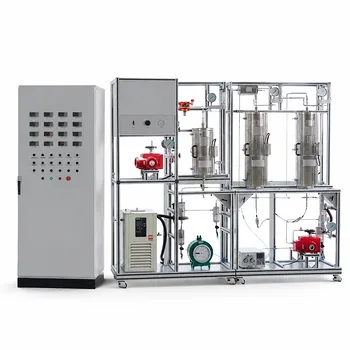
The direct path to a better catalyst is not larger experiments, but smarter, faster ones. Chemical engineering unit operations and pilot-scale parallel reactors accelerate catalyst optimization by enabling high-throughput screening of thousands of material formulations under tightly controlled process conditions. This approach systematically maps the relationship between a catalyst's composition, its operating parameters (temperature, pressure, space velocity), and its performance metrics (conversion, selectivity, and stability) to rapidly isolate optimal leads for processes like naphtha isomerization.
The deep problem in catalyst optimization is navigating a vast, complex experimental landscape where performance is dictated by interdependent variables. The solution is a tiered strategy: use parallel reactors for high-speed discovery and mapping, then use traditional pilot plants to validate performance and study long-term engineering reality under industrial conditions. This bridges the gap from a promising powder to a viable process.
The Strategic Role of High-Throughput Screening
Before a catalyst can be optimized, it must first be discovered. The primary bottleneck in this phase isn't the chemistry; it's the sheer number of experimental combinations required to find a breakthrough material.
Accelerating Discovery with Parallel Reactors
Parallel reactor units function as a force multiplier for discovery. For a process like C5/C6 naphtha isomerization to high-octane products, the parameter space is immense. You must consider catalyst composition (metal loading, promoter types, support acidity), activation protocols, and operating conditions.
A single pilot plant run might yield a handful of data points per week. A parallel reactor unit generates thousands. This high-throughput approach allows you to screen hundreds of zeolite-based catalysts, quickly pinpointing formulations that deliver high isomerate yields at elevated temperatures, a key advantage over legacy chlorinated alumina systems that are highly sensitive to feed contaminants and cannot operate at such high temperatures.
Systematic Mapping of the Parameter Space
The true power of parallel reactors is not just speed, but logic. They enable a systematic Design of Experiments (DoE) approach rather than trial and error. You can simultaneously vary temperature, pressure, and space velocity across a library of candidate materials.
This creates a high-resolution performance map. The output isn't just a "good" catalyst; it’s a deep dataset that reveals why it’s good. You can immediately identify leads with the widest operating windows and the most robust response to process upsets, directly informing the control strategy for the next stage of scale-up.
Translating Chemistry into Controllable Unit Operations
Once a lead catalyst is identified, the focus shifts from discovery to understanding its behavior in a realistic process environment. A traditional unit operations pilot plant is the essential tool for this translation.
Bridging the Gap Between Nanoscale and Macroscale
A designed nanocatalyst with high surface area and tunable properties is only valuable if its benefits are realized in a reactor. Pilot plants bridge this critical gap. They allow you to study the integrated effects of reaction kinetics, heat and mass transfer, and fluid dynamics under continuous flow.
For example, a palladium-zeolite catalyst that shows exceptional isomerization selectivity in a micro-reactor might fail in an adiabatic pilot reactor because of poor heat management. The pilot plant reveals this. It provides the hands-on experience to correlate nanoscale material properties with macroscale process efficiency, directly linking catalyst formulation to energy consumption and product throughput.
Overcoming Mass Transfer Limitations
A catalyst's true performance is often dictated not by its intrinsic kinetics, but by how fast reactants can reach the active sites. Pilot plants are crucial for diagnosing and solving these mass transfer limitations.
By experimenting with different catalyst pellet sizes and operating temperatures, you can directly calculate the Thiele modulus and effectiveness factor. In the kinetic-controlled regime, the reaction uses the entire pellet uniformly. In the diffusion-limited regime, the reaction occurs mainly at the outer shell, and the precious metal in the core is wasted. This analysis provides an immediate cost-optimization strategy: you can replace the inactive core of an expensive noble metal catalyst with an inexpensive inert support like alumina, achieving the same reaction rate at a fraction of the cost.
Diagnosing Catalyst Lifetime and Stability
The perfect initial activity is meaningless if the catalyst deactivates within hours. Understanding and extending catalyst lifetime is the most critical economic driver, and this requires a pilot plant.
Distinguishing Deactivation Mechanisms
Long-duration pilot plant runs are the only definitive way to study deactivation under real conditions. A 50-hour continuous run with a platinum-impregnated catalyst for a related reaction provides a blueprint for this analysis. As conversion declines, you can manipulate the process conditions to diagnose the root cause.
By introducing a controlled reduction cycle, you can directly measure the recovery of activity. A partial recovery points to a reversible deactivation mechanism, like metal oxidation. The portion of activity that is permanently lost points to an irreversible mechanism, such as the sintering of active metal nanoclusters into larger, less active particles. This insight is not available from short-term screening; it is the output of a dedicated unit operations study and is essential for designing the reactor and its regeneration protocol.
Evaluating Resistance to Poisons
Feedstock for naphtha isomerization invariably contains trace contaminants like sulfur and nitrogen compounds that act as catalyst poisons. A pilot plant with precise analytical feeds allows you to measure this impact directly.
You can systematically spike a clean feed with controlled levels of dibenzothiophene or an organic nitrogen compound and monitor the catalyst's conversion, selectivity, and temperature profile in real-time. This provides the data needed to compare the robustness of different catalytic systems, such as a sulfur-sensitive Pt/zeolite catalyst versus a more tolerant but less active Pt/sulfated zirconia formulation. For downstream integration, studies with transition metal sulfides for hydrotreatment before the isomerization reactor can be sequentially simulated.
Understanding the Trade-offs
No single analytical method provides a complete picture. Effective optimization requires navigating the inherent trade-offs between different experimental approaches.
- Discovery Speed vs. Engineering Certainty: High-throughput parallel reactors provide outstanding statistical power for material ranking but have simplified hydrodynamics. Traditional pilot plants give you definitive engineering data but are far too slow for broad exploration. Relying solely on one approach leads to either a scalable but mediocre catalyst or a spectacular catalyst that plugs the reactor.
- Kinetic Control vs. Diffusional Limitations: Operating at low temperatures is ideal for measuring intrinsic kinetics, but it may mask pore diffusion issues that will dominate at the higher industrial operating temperatures. Your pilot plant protocol must deliberately probe both regimes to avoid a costly scale-up failure.
- Activity vs. Stability: The catalyst that is most active in a 4-hour screening test is rarely the most stable one over a 4-month run. A catalyst with high initial conversion but rapid deactivation is an operational nightmare. The optimization process must systematically sacrifice some initial activity to achieve a slower, more predictable deactivation rate that fits the operational cycle of an industrial plant.
Making the Right Choice for Your Goal
The path you choose must align with your specific objective. Here is how to apply these tools effectively based on your primary focus.
- If your primary focus is exploratory catalyst discovery: Prioritize high-throughput parallel reactor units. Your goal is velocity and breadth. Screen vast compositional libraries using DoE principles to generate thousands of data points and identify the 2-3 most promising candidates that justify further investment.
- If your primary focus is understanding intrinsic reaction kinetics: Use a single, highly instrumented pilot plant reactor operated in the absence of mass and heat transfer limitations. Vary pellet size and temperature to calculate the effectiveness factor and trust only the data from the kinetic-controlled regime to build your reactor model.
- If your primary focus is developing an industrially viable process package: A tiered approach is non-negotiable. Use parallel reactors for initial screening, then scale up the top leads to a continuous-flow pilot plant for a long-duration run. Use this run to study deactivation, regeneration protocols, and the impact of a realistic, poison-spiked feedstock. The final deliverable is not just a catalyst, but a robust kinetic model and a validated operational strategy.
A superior catalyst is the product of a well-orchestrated strategy, not a single experiment. By strategically integrating the speed of parallel screening with the reality of pilot-scale unit operations, you transform catalyst development from a discovery science into a predictable engineering discipline.
Summary Table:
| Tool | Primary Focus | Key Benefits | Key Output |
|---|---|---|---|
| Parallel Reactors | High-throughput screening & discovery | Rapidly screens thousands of formulations; maps parameter space (DoE) | Optimal catalyst leads & operating window datasets |
| Pilot Plants | Process scale-up & engineering validation | Bridges scale gap; diagnoses mass transfer limits & deactivation | Validated kinetic models, lifetime data, & process packages |
Bring Industrial Reality to Your Lab with LABPARK
Are you looking to bridge the gap between bench-scale catalyst discovery and industrial-scale unit operations? LABPARK provides state-of-the-art Educational and Vocational Unit Operations Pilot Plants designed specifically for universities, research institutes, and enterprises.
Our pilot plants in chemical engineering, bioprocess & biotech, and environmental & water treatment enable you to:
- Accelerate research with highly accurate, reproducible data.
- Train the next generation of engineers on industry-standard systems.
- Effectively validate kinetic models, mass transfer limits, and catalyst lifetimes.
Ready to elevate your research and teaching capabilities? Contact the LABPARK team today to discuss your specific requirements and find the perfect pilot plant solution for your facility!
Related Products
- Multi-Reactor Educational Pilot Plant for Reaction Engineering Unit Operations
- Internal Circulation Gradient Free Catalytic Reaction Educational Pilot Plant
- Fixed-Bed Chemical Reaction and Gas Dust Tar Removal Unit Operations Pilot Plant
- Crude Benzene Hydrogenation Educational Unit Operations Pilot Plant
- Fluidized Bed Gas Solid Catalytic Reaction Educational Pilot Plant
People Also Ask
- How do educational unit operations pilot plants address safety and waste management when scaling up?
- How do educational unit operations pilot plants bridge theory and design? Bridge the Engineering Gap
- Why Compare Predicted and Experimental Excess Enthalpy? Key to Accurate Pilot Plant Scale-up
- Why Use PTFE & Hastelloy in Chemical Pilot Plants? Prevent Corrosion & Ensure Safety
- How to study gasification in pilot plants? Compare exit gas composition & efficiency