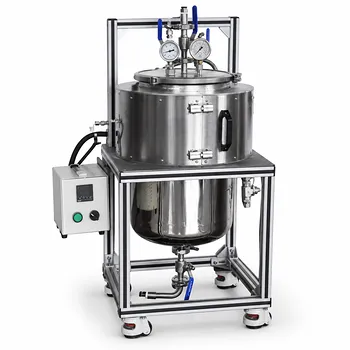
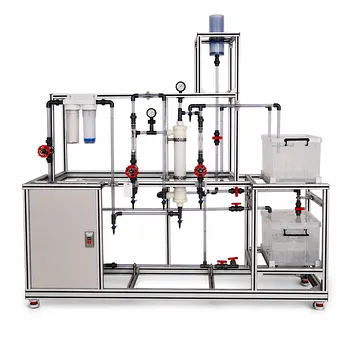
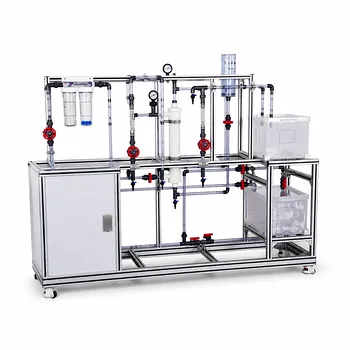
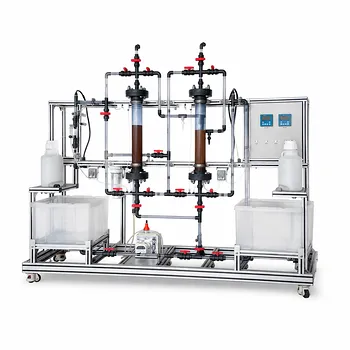
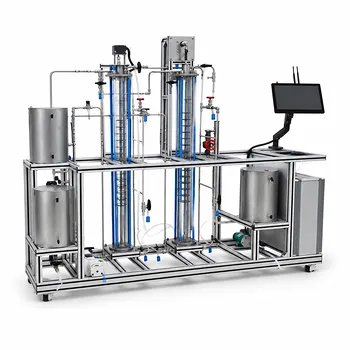
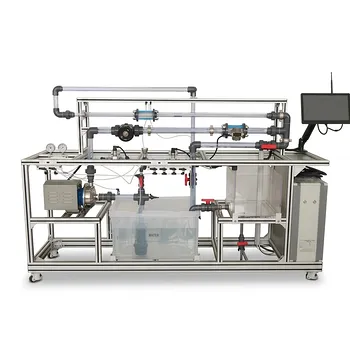
The most powerful classroom is the pilot plant floor. By physically operating unit operations pilot plants, chemical engineering students don't just calculate theoretical productivity—they measure the real-world cycle times and physical constraints that make batch and continuous filtration fundamentally different beasts.
While textbooks provide the equations, hands-on pilot plant work forces students to confront the hidden auxiliary times of batch operations and the delicate cake-quality trade-offs of continuous systems. This transforms the comparison from a math problem into a visceral lesson in operational reality, teaching not just which system is more productive, but why the limiting factors are always mechanical and economic, not purely hydraulic.
Translating Theory into Practice with Pilot Plants
The core of the experiment lies in moving beyond the idealized filtration equations to capture the complete operating cycle. A pilot plant provides the physical system needed to log, feel, and analyze these time-consuming steps.
The Unit Operations Pilot Plant as a Cycle Simulator
A properly instrumented pilot plant allows you to physically execute and time every phase of a filtration cycle. Instead of assuming an arbitrary "auxiliary time," you can measure the real seconds needed for cake discharge, washing, and reassembly.
This transforms the productivity formula from an abstract equation into a tangible sequence of actions. Using integrated digital sensors, you can automatically log the pressure profile during filtration, the flow decay during washing, and the exact idle time between batches.
Why Hands-On Measurement Changes the Analysis
Theoretical problems often treat auxiliary time as a minor constant. Physical operation reveals that cleaning a plate-and-frame press between batches can dominate the cycle, especially for sticky or compressible cakes.
This experience imprints a critical engineering truth: productivity optimization is often a mechanical and operational challenge, not a fluid dynamics one. The pilot plant makes this truth undeniable.
Deconstructing the Batch Cycle: Measuring Hidden Time Costs
For a batch filter like a plate-and-frame press, the operating cycle ($T$) is the sum of active filtration ($\theta$), washing ($\theta_w$), and the often-underestimated discharge and reassembly time ($\theta_d$). The pilot plant forces you to measure all three.
Breaking Down the Total Cycle Time ($T$)
The formula $T = \theta + \theta_w + \theta_d$ looks simple, but measuring each component is an education in itself. You must define exactly when filtration stops and washing begins, a decision often based on cake resistance or pressure build-up.
Once the cake is washed, the timer starts for discharging. This includes loosening the cake, scraping it from the frames, and ensuring no residual material blocks the channels before reassembly. Every second adds up.
Calculating True Hourly Productivity ($Q$)
With the total cycle time and the collected filtrate volume ($V$) in hand, you calculate the overall productivity: $Q = 3600V / T$. This single number integrates all the inefficiencies of the batch sequence.
By running multiple cycles with the same slurry, you can see how $Q$ changes if you extend the filtration time to get more filtrate. A longer $\theta$ increases $V$, but the growing cake resistance slows the filtration rate, creating a diminishing return that drags down the overall hourly rate.
Finding the Experimental Optimum
The pilot plant lets you systematically vary the filtration phase duration and map the resulting $Q$. You will find a distinct maximum—the point where the marginal gain in filtrate volume is exactly offset by the extended cycle time.
This optimum is specific to your slurry, your filter medium, and your team's dexterity in cleaning. No textbook can give you this number; it must be discovered empirically, exactly as you do on the pilot floor.
Exploring Continuous Dynamics: Speed, Submergence, and Cake Thickness
A continuous rotary drum vacuum filter presents a completely different optimization problem. The cycle is mechanized and fixed by mechanical variables like drum rotation speed ($n$) and the submergence ratio ($\psi$).
How Rotation Speed Dictates Cycle Time
In a continuous filter, the filtration, washing, and discharge zones are arranged around a rotating drum. Increasing the drum speed ($n$) directly shortens the time the cake spends in the filtration zone.
This raises productivity ($Q$) because more drum surface passes through the slurry per hour. However, the resulting filtration time per cycle is so short that it forms a much thinner, sometimes slimy cake that is difficult to mechanically scrape off.
The Submergence Ratio’s Role in Product Quality
The submergence ratio ($\psi$) defines what fraction of the drum is submerged in the slurry trough, controlling the effective filtration area. Adjusting $\psi$ in the pilot plant gives students a direct lever to change the ratio between active filtration and cake drying time.
A higher submergence increases output but reduces the time available for washing and dewatering on the exposed drum. You will visually observe how wash water runs off a cake that is too thin or improperly formed, directly linking the mechanics to the separation quality.
The Self-Regulating Trade-off
Continuous filters trade operational simplicity for cake quality control. You cannot independently set filtration time and cycle time; they are geometrically linked by the drum design and speed.
The pilot plant makes this trade-off tangible. You quickly learn that maximizing drum speed can make the cake impossible to discharge, leading to carryover and a messy, inefficient operation. The lesson is that “continuous” does not mean “infinitely controllable.”
Understanding the Trade-offs: Beyond the Productivity Number
Comparing the two systems solely on volumetric productivity ($Q$) for a single test is a novice mistake. The pilot plant exposes deeper system-level constraints that determine economic viability.
The Cleanability and Flexibility Gap
Batch systems, like the plate-and-frame press, demand significant labor for disassembly and cleaning between runs. This makes them inherently flexible but labor-intensive. You see this firsthand when switching from one slurry to another—the batch system can be fully cleaned, while the rotary drum’s internal piping presents a contamination risk.
For producing high-value fine chemicals or pharmaceuticals in a multiproduct plant, this rapid changeover and assured cleanliness are non-negotiable. The pilot plant demonstrates that a lower $Q$ for a batch filter might be perfectly acceptable if it ensures zero cross-contamination and the ability to process five different products in a week.
The Steady-State Operations Lesson
The continuous filter teaches a different lesson: it rewards long, uninterrupted runs of the same product. Once optimized for a given slurry, it delivers a steady flow of filtrate with minimal operator intervention.
This makes it the workhorse for bulk commodity chemicals running at 90-95% utilization. The pilot plant shows that the initial tuning (adjusting speed, vacuum, and knife position) is delicate, but once found, the process is remarkably stable, reinforcing the industrial preference for continuous operation when product variety is low.
Linking Filtration to the Whole Process
A powerful experiment is to connect the pilot-scale filter to upstream and downstream units, like a reactor or a dryer. You can then observe how a batch filtration bottleneck—long idle time waiting for the reactor to finish—might be solved not by filtering faster, but by adding a second filter unit to stagger cycles.
This hands-on scheduling challenge, tracking occupancy times of integrated equipment, directly mirrors the challenges in multipurpose fine chemical plants. It shows that the "best" filtration technology is the one that orchestrates seamlessly with the entire process train.
Making the Right Choice for Your Learning Goal
Your focus in the pilot plant should guide which operational parameters you prioritize. Tailor your experiments to the core concept you need to internalize.
- If your primary focus is mastering fundamental unit operations: Concentrate on measuring the full batch cycle repeatedly. Time each phase manually with a stopwatch, then with digital sensors, to prove that the mechanical limiting step is often not the filtration itself.
- If your primary focus is understanding industrial process intensification: Push the continuous drum filter to its limits. Map the relationship between drum speed, cake thickness, and moisture content to find the exact operating envelope where discharge just barely remains effective.
- If your primary focus is the business and scheduling of multiproduct plants: Run multiple “products” in sequence on the batch filter, and then attempt the same on the continuous filter. Document the cleaning time, solvent use, and risk of cross-contamination to understand why batch flexibility commands a premium.
The pilot plant transforms you from a calculator of equations into an observer of real-world constraints, giving you the practical judgment that no amount of simulation can provide.
Summary Table:
| Feature | Batch Filtration (Plate-and-Frame) | Continuous Filtration (Rotary Drum) |
|---|---|---|
| Cycle Time | Filtration + washing + manual discharge/cleaning | Fixed by drum speed and submergence ratio |
| Productivity ($Q$) | Optimized by adjusting phase durations | Controlled by rotation speed & submergence |
| Flexibility | High; easy cleanability, low contamination risk | Low; internal piping makes cleaning complex |
| Best For | High-value, multiproduct fine chemicals | Steady-state, high-volume bulk commodities |
Bring Hands-On Filtration Dynamics to Your Lab
Are you looking to bridge the gap between theoretical equations and physical operations for your students or researchers?
LABPARK provides premium Educational and Vocational Unit Operations Pilot Plants in chemical engineering, bioprocess & biotech, and environmental & water treatment. Designed to meet the rigorous demands of universities, research institutes, and enterprises, our pilot plants help future engineers master batch and continuous filtration dynamics firsthand.
Contact LABPARK today to discuss your laboratory requirements and request a custom quote!
Related Products
- Hot Filtration Educational Unit Operations Pilot Plant Laboratory System
- Constant Pressure Filtration Educational Unit Operations Pilot Plant
- Ultrafiltration Membrane Separation Educational Pilot Plant
- Hollow Fiber Ultrafiltration Membrane Separation Educational Pilot Plant
- Multifunctional Membrane Separation Educational Pilot Plant with Ultrafiltration, Nanofiltration, Reverse Osmosis
People Also Ask
- How to Determine Specific Cake (r) & Filter Medium (Rm) Resistance Using Filtration Pilot Plant Data
- How to select solid-liquid separation equipment for pilot plants? A Step-by-Step Guide
- How can researchers identify and resolve filter medium blinding? Optimize Your Pilot Plant Runs
- Why Demo Constant-Rate to Constant-Pressure Filtration on a Pilot Plant? Key Practical Insights
- How do Buchner funnels & leaf filters differ in filtration scale-up? Key Differences Explained