The key to mastering industrial refinery wastewater treatment is the stripping pilot plant. To study the removal of hydrogen sulfide (H₂S) and ammonia (NH₃) from refinery foul water, you must operate a pilot-scale stripping column where live steam strips the volatile gases and a precise dose of sulfuric acid locks ammonia into a non-volatile ammonium salt. This hands-on setup lets you directly measure mass transfer efficiency, observe how pH swings dictate ammonia slip, and determine the exact steam-to-feed ratio and acid demand needed for compliance.
Refinery foul water treatment isn't a theoretical exercise—it's a delicate dance between thermodynamics and chemistry. The core insight is that a well-instrumented steam stripping pilot plant, with controlled acid injection, is your indispensable tool for turning H₂S and NH₃ removal from an abstract problem into a quantifiable, optimizable unit operation. Everything from pH control to tray efficiency becomes tangible once you run the columns yourself.
How a Stripping Pilot Plant Mimics the Industrial Heart of Foul Water Treatment
The primary reference reminds us that foul water is born in catalytic reforming, where water picks up H₂S and NH₃. To study its cleanup, you need a faithful, scaled-down replica of the industrial stripper. The pilot plant gives you the freedom to push parameters and watch the physics unfold without compromising a live refinery.
The Stripping Column: Where the Separation Happens
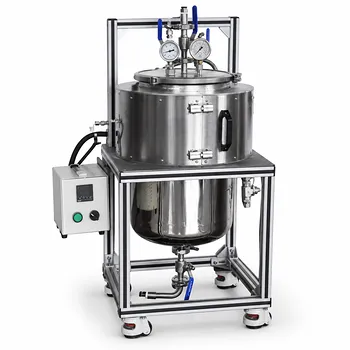
A pilot-scale stripping column is a vertical vessel packed with structured packing or trays. Live steam is injected at the bottom, while pre‑heated foul water (or a safe synthetic mixture simulating the H₂S/NH₃ load) enters near the top. As steam rises, it heats the liquid and strips the dissolved gases.
The stripped vapor leaves the top, carrying H₂S and, if not controlled, free ammonia. The cleaned water exits the bottom. By varying steam flow, feed preheat, and reflux ratio, you directly observe how mass transfer changes—exactly the kind of data that textbooks describe but a pilot plant makes undeniable.
The Sulfuric Acid Injection Point: Turning Ammonia into a Salt
Ammonia is a weak base and highly volatile in water. To prevent it from escaping with the overhead vapor, you inject sulfuric acid (H₂SO₄) into the stripper. The acid reacts with ammonia to form ammonium sulfate—a non‑volatile salt that stays in the liquid bottom stream. Without this acid, the stripper would fail to meet NH₃ removal targets, and you’d see ammonia in the overhead gas. The pilot plant lets you titrate the acid dosage while measuring pH at multiple points, revealing the exact pH window where ammonia is fixed and H₂S stripping remains efficient.
Key Measurements That Turn a Pilot Run into a Deep Scientific Study
Once the plant is running, you need more than a visual check. The real learning comes from precise quantification.
Mass Transfer Efficiency and the Height of a Transfer Unit
By sampling the liquid and vapor at different column heights, you can back-calculate the overall volumetric mass transfer coefficient (KLa) for both H₂S and NH₃. The pilot column’s performance is often expressed as the Height Equivalent to a Theoretical Plate (HETP). This metric directly answers: “How tall must my industrial column be to achieve the same removal?” Collecting these numbers under varying steam rates is a fundamental research exercise.
The pH‑Dependent Fate of Ammonia
Place pH probes at the top, middle, and bottom of the column. As you increase acid addition, the pH profile shifts. You’ll discover a sweet spot—typically between 4.5 and 5.5—where over 98% of the ammonia remains in the liquid as ammonium ion, while H₂S is still effectively stripped. Documenting this pH-dependent equilibrium is how you teach the marriage of acid‑base chemistry and stripping hydrodynamics.
Gas Evolution and Scrubbing for Safety
In educational runs, you may bubble the overhead H₂S‑rich vapor through a downstream scrubber (e.g., a caustic solution). This not only makes the experiment safe but also demonstrates integrated gas‑liquid absorption—mirroring the full refinery treatment train. If you later introduce HCN in a more advanced study, a sodium polysulfide scrubber would be used, as mentioned in supplementary industrial operations.
Understanding the Trade‑offs and Common Pitfalls
No pilot plant teaches only success; the most valuable lessons come from the limitations you encounter.
Too Much Acid Can Be as Bad as Too Little
Over‑acidifying the stripper below pH 3 creates a corrosive environment that can attack stainless steel components and shift the H₂S/HS⁻ equilibrium, potentially reducing stripping efficiency. You must map the relationship between acid dosage, pH, and corrosion risk—a classic engineering trade‑off.
Steam Rate Versus Ammonia Slip
Increasing steam flow always improves H₂S removal, but it also raises the vapor velocity, which can entrain liquid droplets containing fixed ammonium salts. If you push the column too close to flooding, you’ll see ammonia slip appear in the overhead, even with perfect acid control. The pilot plant teaches that flooding margin is just as important as chemistry.
The Danger of Solids and Fouling
Real refinery foul water carries suspended solids and trace hydrocarbons. In a pilot plant, using only a clean synthetic mixture can mislead you about long‑term fouling. A rigorous study must eventually inject a controlled amount of solids to measure pressure drop buildup and mass transfer decay—capturing the real‑world gap between clean design and actual operation.
Making the Right Choice for Your Research or Educational Goal
A single pilot plant can serve many masters. How you configure it and what you measure should be laser‑focused on your deep objective.
- If your primary focus is process optimization: Systematically vary the steam‑to‑feed ratio and acid dosage while measuring residual H₂S and NH₃ in the bottoms water. Build an operating envelope that defines the minimum cost point for meeting discharge limits.
- If your primary focus is mass transfer kinetics: Install liquid‑ and vapor‑phase sampling ports, inject a non‑reactive tracer, and compute the HETP and KLa values for each contaminant. Compare your numbers with theoretical predictions from Onda or Bravo correlations to sharpen your modeling skills.
- If your primary focus is scale‑up and industrial relevance: Run the pilot over a range of feed concentrations typical of catalytic reforming and hydrofining units. Use the dimensionless Reynolds and Froude numbers from your pilot to validate a rate‑based simulation, ensuring the industrial column will perform as promised.
Every drop of foul water you clean in that pilot plant cements the principle that acid‑aided steam stripping is a controllable, engineerable solution—and you walk away with the hard data to prove it.
Summary Table:
| Process Component | Operational Role | Key Research Metric / Variable |
|---|---|---|
| Stripping Column | Uses rising steam to vaporize and separate H₂S and NH₃ | Mass transfer efficiency ($K_La$, HETP) and flooding limits |
| Acid Injection System | Adds $H_2SO_4$ to convert volatile ammonia into non-volatile ammonium salt | pH profiles (optimal sweet spot: 4.5–5.5) |
| Downstream Scrubber | Neutralizes hazardous overhead H₂S vapor for safe lab operation | Gas-liquid absorption efficiency and safety compliance |
Bring Industrial Reality to Your Lab with LABPARK
Ready to elevate your research and hands-on training? LABPARK provides state-of-the-art Educational and Vocational Unit Operations Pilot Plants in chemical engineering, bioprocess & biotech, and environmental & water treatment. Specially designed for universities, research institutes, and enterprises, our pilot plants bridge the gap between theory and industrial practice by allowing precise control over complex mass transfer operations.
Contact us today to customize your pilot plant solution!
Related Products
- Solid Waste Pyrolysis and Refining Educational Pilot Plant for Unit Operations
- Dual-Mode Rectification Pilot Plant for Practical Training Unit Operations
- Multi-Modal Distillation Unit Operations Training Pilot Plant
- Electrochemical Water Treatment Educational Unit Operations Pilot Plant
- Comprehensive Fluid Mechanics Educational Unit Operations Pilot Plant
People Also Ask
- How do educational unit operations pilot plants bridge theory and design? Bridge the Engineering Gap
- How do educational unit operations pilot plants address safety and waste management when scaling up?
- When to transition from PID to adaptive control in pilot plants? Key process indicators.
- Why is the chemical plant startup schedule crucial? De-risk scale-up with pilot plants.
- Why Compare Predicted and Experimental Excess Enthalpy? Key to Accurate Pilot Plant Scale-up