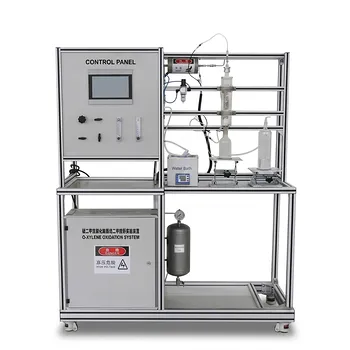
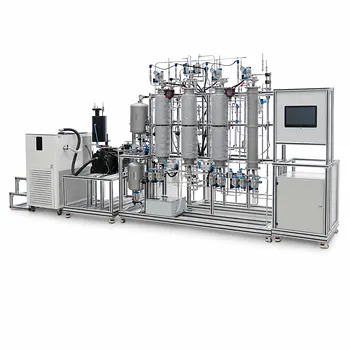
The compromise between yield and speed is the beating heart of industrial chemistry. In a chemical engineering pilot plant, this trade-off becomes tangible. By running a high-pressure catalytic reactor—like those for ammonia synthesis—you can systematically vary temperature and pressure and directly observe how thermodynamic equilibrium and reaction kinetics pull in opposite directions. The real-time temperature-concentration profiles you collect show exactly why real processes operate in a narrow compromise window, not at the theoretical limits of maximum conversion or maximum rate.
Pilot plants translate abstract thermodynamic and kinetic equations into a living system where you see the compromise in action: pushing temperature up speeds the reaction but cripples maximum possible conversion; pushing pressure up helps yield but introduces cost and safety burdens. The demonstration lies in watching concentration profiles shift as you navigate this multi-variable tug-of-war.
The Fundamental Tug-of-War: Yield vs. Speed
High-pressure catalytic synthesis forces two chemical principles into direct conflict. Understanding their opposing requirements is the first step—and pilot plants let you feel that conflict in real time.
What Thermodynamics Dictates
For exothermic, volume-decreasing reactions like ammonia synthesis ($N_2 + 3H_2 \rightleftharpoons 2NH_3$), thermodynamics favor low temperature and high pressure. According to Le Chatelier’s principle, reducing temperature shifts equilibrium toward the exothermic product side, while raising pressure favors the side with fewer gas molecules.
The numbers are dramatic. The standard equilibrium constant $K_p^\ominus$ for ammonia synthesis plummets from $5.8 \times 10^5$ at 298 K to just $5.9 \times 10^{-4}$ at 673 K. A reactor that simply follows thermodynamics would run as cold as possible to maximize equilibrium conversion.
What Kinetics Demands
Reaction rate is about collision frequency and activation energy. Lower temperatures starve the reaction of the energy needed to break the stubborn N≡N triple bond, causing rates to fall to near zero. Kinetics demand higher temperatures—typically above 400°C for iron-based catalysts—to push molecules over the activation barrier.
In a pilot plant, this is brutally visible. If you set the inlet temperature too low, the product stream shows negligible ammonia, even though thermodynamics promise a huge equilibrium yield.
The Result: A Mandatory Compromise
You cannot operate at the thermodynamic optimum nor the kinetic maximum. A practical process must sacrifice some equilibrium conversion to gain acceptable reaction rates. The pilot plant’s job is to let you find that compromise point by mapping out the conversion-versus-temperature curve under various pressures—revealing exactly where the diminishing returns set in.
How a Pilot Plant Materializes the Compromise
Educational and research pilot plants take this theoretical conflict and turn it into a hands-on optimization exercise. They allow you to manipulate the process levers and see the consequences immediately.
Manipulating the Key Levers: Temperature and Pressure
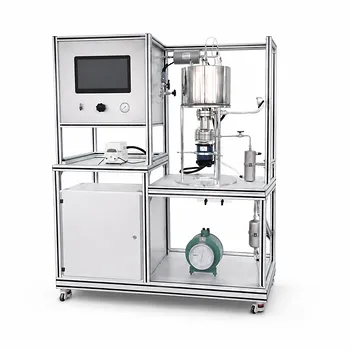
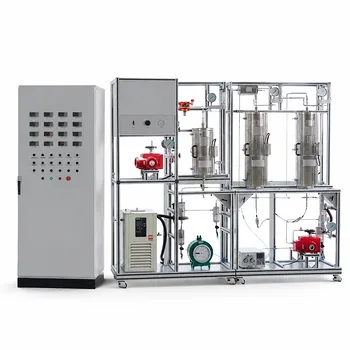
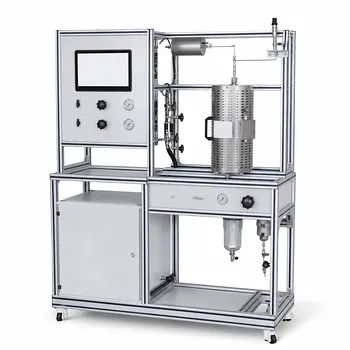
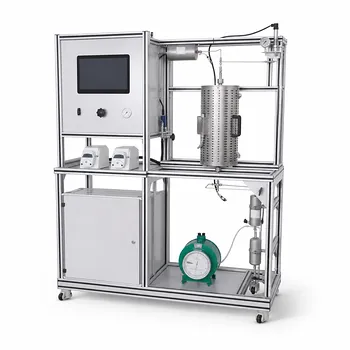
A typical high-pressure catalytic pilot unit features mass flow controllers for gas feeds, a tubular reactor with precise PID temperature control, and back-pressure regulators. You set the inlet temperature (e.g., around 675 K, just at the edge of kinetic viability) and system pressure (100–250 bar) and then systematically vary them.
As you raise temperature, measured product concentration at the reactor exit first rises (kinetics win) and then, past a certain point, begins to fall (thermodynamic equilibrium takes over). The peak of that profile is the compromise point—and seeing it happen live ingrains the concept more deeply than any textbook graph.
Real-Time Observation of Concentration Profiles
Online analysis systems—gas chromatographs or mass spectrometers—stream compositional data. By plotting ammonia mole fraction versus reactor axial position or time, you can watch the reaction accelerate at higher temperatures, then stall as the equilibrium ceiling drops.
This dynamic observation reveals how commercial systems balance conversion rates against equipment cost and thermal constraints. It also demonstrates that the compromise is not a single fixed number; it shifts with catalyst activity, space velocity, and heat removal efficiency.
The Role of Catalysts in Shifting the Battlefield
Catalysts do not change the final equilibrium, but they dramatically lower the activation energy. This shifts the kinetic curve, allowing a practical reaction rate at a lower temperature, moving the compromise window closer to the thermodynamic optimum. In pilot plants, you can compare fresh versus deactivated catalysts to see how the compromise sharpens or drifts, teaching students that catalyst development is an ongoing struggle to make kinetics less of a bottleneck.
The Ammonia Synthesis Archetype
The Haber-Bosch process is the classic teaching example because its thermodynamics and kinetics are so cleanly opposed. A pilot plant scaled to bench or skid scale replicates its core behavior.
The Thermodynamic Cliff: Equilibrium Drops with Temperature
As supplementary data confirm, ammonia synthesis’s equilibrium constant collapses as temperature rises through the 300–500°C operating range. At low temperatures, conversion could theoretically exceed 90%; at 500°C, it struggles to reach 15–20% even at high pressure.
In the pilot plant, you can verify this by running the reactor at a very low space velocity (near-equilibrium conditions) and stepping through temperatures. The measured exit ammonia concentration traces the theoretical decay, validating the thermodynamic model.
The Kinetic Wall: Why You Can’t Just Go Cold
Switch to a realistic space velocity, and the story flips. Below about 670 K, ammonia production plummets not because of equilibrium but because the reaction rate is too slow to achieve any meaningful conversion within the catalyst bed residence time. The pilot plant’s temperature readouts will show that even though thermodynamics are favorable, the product stream is nearly barren.
The Industrial Sweet Spot and Pilot-Plant Validation
Industrial ammonia synthesis operates at 400–530°C and 200–1000 bar, using iron-based catalysts. The pilot plant, even at safer pressures (20–30 MPa), reproduces the same qualitative profile. By manipulating inlet temperature around 675 K and pressure between 100 and 250 bar, operators can map the joint effects, directly seeing that the optimal industrial window is neither the coldest nor the fastest point, but the one delivering maximum economic yield per unit time.
Universal Principles Beyond Ammonia
The same approach applies to other high-pressure catalytic reactions. In catalytic reforming, higher pressure suppresses catalyst coking—a kinetic benefit for stability—but thermodynamically limits aromatization reactions. A pilot unit can measure product composition at various pressures and hydrogen-to-feed ratios, showing the trade-off between catalyst longevity and octane-barrel yield.
Similarly, multi-stage pilot plants for selective oxidation—like the oxidative dehydrogenation of ethylbenzene—demonstrate how inter-stage oxygen injection selectively combusts byproduct hydrogen. This internally reheats the process gas and shifts equilibrium toward higher conversion, a clever kinetic-thermodynamic dance that students can operate and optimize directly.
Understanding the Trade-offs and Limitations
A thoughtful pilot-plant demonstration doesn’t just show the optimum; it exposes the harsh realities that constrain it.
The Deceptive Lure of Extreme Conditions
It’s tempting to think that ramping pressure to 1,000 bar would solve the equilibrium problem. In a pilot plant, you quickly learn otherwise. Higher pressure dramatically increases equipment wall thickness, cost, and safety risks. The compromise is not only between thermodynamics and kinetics but also between conversion and economics.
Material and Safety Constraints in Pilot Units
Industrial-scale ammonia synthesis faces hydrogen embrittlement, where small hydrogen molecules penetrate steel under high temperature and pressure. Pilot plants must use specialized high-strength steel alloys for reactor components to prevent leaks. Safety systems—overpressure relief valves, blast shields, gas leak detectors, and emergency shut-off interlocks—are non-negotiable. These constraints remind students that the theoretical sweet spot must also be a safe and mechanically feasible one.
Scaling Down: What You Lose and What You Learn
A benchtop pilot plant cannot perfectly mimic the heat and mass transfer gradients of a full-scale unit. The compromise you observe may be slightly shifted. Yet, the fundamental principle remains intact: you learn to think in terms of optimizing a multi-variable system, not chasing a single ideal. The pilot plant’s value lies in this mindset, not in exact numerical replication.
Making the Right Choice for Your Goal
How you use a high-pressure catalytic pilot plant to demonstrate the optimization compromise depends on your specific teaching or research objective.
- If your primary focus is teaching thermodynamics and kinetics: Start by isolating one variable at a time. Have students run temperature sweeps at constant pressure and pressure sweeps at constant temperature, mapping the equilibrium line and the rate-limited conversion curve. The gap between the two lines is the living illustration of the compromise.
- If your primary focus is process optimization research: Use the pilot plant to test different catalysts, feed ratios, and inter-stage configurations. Focus on maximizing space-time yield within safe operating limits, explicitly treating the compromise as a multi-objective optimization problem rather than a single-parameter search.
- If your primary focus is safety and industrial practice: Emphasize the material constraints and emergency systems. Show that the real compromise point is not just the kinetic-thermodynamic intersection but the one that fits within alloy strength, pressure vessel codes, and allowable leak rates.
- If your primary focus is bridging theory and industrial reality: Operate the pilot plant for extended campaigns to observe catalyst deactivation and how the optimum set point drifts over time. This drives home that the compromise is dynamic and must be actively managed.
A pilot plant doesn’t just answer the question of where yield and speed meet—it gives you the hands-on intuition to feel why no chemical process can ever escape that delicate, fascinating balance.
Summary Table:
| Parameter | Thermodynamic Requirement | Kinetic Requirement | Pilot Plant Compromise / Solution |
|---|---|---|---|
| Temperature | Low temperature (favors equilibrium yield) | High temperature (increases reaction rate) | Optimized mid-range temperature (e.g., 400–530°C) |
| Pressure | High pressure (shifts equilibrium to products) | High pressure (increases collision rate) | Balanced pressure considering safety and equipment cost |
| Catalyst | No effect on final equilibrium | Lowers activation energy to speed up rate | Shifts the kinetic curve to allow lower operating temperatures |
Bridge the Gap Between Theory and Practical Optimization
Bring complex thermodynamic and kinetic principles to life in your lab. LABPARK provides state-of-the-art Educational and Vocational Unit Operations Pilot Plants in chemical engineering, bioprocess & biotech, and environmental & water treatment. Designed specifically for universities, research institutes, and enterprises, our pilot plants empower students and researchers to master real-world process optimization safely and effectively.
Ready to elevate your engineering curriculum or research capabilities? Contact us today to find the perfect pilot plant system!
Related Products
- Methanol Synthesis and Catalyst Performance Evaluation Educational Unit Operations Pilot Plant
- Carbon Dioxide Hydrogen Methanol Synthesis Educational Unit Operations Pilot Plant
- Fixed Bed Gas Solid Catalytic Reaction Educational Pilot Plant
- Multi Functional Catalytic Reaction and Reactor Evaluation Educational Unit Operations Pilot Plant
- Fluidized Bed Gas Solid Catalytic Reaction Educational Pilot Plant
People Also Ask
- Why is a purge system necessary when operating a gas recirculation loop in a methanol synthesis pilot plant? (Guide)
- How do temp & pressure affect methanol synthesis pilot plants? Optimize equilibrium and catalyst performance.
- Why do modern methanol pilot plants operate at lower pressures? Catalyst & Feed Requirements Explained
- What are the operational requirements for catalyst activation? Safe Methanol Pilot Plant Operation
- Why Compare Predicted and Experimental Excess Enthalpy? Key to Accurate Pilot Plant Scale-up