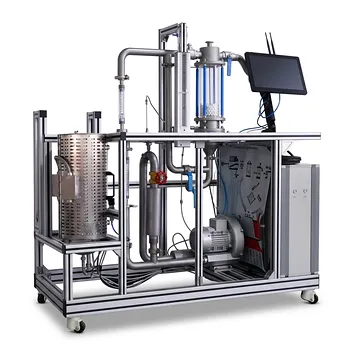
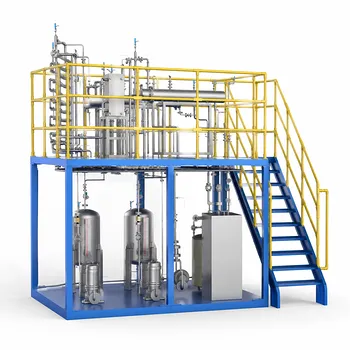
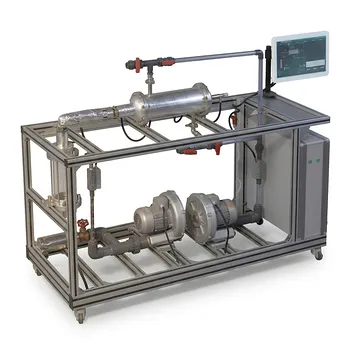
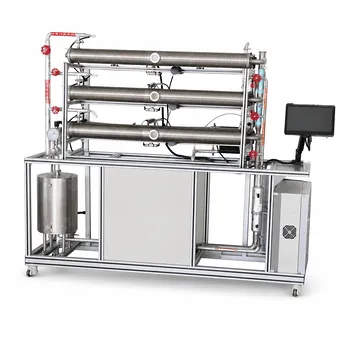
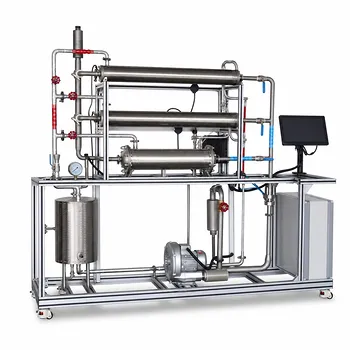
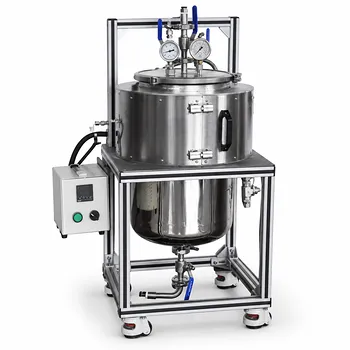
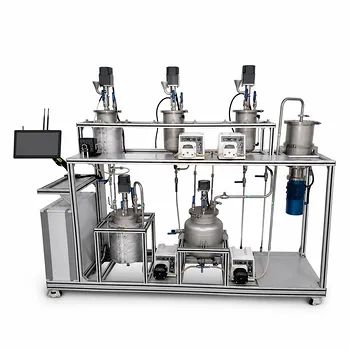
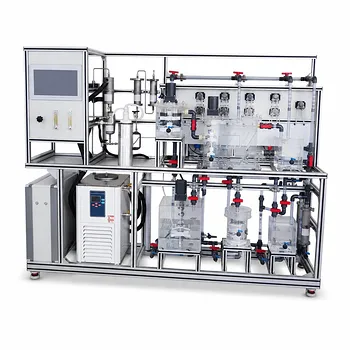
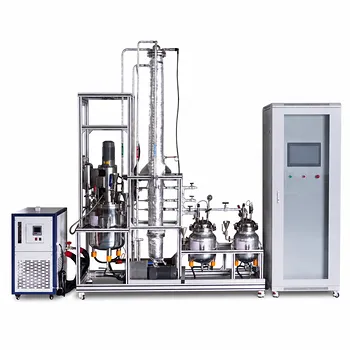
Pilot plants turn the abstract concept of convection into a measurable, side-by-side comparison. A chemical engineering laboratory pilot plant demonstrates the difference in heat transfer rates by running identical heating experiments under two contrasting conditions. In the first, the fluid is left completely still, allowing heat to move only by buoyancy‑driven natural circulation. In the second, a stirrer, pump or fan is engaged to mechanically force the fluid into rapid motion. The temperature sensors in the forced‑convection setup will climb much faster, instantly making the performance gap between the two modes visible and quantifiable.
Natural convection relies solely on density differences and is inherently slow. Forced convection adds external power to accelerate fluid movement, yielding heat transfer rates that can be an order of magnitude greater. A pilot plant lets you intentionally switch between these two regimes and directly measure the dramatic difference.
How a Pilot Plant Quantifies the Two Convection Modes
The Natural Convection Setup: Watching Buoyancy Alone
A pilot plant typically provides a heated surface—such as an electrically heated vertical cylinder, a flat plate, or a jacketed vessel—immersed in a stationary fluid.
When the agitator or pump is switched off, heat transfer becomes entirely dependent on buoyancy. Warm fluid near the hot surface becomes less dense, rises, and is replaced by cooler fluid sinking from above. This creates a sluggish circulation loop that is purely natural (free) convection.
Students measure surface temperatures, fluid temperatures, and the time it takes to reach thermal equilibrium. The temperature rise is slow, illustrating the low baseline efficiency of passive cooling or heating.
Forced Convection: Adding External Energy
Without changing the heater power or the fluid, the operator then engages an external mechanical device. In a stirred vessel, a variable‑speed impeller starts rotating. In a flow loop, a pump circulates liquid through a heat exchanger.
This forced movement sweeps fluid rapidly across the hot surface, constantly stripping away the thermal boundary layer. Fresh, cooler fluid is brought into contact much faster than buoyancy alone could ever achieve.
The same temperature sensors now show a steep, rapid climb toward the target temperature. The pilot plant thus demonstrates in real time how external work (agitation, pumping) radically increases the heat transfer rate.
Capturing the Data: From Temperature to Transfer Coefficients
Pilot plants are instrumented with thermocouples, flowmeters, and power monitors to turn these observations into hard numbers.
Students calculate the experimental heat transfer coefficient, h (W/m²K), by measuring the temperature difference and the electrical power input. Under natural convection, the calculated h value is small—often just 5–25 W/m²K for gases or 50–300 W/m²K for liquids in typical lab setups. When forced convection is activated, the same calculation yields an h value several times larger, often leaping by a factor of 5 to 10 or more.
By varying stirrer speed or pump flow, learners can correlate the Reynolds number with the Nusselt number and verify that higher fluid velocity directly boosts the convective heat transfer coefficient. Forced convection modules often let students explore correlations like Nu = C Re^m Pr^n, linking turbulent mixing to faster energy transport.
Comparing Real-Time Performance: Steady vs. Unsteady
The pilot plant also reveals how the two modes respond differently during transient operation. During a cold startup, the natural convection system drifts slowly toward steady state over many minutes, while the forced convection system reaches equilibrium in a fraction of the time.
By logging temperature profiles, students can see that the rate of temperature rise (dT/dt) is dramatically higher when the fluid is mechanically agitated, providing a dynamic, unsteady‑state demonstration of the same fundamental principle.
Understanding the Trade‑offs: When Simplicity Meets Performance
No heat transfer mechanism is universally superior. A pilot plant that lets you toggle between natural and forced convection makes the trade‑offs concrete.
Energy cost. Forced convection requires continuous electrical or mechanical power to run a pump or stirrer. In large‑scale industrial units, this can represent a significant operating expense. The pilot plant’s power meter allows students to quantify how much extra shaft work is required to achieve the faster heating.
Simplicity versus complexity. Natural convection uses no moving parts—it is silent, maintenance‑free, and immune to pump failure. In safety‑critical passive cooling systems, this simplicity is invaluable even if the heat transfer is slow. The pilot plant shows this directly: switch off the stirrer and the system immediately reverts to the slow, but fail‑safe, natural mode.
Heat transfer limits. For high‑heat‑flux applications, natural convection simply cannot remove enough energy to prevent overheating. A pilot plant experiment with a fixed high‑power heater quickly demonstrates that without forced flow, surface temperatures can spike dangerously high, while activating the pump brings temperatures back to safe limits.
Making the Right Choice for Your Learning or Design Goal
The best way to use a pilot plant is to match the experimental mode to the question you need to answer.
- If your primary focus is understanding fundamentals: Run baseline experiments with no agitation. Measure the low natural‑convection heat transfer coefficients and validate predictions against laminar buoyancy‑driven correlations like Nu = 0.59(Gr Pr)^0.25. This builds deep intuition about boundary‑layer physics.
- If your primary focus is industrial reactor or heat exchanger design: Use the forced‑convection loop. Vary pump speed systematically to build a Reynolds–Nusselt curve and learn how fluid velocity governs equipment sizing and scaling.
- If your primary focus is energy‑conscious process synthesis: Compare the electrical power input of the agitator against the gain in heat transfer rate. Use the pilot plant data to practice calculating payback times and to recognize when passive cooling is “good enough.”
A well‑designed pilot plant transforms a textbook distinction into an intuitive, quantitative experience—giving you absolute clarity on why we pay to force convection, and when we are wise to let nature do the work.
Summary Table:
| Parameter | Natural Convection | Forced Convection |
|---|---|---|
| Driving Force | Density differences (buoyancy) | External mechanical force (pump/stirrer) |
| Heat Transfer Coefficient (h) | Low (5–300 W/m²K) | High (5–10x increase or more) |
| Response Speed | Slow transient response | Rapid approach to steady state |
| Energy & Cost | Zero external power required | Continuous electrical power needed |
| Complexity & Safety | Simple, maintenance-free, fail-safe | More complex, requires moving parts |
Enhance Chemical Engineering Training with LABPARK
Looking to bridge the gap between theoretical heat transfer and physical experimentation? LABPARK designs and manufactures premium Educational and Vocational Unit Operations Pilot Plants in chemical engineering, bioprocess & biotech, and environmental & water treatment.
We empower universities, research institutes, and enterprises with:
- High-precision, instrumented pilot plants that deliver clear, measurable experimental data.
- Robust, fail-safe equipment designed to withstand rigorous academic and industrial training environments.
- Customized solutions tailored to your specific curriculum and research objectives.
Ready to elevate your laboratory's learning experience? Contact LABPARK today to discuss your pilot plant needs!
Related Products
- Solid Spherical Heat Transfer Coefficient Determination Educational Chemical Engineering Pilot Plant
- Comprehensive Multi-Modal Heat Transfer Unit Operations Pilot Plant for Engineering Training
- Shell and Tube Heat Exchanger Heat Transfer Coefficient Determination Educational Pilot Plant
- Three-Tube Heat Transfer Educational Pilot Plant for Unit Operations Training
- Dual Mode Heat Transfer Pilot Plant for Unit Operations Training
People Also Ask
- How are steady-state and unsteady-state heat transfer processes demonstrated practically using chemical engineering pilot plants?
- How do unit conversions affect pilot plant calibration? Avoid errors in heat transfer data analysis
- Why is the prevention of scale formation on heat exchanger surfaces a critical learning objective? Key Lessons
- How is the thermal resistance of a thick-walled hollow cylinder calculated? Key Equations
- Natural vs Forced Convection: Influencing Heat Transfer Pilot Plant Design & Operation