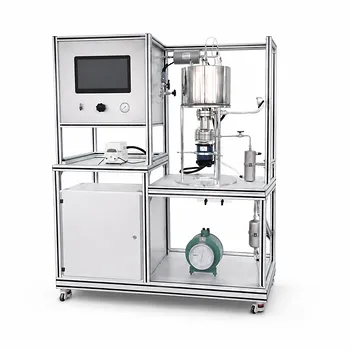
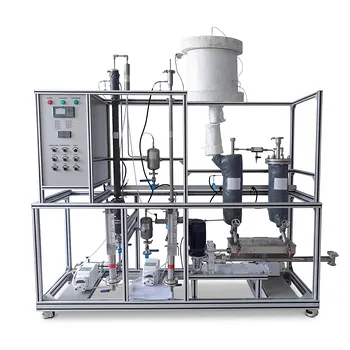
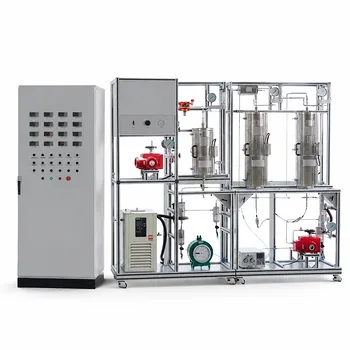
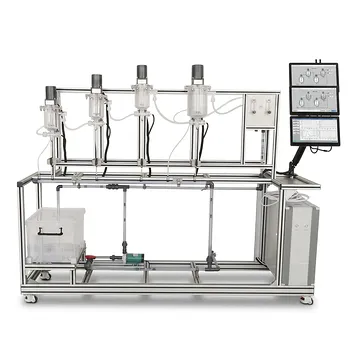
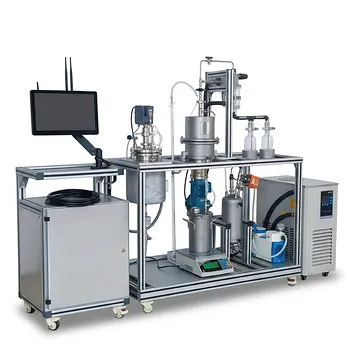
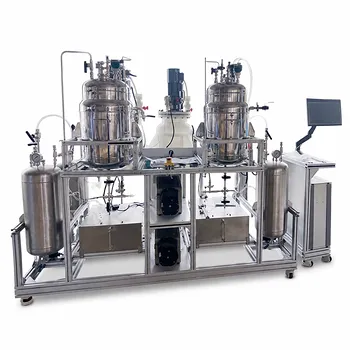
The direct path from benchtop to pilot scale starts with a jacketed reactor and real-time data.
You take the same peroxydisulfate–iodide kinetics that students time with a stopwatch and glass beakers, move it into an educational continuous stirred-tank reactor (CSTR) or batch unit equipped with automated temperature control and inline sensors, then replace manual sampling with digital concentration tracking—instantly turning a clock reaction into a heat- and mass-balanced reactor study.
The core shift isn’t just bigger glassware. It’s the intentional overlay of transport phenomena, heat management, and reactor hydrodynamics onto a known kinetic foundation. Benchtop work defines the intrinsic rate law; pilot-scale work teaches how that rate law survives—or breaks—inside a real engineering system.
Why Move Beyond the Benchtop?
The Limits of Glassware-Based Kinetics Teach Only Part of the Story
Classical benchtop experiments like the iodine clock give students a clean, isothermal view of reaction orders and activation energy.
But that simplicity hides the integrated challenges industrial chemical engineers face.
Measurements rely on manual timing, visual endpoints, and the assumption that mixing is instantaneous and heat is irrelevant.
Real reactors never grant those luxuries.
Pilot-Scale Training Forces the Discipline of Industrial Reactor Design
An educational pilot plant—whether a jacketed batch reactor or a CSTR—introduces non-ideal mixing, finite heat transfer, and residence time distributions.
When students run the same peroxydisulfate–iodide system in that environment, they can measure concentration profiles in real time, calculate heat balances, and see exactly how physical scale alters reaction performance.
That’s the missing bridge between textbook kinetics and industrial operation.
How to Transition the Experiment Step by Step
1. Start with a Reaction Whose Bench Kinetics Are Fully Known
The peroxydisulfate–iodide reaction is ideal: its bench-level rate law, rate constant, and activation energy have already been measured by students.
Before scaling, verify that the mechanism remains the same under the planned pilot conditions and that any side reactions won’t dominate.
Document the safety envelope—especially if the reaction is exothermic—to set pilot-plant limits.
2. Select the Reactor that Matches Your Learning Objectives
A jacketed batch reactor keeps the transient, concentration-decay spirit of the benchtop experiment while adding precise thermal control and sampling ports.
A CSTR flips the focus toward steady-state operation, conversion as a function of residence time, and the dynamics of continuous processing.
Many pilot units can run both modes, letting students compare how the same kinetics produce completely different time–concentration curves.
3. Instrument for Real-Time Concentration, Not Just a Stopwatch
Swap graduated cylinders for inline conductivity probes or spectrophotometric flow cells connected to a data acquisition system.
Instead of recording times at a single color change, students get a continuous curve of concentration versus time—or, in a CSTR, steady-state concentration at each flow rate.
That data stream is what makes the integral and differential methods of analysis truly practical at the pilot scale.
4. Redesign the Lab Protocol to Emphasize Kinetic Derivation, Not Just Operation
Have students collect data at multiple temperatures while the jacket holds each set point.
Then, guide them to plot ln(concentration) vs. time for first-order behavior or 1/concentration vs. time for second order to extract the rate constant (k).
Finally, use the automated temperature-sweep capability to build an Arrhenius plot of (\ln k) versus (1/T) and calculate the activation energy (E_a) directly from pilot data.
This makes the math a living tool rather than an abstract exercise.
5. Add the Heat Balance as a Core Deliverable
A benchtop beaker ignores heat; a jacketed reactor can measure it.
Monitor the jacket inlet and outlet temperatures and flow rate to calculate the heat duty removed or added at each stage.
For exothermic reactions like peroxydisulfate–iodide, this data lets students quantify the heat of reaction and discuss thermal runaway risks—a safety lesson no benchtop can provide.
6. Use the Data to Run Scaling Simulations
Once students have the intrinsic rate law and thermal parameters, feed those into a reactor modeling environment or simple Excel-based mass-and-energy balance.
Simulate what would happen if the same reaction ran in a 1000 L CSTR or a plug-flow reactor.
Compare predicted conversion and temperature profiles with pilot observations.
That’s where the real industrial mindset forms: models don’t blindly replace experiments; they are tested against small-scale data, then extrapolated with informed caution.
Understanding the Trade-offs and Pitfalls
The Cost and Maintenance Are Real, Not Trivial
Even educational pilot plants carry a significant purchase price and demand ongoing calibration, cleaning, and sometimes hazardous-material handling protocols.
Departments need dedicated technical staff or faculty champions who treat the equipment as a teaching asset, not a one-time demonstration tool.
Students Can Drown in Complexity Without Strong Scaffolding
Jumping straight from a stopwatch to a fully automated reactor with SCADA software can overwhelm undergraduates.
The most successful transitions introduce the pilot plant in stages: first a guided demonstration, then a structured lab where students monitor but don’t control, and finally open-ended projects where they design their own experimental matrices.
Pilot-Derived Rate Constants May Not Match Benchtop Values Exactly
Non-ideal mixing, dead zones, and heat transfer lags can make an otherwise simple reaction behave as if it has a different effective rate constant.
That’s not a failure—it’s the whole point.
Teach students to diagnose these differences using residence time distribution studies or by comparing batch and CSTR results, reinforcing that reactor performance is the convolution of chemistry and physics.
How to Launch This Transition in Your Department
If your primary focus is building fundamental kinetic intuition: Keep the benchtop experiments as the introduction, then add a single jacketed batch reactor session that mirrors the same chemistry. Let students see what changes and what stays the same.
If your primary focus is linking kinetics to reactor engineering: Design a lab sequence where benchtop half-lives are used to predict CSTR conversion, then the predictions are tested on the pilot plant—explicitly turning discrepancies into learning moments about residence time distribution and mass transfer.
If your primary focus is process safety and heat management: Choose a mildly exothermic reaction like peroxydisulfate–iodide and make the heat balance, jacket response, and potential for temperature excursion the centerpiece of the report, not an afterthought.
If your primary focus is aligning with industry’s digital future: Invest in the software backbone—historians, trend tools, and simple simulation packages—so students leave not only having run a pilot plant, but having integrated data, models, and operational judgment the way modern plants do.
By embedding a known reaction into a controlled, instrumented reactor and then forcing the class to reconcile the physics with the chemistry, a department doesn’t just teach kinetics at a bigger scale—it teaches the engineering discipline that turns a rate constant into a safe, productive process.
Summary Table:
| Aspect | Benchtop Scale | Pilot-Scale Training |
|---|---|---|
| Primary Focus | Intrinsic rate laws & chemical kinetics | Transport phenomena, heat transfer, & hydrodynamics |
| Temperature Control | Assumed isothermal (simple beaker) | Dynamic automated jacket control |
| Data Collection | Manual timing & visual endpoints | Inline sensors (conductivity/spectrophotometric) |
| Key Deliverables | Basic activation energy calculations | Heat balances, scaling simulations, & process safety analysis |
Modernize Your Chemical Engineering Lab with LABPARK
Transitioning from benchtop kinetics to pilot-scale operations requires the right equipment. LABPARK provides state-of-the-art Educational and Vocational Unit Operations Pilot Plants in chemical engineering, bioprocess & biotech, and environmental & water treatment.
Designed for universities, research institutes, and enterprises, our systems bridge the gap between classroom theory and industrial reality. Contact LABPARK today to discover how we can elevate your department's training capabilities.
Related Products
- Micro-Scale Gas-Solid Catalytic Reaction Educational Pilot Plant
- Multi-Reactor Educational Pilot Plant for Reaction Engineering Unit Operations
- Fixed Bed Gas Solid Catalytic Reaction Educational Pilot Plant
- Internal Circulation Gradient Free Catalytic Reaction Educational Pilot Plant
- Steam Methane Reforming Hydrogen Production and Purification Educational Pilot Plant
People Also Ask
- Why is a multibed configuration necessary for exothermic reactions? Optimize your pilot plant trajectory.
- Fluidized vs. Fixed Bed Reactors: Comparing Heat & Complexity in Pilot Plants
- Why is thermal management a major challenge in methane oxidative coupling? Reactor Solutions for Pilot Plants
- How does the Mears criterion evaluate transport resistance? Key Guide to Intrinsic Kinetics
- How do reactor pilot plants safely study gas-solid reactions? Master kinetics with thermal & flow control.