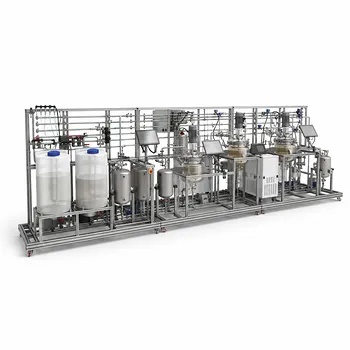
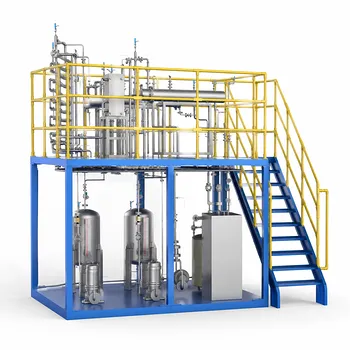
Pilot plants are the ultimate classroom for Quality by Design—they let students and researchers stop imagining a design space and start building it. By physically manipulating temperature, flow rates, and mixing speed on scaled-down reactors and bioreactors, learners execute systematic Design of Experiments (DoE) and observe how raw material and process variations directly shape final product quality. This hands-on environment transforms abstract regulatory concepts like ICH Q8 into a tactile, data-rich experience, teaching not just what a design space is, but how to construct, validate, and protect it.
The true power of pilot plants in QbD education lies in making multivariate cause-and-effect immediately visible. Instead of memorizing theory, users physically map the operating region where quality is assured—and they witness how equipment limitations, raw material shifts, and control decisions shrink that region. The result is an intuitive, risk-based understanding that no simulation alone can provide.
From Theory to Practice: The Pilot Plant as a Learning Laboratory
Embodying the ICH Q8 Framework
Pilot plants force students to live the central QbD mantra: quality cannot be tested into a product; it must be designed in. When they run a reaction or fermentation themselves, they see that a “design space” is not a static box on a slide—it’s a verified multidimensional region they have to defend with data.
This direct engagement bridges the gap between regulatory guidelines and shop-floor reality. Learners experience first-hand why the design space must be proposed before validation, and how process understanding underpins every filing commitment.
The Power of Hands-On DoE
Systematic experimentation moves from textbook factorial arrays to a living process. On a pilot-scale reactor or bioreactor, a student can vary temperature and agitation simultaneously, then measure yield or purity changes in real time.
This immediate feedback reveals interaction effects that flat simulations hide. It also ingrains the discipline of statistically designed experiments, because the resource cost of each run makes every data point a deliberate choice.
Mapping the Design Space Through Multivariate Experimentation
Defining Critical Process Parameters (CPPs) and Their Interactions
A pilot plant lets users isolate and combine Critical Process Parameters—such as pH, nutrient feed rate, and dissolved oxygen in a bioprocess—to see how they jointly influence a Critical Quality Attribute (CQA) like product titer.
Real equipment introduces noise: slight pump pulsations, imperfect mixing, or sensor drift. These imperfections teach students why interaction terms matter and why the design space must be expressed as a multivariate model, not a series of independent ranges.
Observing Critical Quality Attributes (CQAs) in Real Time
Integrated sensors and Process Analytical Technology (PAT) tools turn the pilot plant into a live quality dashboard. Instead of waiting for off-line lab results, students watch CQAs—particle size, viscosity, or conversion—respond to their parameter changes.
This immediacy cements the link between operation and outcome. It demonstrates that a design space is a real-time control concept, not a post-hoc testing exercise.
Visualizing the Boundaries of Reliable Operation
By running enough experimental points, students learn to draw a probability-based design space where, for example, over 80% of batches meet specifications. They see the difference between a theoretical “normal operating range” and the statistically assured region that accounts for process variability.
The pilot plant’s inherent fluctuations—from raw material lot differences to ambient temperature swings—make this tangible. The reliable design space always looks smaller than the mathematical model, and that lesson sticks.
Managing Complexity and Variability
Simulating Raw Material Variability with Feedforward Control
A pilot plant with programmable feed systems can introduce deliberate raw material shifts—like using a lower-purity reactant—to show how fixed conditions fail. Students then apply feedforward control, solving model equations to adjust a process parameter (e.g., increasing catalyst concentration) and keep the output CQA on target.
This exercise teaches that a design space is dynamic. It must be defended by active control loops that absorb incoming variability, not by hoping everything stays constant.
Propagating Upstream Changes Downstream
A train of multiple unit operations (reactor → crystallizer → granulator) reveals how a small disturbance at the first step can cascade. Students manipulate a starting material and then measure the effect on final tablet dissolution or crystal size distribution.
They learn to set science‑based raw material acceptance criteria that protect the entire process train. This end‑to‑end view is the essence of risk‑based QbD, and it’s impossible to simulate authentically without physical material flowing through actual equipment.
Integrating Process Analytical Technology (PAT) and Soft Sensors
Pilot plants can replace traditional grab sampling with soft sensors that infer CQAs from easy‑to‑measure variables. For example, a reaction’s conversion can be predicted in real‑time from heat balance data.
Students configure these inferential models, validate them against offline results, and then use them to manage the design space continuously. This hands‑on PAT integration is exactly what modern pharmaceutical and biotech plants demand.
Understanding the Trade‑offs of Pilot Plant Education
Scale‑Down Limitations and Model Fidelity
Pilot plants are not perfect miniatures of production. Heat transfer, mixing times, and surface‑to‑volume ratios often differ significantly. Students must learn that a design space established at pilot scale is a hypothesis for full‑scale, not a final guarantee.
Ignoring this creates a dangerous illusion of readiness. The best programs use pilot data to discuss scale‑up uncertainty and to practice the experiments needed for process validation later.
Resource Intensity vs. Learning Depth
Running a physical DoE campaign can take days and consume significant materials and energy, whereas a simulation takes minutes. However, the depth of understanding from handling a real pump failure, interpreting a noisy sensor, or recovering from an operating error cannot be compressed.
Educational programs must balance these costs. The pilot plant is most valuable when the goal is to build an engineer’s intuition and risk judgment—not just to teach statistics.
Over‑simplification of Regulatory Realities
The design space a student maps in a week‑long lab session is far simpler than one required for a regulatory filing, which demands extensive lifecycle documentation and formal risk assessments. There is a risk of believing that a successful pilot‑scale DoE equals a validated process.
Educators must complement the pilot experience with case studies on regulatory expectations, teaching that a design space is a living commitment reviewed throughout the product lifecycle.
Preparing for Industrial Practice
Bridging Scale‑up and Technology Transfer
When students run a pilot plant with QbD intent, they instinctively ask the questions that drive technology transfer: How do I know this design space will work at a new site or larger volume? What evidence would I need?
They practice gathering that evidence, using scale‑up correlations and process models. This turns them into professionals who can lead a transfer, not just follow a protocol.
Developing a Risk‑Based Mindset for Process Control
The pilot plant trains a different kind of thinking: What could go wrong? How do I detect it early? Which parameter must be controlled tightest? Learners begin to see the design space as a control confidence envelope, not a permission slip to operate anywhere inside.
This risk‑based mindset—continuously monitoring and improving the process—is the ultimate goal of QbD. The pilot plant ingrains it in muscle memory.
How to Leverage Pilot Plants for Your QbD Training Goals
- If your primary focus is fundamental understanding: Use the pilot plant for simple two‑parameter DoE studies. Let students discover main effects and interactions physically, then cross‑validate with statistical software to see why design space models are built the way they are.
- If your primary focus is advanced control strategies: Implement feedforward and PAT studies. Challenge students to design the sensor network and control loops that automatically keep the process within the design space, even under simulated raw material drift.
- If your primary focus is scale‑up and transfer: Structure the course as a tech‑transfer simulation—map the design space at pilot scale, then justify how it would be proven at industrial scale using mixing rules and risk analysis.
- If your primary focus is regulatory readiness: Integrate ICH Q8 case studies and require a design space justification report. Students must define CQAs, CPPs, risk assessments, and acceptance criteria based on their own experimental evidence from the pilot plant.
Ultimately, pilot plants don’t just teach the what of Quality by Design—they teach the how, forging professionals who can build quality into processes from the very first experiment.
Summary Table:
| Key QbD Concept | How Pilot Plants Teach It | Educational Value |
|---|---|---|
| Design Space Mapping | Multivariate DoE (manipulating temp, pH, mixing) | Visualizes interaction effects & reliable boundaries |
| Real-time Quality (CQAs) | Integrating PAT sensors & soft sensors | Demonstrates real-time control over final product quality |
| Variability Management | Simulating raw material shifts & feedforward loops | Teaches dynamic control instead of static operations |
| Scale-up & Tech Transfer | Comparing pilot data with full-scale models | Develops risk-based validation & scale-down skills |
Bring Hands-On QbD Training to Your Institution
Are you looking to equip your students or researchers with the practical skills needed for modern process design? LABPARK provides premium Educational and Vocational Unit Operations Pilot Plants in chemical engineering, bioprocess & biotech, and environmental & water treatment. Our state-of-the-art pilot systems help universities, research institutes, and enterprises bridge the gap between theoretical Quality by Design (QbD) and real-world industrial validation.
Contact LABPARK today to find the perfect pilot plant solution for your lab!
Related Products
- Natural Product Extraction Unit Operations Training Pilot Plant
- Fixed-Bed Chemical Reaction and Gas Dust Tar Removal Unit Operations Pilot Plant
- Ethyl Acetate Synthesis Unit Operations Pilot Plant for Practical Training
- Methanol Synthesis and Catalyst Performance Evaluation Educational Unit Operations Pilot Plant
- Electrolytic Hydrogen Production Educational Unit Operations Pilot Plant
People Also Ask
- How to Demo Solubility Sensitivity in SFE Pilot Plants? Practical Thermodynamics
- How do pilot plants differentiate physical vs chemical extraction? Enhance Chemical Engineering Training
- How are HTU and NTU applied to determine extraction column height? Guide to Pilot Plant Scaling
- Why use split-plot designs in pilot plants instead of CRD? Optimize process parameters effectively.
- Why use step disturbance in pilot plants? Master process control dynamic response.