The answer is immediate: anaerobic digestion unit operations in bioprocess pilot plants serve as a scaled-down, controllable environment to convert organic waste streams into biogas—directly demonstrating waste minimization through resource recovery—while allowing students and researchers to optimize every variable that governs this transformation.
Anaerobic digestion pilot plants turn the abstract concept of a “circular economy” into a tangible, measurable process. Their core value lies in showing that organic waste isn't an endpoint—it’s a feedstock that can be systematically converted into renewable energy. The real study, however, goes far beyond just producing gas; it’s about meticulously controlling and understanding the biological and engineering levers that make this conversion efficient, stable, and scalable.
The Core Mechanism: Turning Waste into Value
The primary reference point for any study is the fundamental transformation that takes place. Anaerobic digestion is a biological process where microorganisms break down organic matter in an oxygen-free environment. In a pilot plant, this natural cycle becomes a monitored, engineered unit operation. The explicit goal of waste minimization is achieved by radically reducing the volume of organic solids that would otherwise require disposal, while the resource recovery is embodied in the two main outputs: biogas and a nutrient-rich digestate.
How Pilot Plants Mimic Real-World Bioprocessing
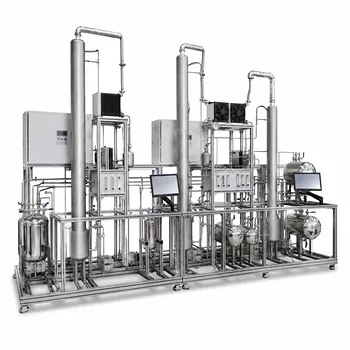
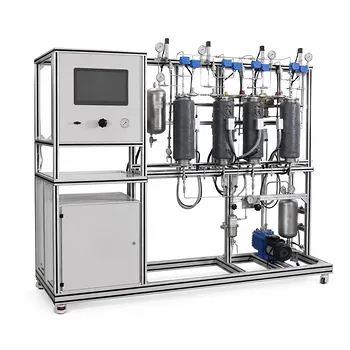
A true pilot plant isn't just a big flask. It’s an integrated set of unit operations that simulate a full-scale facility. This typically includes a feedstock preparation stage, a temperature-controlled bioreactor, a gas collection and measurement system, and a digestate handling unit. By working at this intermediate scale, researchers can study the continuous flow of material and energy—a critical leap beyond batch experiments in a classroom lab.
The Power of Parameter Control in Learning
The true educational and research insight comes from manipulating key operational levers. A pilot plant allows you to actively adjust temperature (mesophilic vs. thermophilic), pH, and, most critically, the organic loading rate. You can observe how pushing the system’s limits with a higher loading rate might increase biogas output but risk acidification, which would destabilize the reactor. This collision of theory and real-time data makes the concept of microbial health an immediate, practical concern.
Expanding the Study Beyond Basic Biogas Production
The deep need in such a question often concerns applicability and optimization. The primary reference highlights biogas as a source of electricity and heat, but the value of a pilot plant is its ability to demonstrate the entire system’s trade-offs and its potential for integration with broader resource recovery operations.
Validating Source Reduction Principles
Waste minimization begins before the reactor. A pilot plant is a safe, realistic platform to test source reduction strategies. You can modify the feedstock—for example, by introducing alternative raw materials or changing preprocessing steps—and instantly monitor how that affects biogas yield and the volume of residual digestate. This approach directly illustrates that eliminating a problematic input at the source is always more efficient than trying to manage its toxic or inhibitory effects downstream.
Studying the Energy-to-Purity Trade-off
The raw biogas produced is a mixed product. To be a genuine resource, it often needs upgrading. A comprehensive study can integrate focused separation unit operations, such as a small-scale scrubbing column, to separate methane from CO₂ and hydrogen sulfide. Researchers then face the classic industrial dilemma: analyzing the energy-to-purity trade-off. How much of the recovered energy must you spend on purification, and what quality of gas does your target application truly demand? This reframes the problem from “making gas” to “delivering a commercially viable energy product.”
Integrating with Advanced Resource Recovery Chains
The digestate is a second stream of value, not a waste. This is where connecting the anaerobic digestion unit to other pilot-scale operations becomes a powerful teaching tool. The digestate can feed a membrane filtration unit to recover water and concentrate nutrients like phosphorus and nitrogen. This demonstrates how to shift from a linear “digest and dispose” model to a multi-step, intensified platform where the waste from one process is the feedstock for another, unlocking a complete circular economy story.
Understanding the Trade-offs and Pitfalls
Objective study requires a clear-eyed view of the challenges. A pilot plant reveals these limitations not as theoretical drawbacks, but as operational realities that require constant engineering judgment. Ignoring the deep need for stability and system integration is a common pitfall.
Biological Sensitivity vs. Process Stability
The microorganisms at the heart of the process are sensitive to shock loads of organic matter, toxins, or rapid temperature swings. A pilot plant vividly demonstrates how a single bad batch of feedstock can crash the reactor—a lesson in the critical need for robust feedstock quality control and conservative start-up procedures that is worth more than any lecture.
Input Diversification and Process Economics
Using a highly variable waste stream, like food waste, exposes researchers to the complexity of inconsistent composition. While the goal is waste minimization, the process demands a certain homogeneity to operate efficiently. Minimizing the diversity of waste inputs might simplify the process, but reducing the scale of the problem. The pilot plant becomes a laboratory for this exact negotiation: identifying the optimal blend of feedstocks that balances recovery efficiency with the practical goal of handling real-world waste.
Making the Right Choice for Your Study Goals
The pilot plant is a platform, and its configuration must match your primary objective. The way you frame your investigation determines which levers you pull and what success looks like.
- If your primary focus is process optimization for maximum energy yield: Manipulate organic loading rates and temperature profiles while closely monitoring gas composition and volatile fatty acid levels to find the point of peak efficiency just before inhibition sets in.
- If your primary focus is holistic waste-to-product circularity: Integrate the digester with downstream separation units like membranes or nutrient-recovery columns, turning the study into a complete biorefinery that issues only minimal, inert waste.
- If your primary focus is workforce training on plant troubleshooting: Deliberately introduce common failure scenarios—such as a pH crash or feed pump failure—into the pilot plant so students learn to diagnose, recover, and stabilize the process in a no-risk environment.
- If your primary focus is researching biodegradability of new feedstocks: Use the pilot plant as a standardized test bed to run long-term trials on novel materials, such as bio-based plastics, to generate the mass balances and degradation kinetics needed for real-world application.
The anaerobic digestion pilot plant is ultimately a truth-telling machine. It strips the process of theory and forces you to confront the material flows, energy inputs, and biological realities that define any real attempt to turn waste into a resource.
Summary Table:
| Study Focus | Key Levers & Parameters | Target Outputs & Benefits |
|---|---|---|
| Energy Yield Optimization | Organic loading rate, pH, temperature profiles | Maximized biogas production & peak conversion efficiency |
| Waste-to-Product Circularity | Feedstock composition, downstream separation systems | Purified methane, nutrient recovery, water reclamation |
| Process Stability & Troubleshooting | VFA levels, shock loads, microbial health indicators | Hands-on operator training & reactor crash prevention |
| Feedstock Biodegradability | Novel materials (e.g., bioplastics), retention times | Accurate mass balances & degradation kinetics data |
Bring Circular Economy Concepts to Life with LABPARK
Are you looking to scale up your bioprocess research or provide hands-on vocational training in resource recovery? LABPARK designs and manufactures state-of-the-art Educational and Vocational Unit Operations Pilot Plants across chemical engineering, bioprocess & biotech, and environmental & water treatment.
By partnering with LABPARK, universities, research institutes, and enterprises can:
- Simulate Real-World Processes: Transition seamlessly from benchtop theory to continuous, pilot-scale waste-to-energy operations.
- Ensure Precise Parameter Control: Master complex variables like organic loading rates, pH, and temperature in a safe, controlled environment.
- Train the Future Workforce: Equip students and technicians with practical troubleshooting skills on industry-grade equipment.
Ready to elevate your engineering curriculum or research capabilities? Contact LABPARK today to customize the ideal pilot plant for your laboratory!
Related Products
- Bio-fermentation Ethanol Production Practical Training Unit Operations Pilot Plant
- Multimodal Absorption and Desorption Pilot Plant for Unit Operations Training
- Multi-Modal Distillation Unit Operations Training Pilot Plant
- Dual-Mode Rectification Pilot Plant for Practical Training Unit Operations
- Green Anhydrous Ethanol Purification Extractive Distillation Unit Operations Training Pilot Plant
People Also Ask
- Why Use PTFE & Hastelloy in Chemical Pilot Plants? Prevent Corrosion & Ensure Safety
- Why Compare Predicted and Experimental Excess Enthalpy? Key to Accurate Pilot Plant Scale-up
- Why is the chemical plant startup schedule crucial? De-risk scale-up with pilot plants.
- When to transition from PID to adaptive control in pilot plants? Key process indicators.
- Why must batch and fed-batch fermentation pilot plants be designed to accommodate changing rheological conditions?