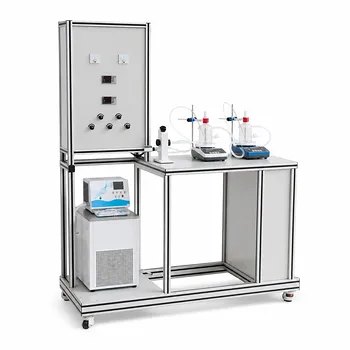
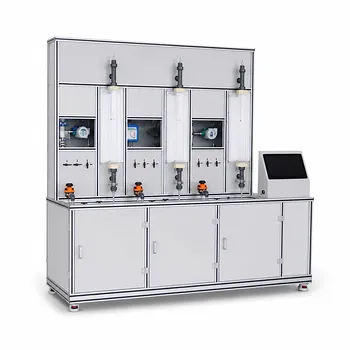
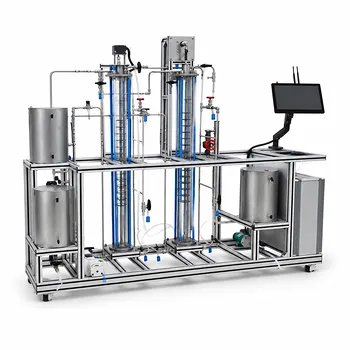
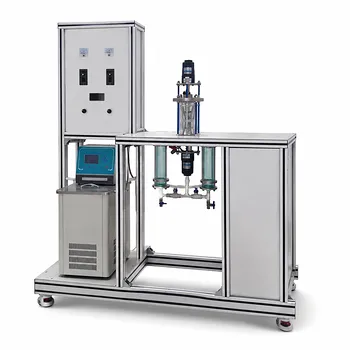
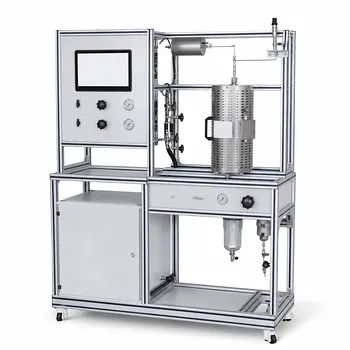
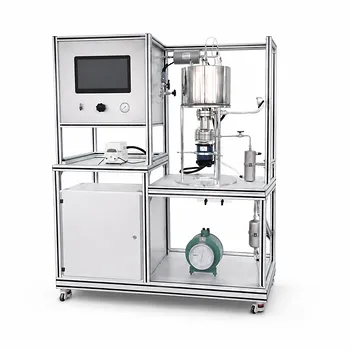
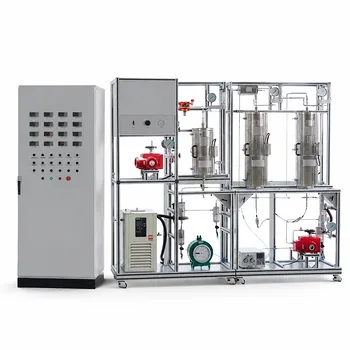
A biphasic liquid-liquid catalytic system transforms catalyst separation from a complex thermal challenge into a simple, visual gravity-driven process. An educational unit operations pilot plant demonstrates this by integrating a reactor with a gravity separator (decanter). Students directly observe the spontaneous separation of a dense, catalyst-containing polar phase from a lighter, non-polar product phase, then trace the catalyst solution’s continuous recycle back to the reactor. This hands-on setup teaches phase equilibrium, mass transfer in liquid-liquid systems, and the industrial logic of designing separation loops that avoid energy-intensive distillation.
By coupling a continuous stirred-tank reactor with a liquid-liquid decanter, an educational pilot plant lets students see the moment the catalyst-rich polar phase falls out of the organic product stream—turning abstract concepts of phase equilibrium, mass transfer, and industrial catalyst recycle into tangible, teachable moments.
The Biphasic Catalysis Principle in a Pilot Plant
Visualizing Catalyst Immobilization and Phase Separation
Biphasic catalysis dissolves the catalyst in a polar solvent—such as 1,4-butanediol or an aqueous solution with polar ligands—that is immiscible with the non-polar reaction products. The catalyst stays confined to one liquid phase while products form a distinct organic layer. In a pilot plant, this creates an immediate visual lesson: once the reaction mixture exits the CSTR, it flows into a vertical separator vessel where gravity pulls the denser catalyst phase downward and the lighter product phase upward.
Demonstrating Continuous Catalyst Recovery and Recycle
The pilot plant’s decanter is not a dead-end device. A pump draws the settled polar phase from the bottom and returns it to the reactor feed, creating a closed catalyst loop. Students measure the catalyst concentration in the recycle and the organic product stream, quantifying recovery rates that often exceed 99%. They see how this circuit decouples reaction temperature from separation temperature, avoiding the thermal stress that can deactivate catalysts above 420 K.
Core Engineering Concepts Brought to Life
Phase Equilibrium and Liquid-Liquid Mass Transfer
Because the reaction occurs at the interface between two immiscible liquids, the pilot plant makes mass transfer visible. Students can vary stirrer speed or feed composition and measure how conversion changes, linking interfacial area and mass transfer coefficients to reactor performance. By sampling both phases, they calculate partition coefficients and build a thermodynamic understanding of why the product stays in the organic layer while the catalyst remains polar.
Gravity-Driven Separation and the Role of Physical Properties
Liquid-liquid extraction pilot plants are specifically built to show what textbooks describe. Students observe how small differences in density and interfacial tension determine how quickly droplets coalesce. When the density contrast is modest, phase separation slows down, and backmixing or emulsification can appear—exactly the scale-up challenges that engineers face. By recording separation times and analyzing droplet settling, students connect Stokes’ law and coalescence theory to real equipment design.
Bridging the Gap to Industrial Practice
Comparing Homogeneous and Biphasic Separation Schemes
An educational plant can be reconfigured to highlight why biphasic systems matter. In a traditional homogeneous catalytic process, the catalyst is dissolved in the product phase, requiring a downstream stabilizer column and distillation to recover the non-volatile catalyst—a thermally harsh and capital-intensive path. Switching to a biphasic setup replaces those columns with a single decanter. Students see the same reactor produce a clean product stream with dramatically fewer unit operations, cementing the advantage of phase-behavior-based separation.
Techno-Economic and Scale-Up Insights
By running the pilot plant at different throughputs, learners collect data on energy use, solvent hold-up, and catalyst inventory. They can compare the cold start-up cost of a distillation train versus the simplicity of a liquid-liquid loop. These experiments teach the practical side of process selection: extraction and decantation often win when thermal degradation threatens product quality or when the catalyst is exceptionally valuable.
Understanding the Trade-offs
The elegance of gravity separation comes with real constraints. When density differences are extremely small, the decanter footprint can become impractically large, and separation time may not keep pace with production rates. Low interfacial tension can lead to stable emulsions, requiring additional coalescing internals or chemical demulsifiers that complicate operation. Catalyst leaching into the product phase, even at part-per-million levels, must be monitored; a perfectly insoluble system is rare. Pilot plants allow students to engineer around these challenges—adjusting solvent polarity, adding internals, or fine-tuning pH—turning limitations into design exercises.
Making the Right Choice for Your Educational Goal
- If your primary focus is conveying the fundamentals of phase equilibrium and mass transfer: Set up a simple gravity decanter with a transparent body; let students measure partition coefficients and film mass transfer coefficients directly.
- If your primary focus is process integration and continuous flow thinking: Operate the full loop for hours, challenge students to stabilize the catalyst recycle without contamination, and map the steady-state material balance across the reactor and separator.
- If your primary focus is comparing industrial separation routes: Run the same model reaction first through a distillation train and then through a biphasic decanter; capture the energy and catalyst loss data to drive home why process chemistry dictates separation technology.
- If your primary focus is scale-up and troubleshooting: Introduce intentional upsets—a feed with lower density oil, a mixer speed that emulsifies—and task students with restoring clean phase separation using engineering principles.
A well-designed biphasic pilot plant transforms a complex catalytic cycle into a visual, data-rich playground where tomorrow’s engineers master the separation logic that underpins industrial efficiency.
Summary Table:
| Feature | Homogeneous Catalysis | Biphasic Catalysis |
|---|---|---|
| Separation Method | Distillation / Thermal columns | Gravity decanter (density-driven) |
| Energy Consumption | High (thermal separation) | Low (mechanical recycle) |
| Catalyst Recovery | Complex; risk of degradation | Simpler; recovery rates >99% |
| Key Engineering Focus | Vapor-liquid equilibrium | Liquid-liquid mass transfer |
Elevate Chemical Engineering Education with LABPARK
Bridge the gap between textbook theory and industrial reality. LABPARK provides premium Educational and Vocational Unit Operations Pilot Plants tailored for chemical engineering, bioprocess & biotech, and environmental & water treatment.
Whether you are a university, research institute, or enterprise, our pilot plants deliver clear visualization, precise process control, and reliable continuous operation.
Contact LABPARK today to configure the perfect pilot plant for your laboratory!
Related Products
- Fluidized Bed Gas Solid Catalytic Reaction Educational Pilot Plant
- Carbon Dioxide Hydrogen Methanol Synthesis Educational Unit Operations Pilot Plant
- Ternary Liquid-Liquid Equilibrium Educational Pilot Plant
- Two Phase Flow Pattern Velocity Resistance Measurement Educational Pilot Plant
- Multi Functional Catalytic Reaction and Reactor Evaluation Educational Unit Operations Pilot Plant
People Also Ask
- Why is the bed height-to-diameter ratio (L/dt) critical? Fluidized bed pilot plant selection guide.
- How is the minimum fluidization velocity (U_mf) determined and utilized? A Unit Operations Guide
- How does the Mears criterion evaluate transport resistance? Key Guide to Intrinsic Kinetics
- How do reactor pilot plants safely study gas-solid reactions? Master kinetics with thermal & flow control.
- How do pilot plants demonstrate fluidized-bed reactor advantages over fixed-bed? Find Out Now