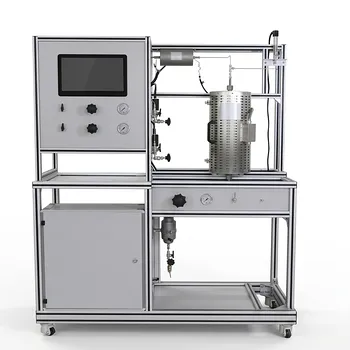
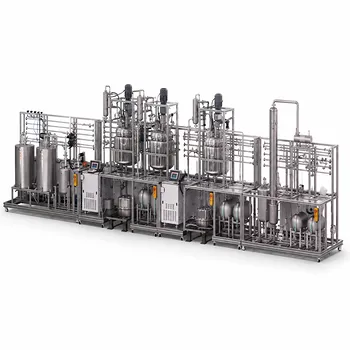
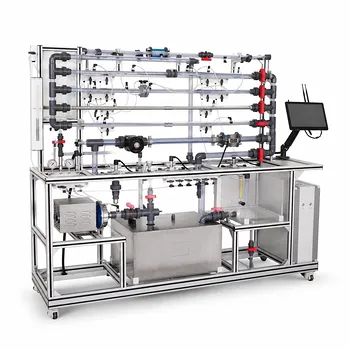
The key to comparing SCR and NSCR in a pilot plant lies in a single, versatile reactor platform.
By equipping a pilot plant with an adjustable-temperature reactor furnace and a flexible gas feed system, you can directly benchmark both processes. The furnace is set to the lower SCR range (420–670 K) and then the higher NSCR range (970–1120 K), while the feed system switches between ammonia/urea (for SCR) and methane or hydrogen (for NSCR). This side-by-side testing allows quantification of reaction kinetics, selectivity, and the energy balance linked to oxygen consumption.
The pilot plant becomes a decision-making simulator that exposes the fundamental trade-off: SCR offers superior selectivity for NOx using ammonia in an oxidizing environment, while NSCR leverages simpler hydrocarbon reductants but demands significantly higher temperatures and consumes oxygen, directly impacting energy efficiency and safe operating windows.
Configuring the Pilot Plant for Two Distinct Chemistries
Dual-Range Temperature Control
The reactor furnace must reliably span a wide temperature envelope.
SCR operates efficiently in the 420–670 K range, where ammonia selectively reduces NOx.
NSCR requires 970–1120 K to activate methane or hydrogen as a reductant.
A single unit with programmable temperature ramping lets students map conversion versus temperature for both processes without hardware changes.
Adaptable Gas Delivery and Reducing Agents
The feed system needs precise mass flow controllers for multiple gas streams.
For SCR, the system can simulate lean exhaust by blending NOx, oxygen, and nitrogen, then introduce ammonia or urea.
Urea can be dosed upstream, where it thermally decomposes to ammonia and CO₂—a two-step process easily demonstrated in a pre-heater section.
For NSCR, the same manifold instead supplies methane or hydrogen, along with oxygen, to replicate fuel-rich conditions over the catalyst.
Catalyst and Reactor Flexibility
A tubular reactor with interchangeable catalyst beds allows testing of both SCR monoliths and NSCR pellets.
The pilot plant can hold a typical SCR catalyst (often vanadia- or metal-zeolite based) and an NSCR catalyst (like platinum/palladium on alumina).
Controlling space velocity by adjusting gas flow rates enables fair comparison of intrinsic activity.
Analyzing Performance: Kinetics, Selectivity, and Energy
Measuring Conversion Kinetics
By monitoring inlet and outlet NOx concentrations at steady state, you obtain conversion versus temperature curves.
The adjustable reactor makes it possible to collect data at identical space velocities for both processes, isolating the chemical differences.
This direct comparison teaches how activation energies differ and why each catalyst has an optimal thermal window.
Quantifying Selectivity
Selectivity in emission control is about the destination of the reducing agent.
In SCR, ammonia reacts almost exclusively with NOx to form N₂.
In NSCR, the reductant also combusts with oxygen, which lowers the fraction of reactant that actually reduces NOx.
A pilot plant equipped with gas analyzers (NO, NO₂, NH₃, CO, CO₂, O₂) can compute the selectivity factor—ammonia- or reductant-to-N₂ efficiency—revealing why SCR is "selective."
Assessing Energy Balance and Heat Recovery
NSCR consumes oxygen because the hydrocarbon reductant burns exothermically.
This oxygen consumption raises the reactor temperature and generates recoverable heat.
A pilot plant with integrated temperature sensors and a calorimetric jacket can quantify the net energy output.
Students can thus evaluate whether the extra heat offsets the higher initial furnace heating demand, a critical lesson in process economics.
Understanding the Trade-offs
Operating Temperature Penalty
NSCR’s 970–1120 K requirement demands much more furnace energy than SCR’s 420–670 K.
This high temperature can also sinter catalysts over time and require expensive materials of construction.
Pilot-scale observation of heating times and energy input at each temperature band makes this penalty tangible.
Reducing Agent Cost and Availability
Ammonia and urea are widely available but require safe handling and precise injection to avoid slip.
Methane and hydrogen can be cheaper or available on-site (e.g., from natural gas) but introduce flammability risks and a larger carbon footprint.
In a pilot plant, students can log reductant consumption rates and calculate cost per gram of NOx removed.
Secondary Emissions and Safety
Ammonia slip from SCR is a regulated pollutant; the pilot plant can measure slip with an ammonia analyzer to optimize the NH₃/NOx ratio.
NSCR can generate carbon monoxide and unburned hydrocarbons if oxygen is insufficient, demanding tight control of the air-fuel ratio.
Running both processes in the same facility highlights how the hazard profile and tail-gas treatment requirements shift.
Oxygen Competition in NSCR
The fundamental limitation of non-selective reduction is the competition between NOx and O₂ for the reductant.
Because oxygen is often present in large excess, a significant portion of the reducing agent is wasted in combustion.
A pilot experiment can quantify this by varying the O₂ concentration and measuring the drop in NOx conversion, directly illustrating the root cause of low selectivity.
Making the Right Choice for Your Training or Research Goal
Your objective determines which process to emphasize and how to design the pilot plant runs.
- If your primary focus is teaching selective catalytic chemistry: Prioritize SCR experiments with ammonia injection, urea hydrolysis, and NH₃ slip monitoring to demonstrate molecular precision in emission control.
- If your primary focus is exploring high-temperature kinetics and energy integration: Design NSCR runs with methane or hydrogen, and use the calorimetric data to study heat recovery and the exothermic trade-off.
- If your primary focus is benchmarking catalyst durability: Use the same reactor hardware to cycle between SCR and NSCR conditions, observing how cycles affect catalyst activity and selectivity over time.
- If your primary focus is process economics: Run both processes at their respective optima and log energy input, reductant consumption, and catalyst cost per kilogram of NOx removed, letting the data drive the technology selection discussion.
A well-designed reaction engineering pilot plant transforms abstract catalytic reduction concepts into hands-on evidence, letting you dissect the why behind the choice between SCR and NSCR.
Summary Table:
| Feature | Selective Catalytic Reduction (SCR) | Non-Selective Catalytic Reduction (NSCR) |
|---|---|---|
| Operating Temperature | 420–670 K (Lower energy demand) | 970–1120 K (Higher energy demand) |
| Reducing Agent | Ammonia ($NH_3$) or Urea | Methane ($CH_4$) or Hydrogen ($H_2$) |
| NOx Selectivity | High (selective reaction) | Low (competes with oxygen combustion) |
| Typical Catalyst | Vanadia- or metal-zeolite | Platinum or palladium on alumina |
Bring Hands-On Catalytic Research to Your Lab
Enhance your academic and research capabilities with LABPARK. We design and manufacture advanced Educational and Vocational Unit Operations Pilot Plants in chemical engineering, bioprocess & biotech, and environmental & water treatment for universities, research institutes, and enterprises.
Whether you are demonstrating gas-phase reaction kinetics or benchmarking advanced emission control technologies, our versatile pilot plant platforms provide the precision, safety, and flexibility your team needs.
Contact LABPARK today to discuss your custom pilot plant specifications and request a quote!
Related Products
- Multi-Reactor Educational Pilot Plant for Reaction Engineering Unit Operations
- Fixed Bed Gas Solid Catalytic Reaction Educational Pilot Plant
- Fixed-Bed Chemical Reaction and Gas Dust Tar Removal Unit Operations Pilot Plant
- Fluidized Bed Gas Solid Catalytic Reaction Educational Pilot Plant
- Micro-Scale Gas-Solid Catalytic Reaction Educational Pilot Plant
People Also Ask
- How do educational unit operations pilot plants address safety and waste management when scaling up?
- How do educational unit operations pilot plants bridge theory and design? Bridge the Engineering Gap
- Why Compare Predicted and Experimental Excess Enthalpy? Key to Accurate Pilot Plant Scale-up
- How to study gasification in pilot plants? Compare exit gas composition & efficiency
- Why Use PTFE & Hastelloy in Chemical Pilot Plants? Prevent Corrosion & Ensure Safety