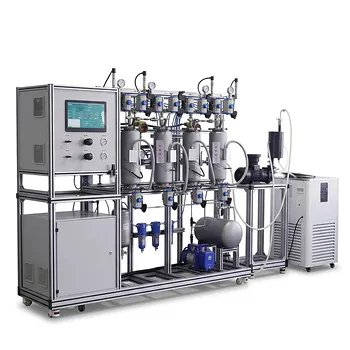
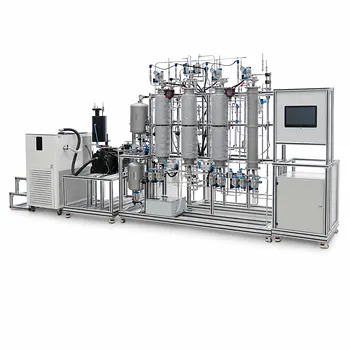
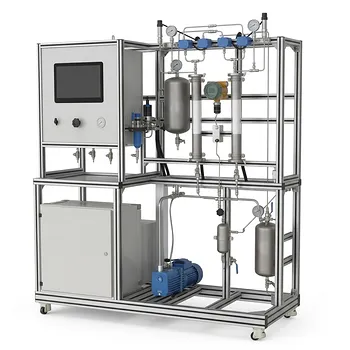
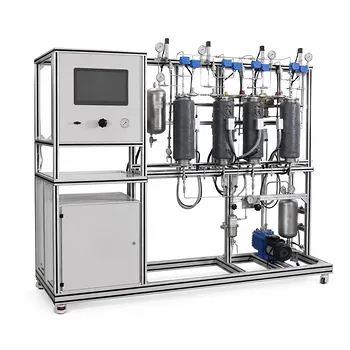
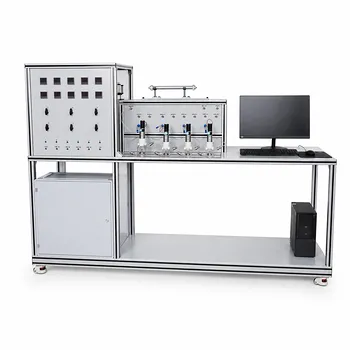
A gas adsorption unit operations pilot plant makes the invisible dynamics of mass transfer visible. By using multi-point concentration sensors arrayed along the bed, students can watch the solute concentration wave advance in real time and precisely identify the breakthrough point ((t_B)) where the outlet purity begins to degrade. Valving configurations then let them toggle between parallel and series guard beds, revealing how a series layout permits complete saturation of a lead bed while a lag bed polishes the effluent. This direct comparison teaches a foundational lesson in process economics: it sharply reduces adsorbent waste relative to a parallel setup, which must be taken offline before full saturation to avoid impurity leakage.
The pilot plant’s power is not just in demonstrating adsorption, but in unmasking the hidden cost of poor bed configuration. Observing the breakthrough curve lets you time regeneration perfectly, and switching from parallel to series operation reveals how lead-lag guarding can maximize adsorbent utilization while slashing operating expenses.
Visualizing the Breakthrough Curve in Real Time
A breakthrough curve is the heartbeat of an adsorption process. The pilot plant transforms this abstract concept into a tangible event that students can measure, perturb, and analyze dynamically.
The Anatomy of a Breakthrough Curve
As an impurity-laden gas enters a clean bed, a mass transfer zone (MTZ) forms. Inside the pilot plant, concentration sensors placed at different bed heights show this zone moving like a wave toward the outlet. The breakthrough point, (t_B), is typically defined when the effluent concentration reaches 5–10% of the inlet value. Before (t_B), the adsorbent is working; after, impurity slippage escalates rapidly.
Linking Sensor Data to the Mass Transfer Zone
The longitudinal spacing of sensors lets students reconstruct the MTZ shape. If the breakthrough curve recorded at the outlet is steep, the MTZ is short and the bed is efficient. A gradual rise signals a long MTZ and poor bed utilization. Students can then alter flow velocity, temperature, or particle size to observe how these factors compress or stretch the zone.
Factors That You Can Manipulate and Measure
The pilot plant enables controlled variation of four key influences on the breakthrough curve:
- Adsorbate-adsorbent properties: Type of gas and solid drive equilibrium capacity.
- Operating conditions: Temperature, pressure, feed concentration, and pH shift the adsorption isotherm.
- Fluid dynamics: Higher flow velocity thickens the MTZ, accelerating breakthrough.
- Mechanical factors: Packing density and particle size affect channeling and pressure drop.
By isolating each variable, students learn to predict bed lifetimes and determine when regeneration should be triggered.
Comparing Guard Bed Configurations: The Cost of Design Choices
Industrial guard beds are often sacrificial layers of adsorbent placed before sensitive downstream units. The pilot plant’s ability to rapidly switch between parallel and series configurations exposes the profound economic impact of a seemingly simple piping choice.
The Inefficiency of Parallel Guard Beds
In a parallel setup, two beds share the feed, but only one is online at a time. To prevent any impurity breakthrough, the bed must be taken offline before it is fully saturated — typically when the MTZ front just reaches the bed’s exit. This waste-safety trade-off means up to 20–40% of the bed’s static capacity may be discarded, elevating both adsorbent replacement and disposal costs.
The Lead-Lag Advantage of Series Operation
Series configuration routes the full gas stream through a lead bed and then through a lag bed. The lead bed can be run until it is completely saturated, because any impurity that slips through is captured by the lag bed. Once the lead bed’s MTZ has fully exited and the lag bed’s inlet concentration rises, valving swaps the roles. Students see that this lead-lag strategy nearly doubles adsorbent utilization compared to parallel guarding.
Simulating Regeneration Cycles in a Pilot Plant
With two vessels, students can also model a dual-vessel swing process. While one bed adsorbs, the other undergoes thermal or pressure swing regeneration. In a series layout, they observe how a saturated lead bed can be isolated, regenerated, and then placed back in the lag position, mimicking a continuous, cost-optimized industrial cycle.
Understanding the Trade-offs and When to Use Each Layout
Selecting between parallel and series guarding is not a matter of dogma; it depends heavily on the nature of the breakthrough curve and process constraints.
Steep Curves Favor Swing Operations
Systems with rapid adsorption kinetics and very short mass transfer zones (steep breakthrough curves) often work well in a dual-vessel swing arrangement — essentially a sequential parallel system. Because the bed breaks through abruptly, running to full saturation in a series arrangement offers little extra advantage and may complicate cycle timing.
Long, Flat Curves Demand Series Layouts
When the mass transfer zone is long — typical for many physical adsorbents with weak affinities — the breakthrough curve is shallow. A parallel bed would have to be pulled offline incredibly early to avoid slippage, wasting enormous amounts of capacity. Here, series operation is economically indispensable.
Pressure Drop and Flow Distribution Pitfalls
Students must also measure pressure drop across the beds. Series operation puts two beds in the flow path, doubling the system resistance. If the feed rate is high, this can exceed blower capacity or cause maldistribution. Parallel operation handles higher total flow rates within single-vessel design limits, which is why it is common when throughput, not adsorbent utilization, is the bottleneck.
Making the Right Choice for Your Laboratory or Plant
The decision to emphasize one configuration over another depends on your educational or research objectives. A pilot plant that offers reconfigurable valving and multi-point sensing can address all of these goals with minimal hardware changes.
- If your primary focus is teaching adsorption fundamentals: Use the multi-point sensors to construct breakthrough curves under varying flow rates, temperatures, and bed lengths. Let students see the MTZ directly and calculate its length from the curve shape.
- If your primary focus is process economics and waste reduction: Set up a side-by-side experiment: first run a parallel guard bed until the target breakthrough threshold, then switch to a lead-lag series configuration with the same feed. Calculate the grams of adsorbent waste avoided per cycle — the difference is stark and memorable.
- If your primary focus is scaling up to industrial design: Challenge students to measure the bed’s pressure drop in series vs. parallel, then determine the optimal configuration for a given feed rate, MTZ length, and allowed blower power. This requires integrating mass transfer theory with basic mechanical design, exactly as is done in full-scale front-end engineering.
A properly instrumented pilot plant demystifies what happens inside a packed bed and empowers students to size, configure, and operate adsorbers with confidence, turning the adsorption breakthrough curve into a tool for profit, not just a laboratory curiosity.
Summary Table:
| Feature / Layout | Parallel Configuration | Series (Lead-Lag) Configuration |
|---|---|---|
| Flow Path | Feed shared or split; only one bed online at a time | Feed routes through lead bed, then lag bed |
| Adsorbent Utilization | Lower (20-40% discarded to prevent leakage) | Higher (lead bed runs to 100% saturation) |
| Pressure Drop | Normal / Lower system resistance | Double (flow passes through two beds in series) |
| Best Suited For | Steep breakthrough curves / High flow rates | Long, flat breakthrough curves (weak affinity) |
| Key Economic Benefit | Simple design & timing | Drastically reduced adsorbent waste & disposal costs |
Bring Industrial-Scale Mass Transfer Learning to Your Lab with LABPARK
Ready to equip your students or research team with the tools to master adsorption dynamics and process economics?
LABPARK provides state-of-the-art Educational and Vocational Unit Operations Pilot Plants in chemical engineering, bioprocess & biotech, and environmental & water treatment. Designed specifically for universities, research institutes, and enterprises, our modular plants make complex thermodynamic and fluid dynamics principles tangible and measurable.
Contact LABPARK today to discover how our customizable pilot plants can elevate your engineering curriculum and research capabilities!
Related Products
- Gas-Solid Heterogeneous Separation Demonstration Educational Unit Operations Pilot Plant
- Multi-Component Gas Pressure Swing Adsorption Pilot Plant for Unit Operations Education
- Bench Scale Dual Column Gas Separation and Capture Educational Pilot Plant
- Educational Pressure Swing Adsorption Ethylene Capture Unit Operations Pilot Plant
- Pressure Swing Adsorption Educational Unit Operations Pilot Plant
People Also Ask
- Why is pressure drop characterization critical in separation pilot plants? Key operational insights.
- What are the key thermodynamic considerations for gas mixture modeling? Expert Guide
- What are the primary operational objectives and physical requirements when running heterogeneous separation pilot plants?
- What are the trade-offs in olefin-paraffin separation? Optimize Pilot Plant Performance
- What are the material limitations of gas separation pilot plants? Key factors to consider.