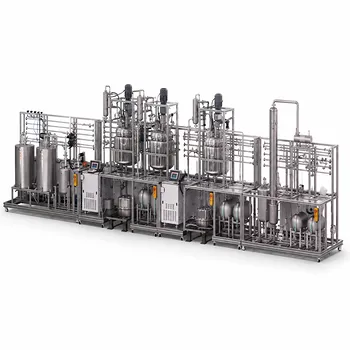
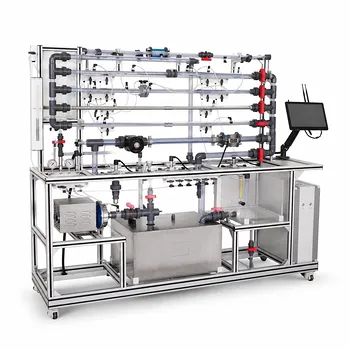
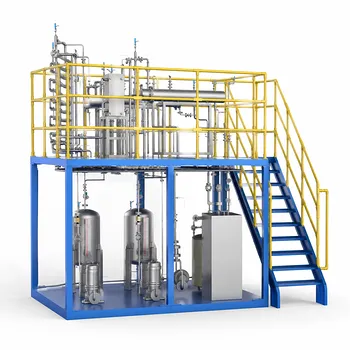
The most direct way to demonstrate and optimize the filtration of insoluble salt by-products in a chemical engineering pilot plant is by using modular solid-liquid separation units—such as plate-and-frame filters or rotary vacuum filters—to analyze filtration kinetics, cake wash efficiency, and cycle times at a realistic intermediate scale.
This hands-on approach bridges the gap between gram-scale laboratory precipitations and the demands of commercial production. It reveals how cake formation, washing behavior, and throughput change under scaled-up conditions, enabling engineers to maximize recovery rates and evaluate the chemical economics of by-product utilization before committing to full-scale design.
A pilot plant transforms theoretical separation principles into actionable data by exposing the real-world interplay between crystal morphology, operating conditions, and equipment design—critical knowledge that cannot be gained from bench-scale experiments alone.
The Bridge from Lab Curiosity to Industrial Reality
Chemical reactions that generate insoluble salt by-products often look trivial in a beaker but behave unpredictably at scale. A unit operations pilot plant serves as the critical intermediate step—a semiworks—where mass transfer, heat transfer, and hydrodynamics can be systematically studied.
Why Bench-Scale Filtration Fails to Predict Large-Scale Performance
Laboratory filtrations (a few grams through a Büchner funnel) rarely encounter issues like cake compressibility, channeling, or cloth blinding to the same degree. A pilot plant, handling kilograms per hour, exposes these non-idealities, making it indispensable for scale-up.
Closing the Gap with Controlled Intermediate Scale
Researchers can operate exactly the same chemistry but at a throughput that reveals time-dependent fouling, sustained pressure drops, and washing inefficiencies. This controlled environment delivers the hard data needed to design full-scale filter presses or rotary drum filters with confidence.
Demonstrating Filtration: What the Pilot Plant Reveals
A well-instrumented pilot plant turns the empirical act of filtration into a quantitative engineering discipline. The modular nature of these units allows the isolation and study of each critical sub-step.
Filtration Kinetics: More Than Just a Flow Rate
By recording filtrate volume over time at constant pressure (or pressure rise at constant rate), students can determine specific cake resistance and filter medium resistance. This directly informs the required filtration area for a given production target.
Cake Wash Efficiency: Maximizing Purity, Minimizing Loss
After the initial filtration, the retained solid cake still holds valuable mother liquor. A pilot plant enables washing experiments where wash ratio, displacement, and dilution can be measured separately. Optimizing wash protocols at this scale recovers trapped product and reduces waste, directly improving economics.
Cycle Times and Throughput
The entire sequence—filling, filtration, washing, dewatering, and discharge—defines the equipment’s throughput. Pilot testing at different cake thicknesses and solids loadings provides the real-world cycle time data needed to select between a batch filter press or a continuous rotary vacuum filter.
Optimizing Separation: Variables You Can Control
A pilot plant is not just a large-scale demonstration; it is a research platform where process parameters can be deliberately manipulated to understand their impact on solid-liquid separation.
Solid-to-Liquid Ratio and Slurry Concentration
Feeding a denser slurry to the filter yields a thicker cake faster, but often at the cost of a higher pressure drop. The pilot plant lets you map the full relationship between feed concentration and filtration time.
The Critical Role of Crystal Morphology
In processes like the wet production of phosphoric acid, the filterability of by-product calcium sulfate depends heavily on its crystal habit. Dihydrate gypsum (CaSO₄·2H₂O) forms large, well-defined crystals that filter and wash much faster than the fine, needle-like hemihydrate form. A pilot plant can be operated at controlled temperatures (e.g., 80–85 °C) and sulfate levels to purposefully grow the most filterable crystal phase, dramatically cutting filtration time.
Reaction and Crystallization Temperature
Temperature does double duty: it influences reaction kinetics and the solubility/supersaturation driving force for crystallization. Running the pilot crystallizer at an elevated, tightly controlled temperature can promote crystal growth over nucleation, yielding a coarser, more permeable cake.
Selecting and Configuring the Filtration Equipment
The choice of filtration hardware is never one-size-fits-all. A modular pilot plant allows side-by-side evaluation of different technologies for the same salt slurry.
Plate-and-Frame Filters for Deep, Washing-Intensive Cakes
When the solid is compressible or the product must be washed to extreme purity, a plate-and-frame press is often the benchmark. Pilot testing determines the optimal number of plates, wash plate placement, and pressure profile.
Rotary Vacuum Filters for High-Throughput, Continuous Operation
For insoluble salts that precipitate continuously in a stirred reactor, feeding the slurry directly to a rotary vacuum drum filter eliminates large hold-up tanks. The pilot unit quantifies drum speed, submergence depth, and knife-advance rate needed to achieve steady-state throughput without cloth blinding.
Preventing Reactor Blockage in Three-Phase Systems
If the insoluble salt forms inside a reactor (gas-liquid-solid), choosing a slurry reactor configuration and coupling it to a continuous filter becomes vital. This prevents the solid from settling and clogging a fixed bed, as demonstrated in pilot-scale hydrocracking units where catalyst fouling is managed by fluidized-bed or moving-bed designs.
Understanding the Trade-offs
Every optimization in salt filtration involves a compromise. Pilot plant data makes these trade-offs explicit.
Wash Efficiency vs. Dilution Cost
Aggressive washing with high water ratios can recover nearly all soluble product but creates a dilute wash stream that may be expensive to handle downstream. The pilot plant quantifies the exact recovery-vs-dilution curve, allowing an economic optimum to be chosen.
Cake Thickness vs. Cycle Time
Thicker cakes increase capacity per cycle but slow filtration and can leave the center poorly washed. Running multiple cycles at different thicknesses reveals the sweet spot where throughput per hour is maximized.
Equipment Complexity and Energy Cost
A rotary vacuum filter operates continuously and is easy to automate, but consumes vacuum pump energy continuously. A plate-and-frame filter is simpler mechanically but demands more frequent manual intervention. Pilot data turns these qualitative preferences into calculable operating costs.
How to Apply This to Your Project
A pilot plant’s value is realized when its operation is tied to a clear goal. Below are recommended focuses depending on your primary objective.
- If your primary focus is education: Use transparent, modular filtration units to let students see cake formation, measure filtrate volumes, and correlate the resulting data with Darcy’s law in real time.
- If your primary focus is process scale-up: Run extended campaigns to collect filter medium resistance and cake compressibility data, then use classical filtration equations to size the full-scale equipment.
- If your primary focus is economic assessment: Operate the pilot plant in complete, close-material balance cycles to determine precisely how much product is lost to the cake and how much solvent/energy is consumed in washing.
- If your primary focus is handling difficult solids: Leverage the ability to swap filter cloths, test pre-coat agents, or change the precipitation step upstream in an integrated pilot line to improve crystal habit before filtration.
A pilot plant gives you the freedom to fail small and cheaply, so that your full-scale installation succeeds on the first attempt.
Summary Table:
| Parameter | Impact on Filtration | Pilot Plant Optimization Role |
|---|---|---|
| Crystal Morphology | Affects cake permeability & wash speed | Controls crystallization temperature to grow large crystals |
| Filtration Kinetics | Determines required filtration area | Records pressure drop & volume to calculate resistance |
| Wash Efficiency | Balances product purity & dilution costs | Evaluates wash ratios to maximize recovery & minimize waste |
| Equipment Setup | Dictates cycle times & continuous throughput | Evaluates plate-and-frame vs. rotary vacuum units |
Scale Up Your Separation Processes with LABPARK
Are you looking to bridge the gap between laboratory research and industrial production? LABPARK provides premium Educational and Vocational Unit Operations Pilot Plants in chemical engineering, bioprocess & biotech, and environmental & water treatment. Designed for universities, research institutes, and enterprises, our modular pilot systems empower you to optimize filtration kinetics, analyze cake wash efficiency, and master solid-liquid separation.
Maximize your process efficiency and train future innovators—contact LABPARK today to request a quote!
Related Products
- Natural Product Extraction Unit Operations Training Pilot Plant
- Fixed-Bed Chemical Reaction and Gas Dust Tar Removal Unit Operations Pilot Plant
- Ethyl Acetate Synthesis Unit Operations Pilot Plant for Practical Training
- Methanol Synthesis and Catalyst Performance Evaluation Educational Unit Operations Pilot Plant
- Electrolytic Hydrogen Production Educational Unit Operations Pilot Plant
People Also Ask
- How to Demo Solubility Sensitivity in SFE Pilot Plants? Practical Thermodynamics
- How do pilot plants differentiate physical vs chemical extraction? Enhance Chemical Engineering Training
- How are HTU and NTU applied to determine extraction column height? Guide to Pilot Plant Scaling
- How can Hotelling's T² & Q statistics detect pilot plant abnormalities? Optimize Safety
- What are the limitations of acentric factor models? Avoid pilot plant errors with polar fluids.