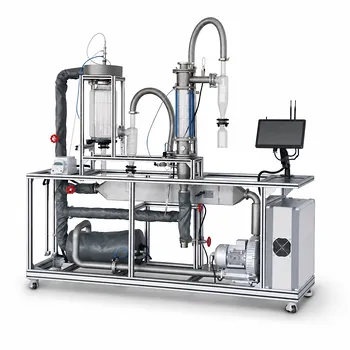
Design conditions are not a bureaucratic checkbox—they are the physics that stand between a safe, correctly budgeted pilot plant and a catastrophic miscalculation. When you use operating pressure and temperature to evaluate wall thickness, you ignore the worst-case stresses the vessel will actually face: process upsets, thermal material weakening, hydrostatic head, wind loads, and the self-weight of tall columns. The result is a drastic underestimation of required wall thickness, creating severe safety hazards and throwing fabrication cost estimates off by a factor of two or more.
Using operating conditions instead of design limits is a dangerous shortcut. For tall distillation columns and reactors, wall thickness is rarely governed by normal running pressure alone—it’s the combination of maximum possible pressure, temperature-degraded material strength, structural self-weight, and wind bending moments that dictates the real number. This mistake simultaneously creates a safety risk and derails project budgets.
Why Design Conditions Are Non-Negotiable for Vessel Integrity
The Critical Difference Between Operating and Design Parameters
Operating conditions describe the process’s steady-state target—the pressure and temperature you expect during normal runs. Design conditions are the maximum safe limits the vessel must withstand, including safety margins. Codes like ASME Section VIII and API RP 520 explicitly require that pressure vessel design be based on these maximums, because the vessel must survive startup, shutdown, transient excursions, and relief valve activation without failing.
The Hidden Structural Loads in Tall Vertical Equipment
A distillation column or reactor standing 15 meters tall experiences forces that have nothing to do with internal operating pressure. Wind bending moments and the dead weight of the column with its internals and liquid holdup can impose stresses that surpass the stress from internal pressure, especially at low operating pressures (below 5 bar). In these cases, the wall thickness needed to prevent buckling or bending is far greater than what a simple pressure calculation would suggest. Using only operating pressure would yield a dangerously thin wall.
When Low Pressure Disguises a Thick Wall
This is the trap engineers often fall into—assuming low-pressure equals thin-walled. For a pilot column operating at 2 bar but subject to high wind loads and significant liquid head at the bottom, the structural demands can dictate a thickness several times larger than the pressure-alone calculation. Ignoring this leads to a vessel that cannot support its own weight under storm conditions.
Temperature’s Invisible Effect on Material Strength
Steel loses strength as temperature rises. At 500°C, low-carbon steel’s tensile strength can drop from 450 MPa to 210 MPa—a loss of over 50%. The allowable stress used in wall thickness formulas is tied to the material’s strength at the design temperature, not the operating temperature. If you plug in operating temperature, you will use a higher allowable stress than permitted, underestimating the thickness needed to safely contain the pressure at the real worst-case temperature.
Creep: The Silent Deformation at High Temperatures
Under continuous load at elevated temperatures, metals undergo slow, permanent deformation known as creep. Reactor furnace tubes and high-temperature zones require creep-resistant alloys like Inconel 600 to avoid gradual thinning and rupture. This design consideration is entirely missed if you base your analysis only on operating parameters, because creep life calculations depend on the maximum sustained temperature and stress, not the average running condition.
The Domino Effect on Safety Systems and Cost Estimation
Wall thickness errors cascade. The pressure relief system is sized based on the vessel’s design pressure; underestimating it results in relief valves that cannot protect the column. Costing models use pressure factors ($F_p$) and material factors ($F_m$) that jump dramatically with design pressure and alloy selection. For example, $F_p$ might be 1.0 at 50 psig but 4.2 at 1000 psig, while upgrading from carbon steel to solid Monel multiplies the material factor by nearly 10. Using operating pressure instead of design pressure would show a fraction of the real fabrication cost, leading to a budget shortfall that can kill a pilot plant project.
Common Pitfalls to Avoid When Specifying Conditions
Forgetting the Hydrostatic Head
In tall columns, the liquid at the bottom exerts an additional hydrostatic pressure. The design pressure must include this head added to the maximum operating pressure. Leaving it out—common when someone uses the overhead operating pressure—creates an under-designed bottom section and a false sense of cost.
Ignoring the Minimum Design Metal Temperature (MDMT)
High-temperature focus often overshadows the low end. At cold start-up or during auto-refrigeration from a process upset, the vessel’s metal temperature can drop below the ductile-to-brittle transition point. The vessel must have adequate toughness at the MDMT to prevent brittle fracture. If design temperature only accounts for heat, you’ve missed half the safety equation.
Crossing Code Division Thresholds Without Noticing
ASME Section VIII Division 1 becomes uneconomical above about 200 bar because the formula forces excessive wall thickness. Division 2 permits higher allowable stresses through more rigorous analysis, reducing thickness—but it comes with stricter material and testing requirements. Using an operating pressure of 180 bar but having a design pressure of 210 bar pushes you across that threshold. Failing to recognize this means you’ll either underestimate wall thickness (if you stay in Division 1) or misapply the code entirely.
Making the Right Choice for Your Pilot Plant’s Vessel Design
To evaluate wall thickness and cost accurately, always base your calculations on the maximum design pressure and temperature, incorporating structural loads, material degradation, and code requirements. Here’s how to focus your effort depending on your goal:
- If your primary focus is safety and code compliance: Add a 5–10% margin to the maximum operating pressure, include hydrostatic head, and use allowable stress values at the true maximum design temperature—never the operating point.
- If your primary focus is accurate budget forecasting: Calculate the pressure factor ($F_p$) using design pressure, not operating pressure, and select the material factor ($F_m$) based on the required alloy for the design temperature and corrosion environment.
- If your primary focus is tall gravity-fed columns: Perform a structural analysis for dead weight, wind, and seismic loads. For low-pressure columns, this will likely dictate the wall thickness entirely.
- If your primary focus is high-temperature reactors: Design for creep rupture life using the maximum expected metal temperature, and specify advanced alloys early to avoid a cost shock later.
Design conditions are the only language the vessel’s steel understands. Speak that language from the start, and you’ll deliver a pilot plant that is both safe and financially sound.
Summary Table:
| Factor | Operating Conditions | Design Conditions | Impact on Vessel Wall & Cost |
|---|---|---|---|
| Pressure & Temp | Normal steady-state run | Maximum limit + safety margin | Higher design limits require thicker walls and drive up material/fabrication costs. |
| Structural Loads | Often ignored in simple calcs | Includes wind, seismic, dead weight | Tall columns (e.g., distillation) require extra thickness to prevent buckling. |
| Material Strength | Assumes normal temperature | Accounts for high-temp degradation | Lower allowable stress at peak temperatures dictates thicker walls or costly alloys. |
Build Safe, Compliant, and Cost-Effective Pilot Plants
Designing high-pressure unit operations requires absolute precision to ensure safety and stay within budget. LABPARK provides state-of-the-art Educational and Vocational Unit Operations Pilot Plants in chemical engineering, bioprocess & biotech, and environmental & water treatment tailored for universities, research institutes, and enterprises.
Don't risk safety hazards or budget overruns due to inaccurate design specifications. Let our engineering experts guide you.
👉 Contact LABPARK today to discuss your pilot plant requirements
Related Products
- Carbon Dioxide Hydrogen Methanol Synthesis Educational Unit Operations Pilot Plant
- Methanol Synthesis and Catalyst Performance Evaluation Educational Unit Operations Pilot Plant
- Constant Pressure Filtration Educational Unit Operations Pilot Plant
- Multi Pump Fluid Transport Process Piping Unit Operations Training Pilot Plant
- Pressure Swing Adsorption Educational Unit Operations Pilot Plant
People Also Ask
- How do temp & pressure affect methanol synthesis pilot plants? Optimize equilibrium and catalyst performance.
- Why is a purge system necessary when operating a gas recirculation loop in a methanol synthesis pilot plant? (Guide)
- Why do modern methanol pilot plants operate at lower pressures? Catalyst & Feed Requirements Explained
- What are the operational requirements for catalyst activation? Safe Methanol Pilot Plant Operation
- Why is the chemical plant startup schedule crucial? De-risk scale-up with pilot plants.