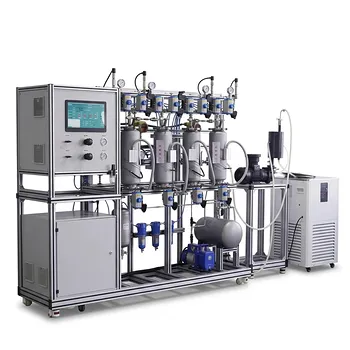
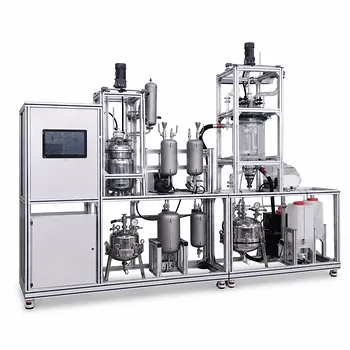
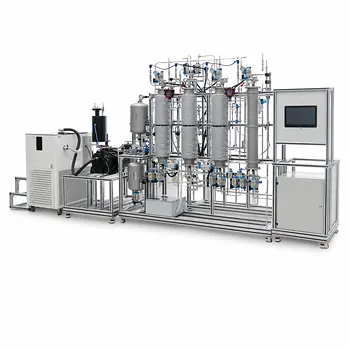
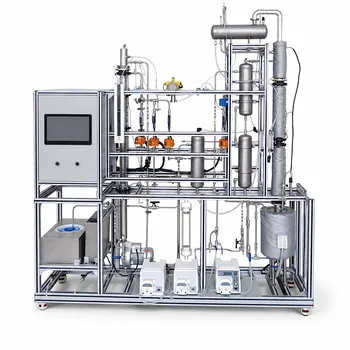
The cornerstone of gas-solid separation equipment selection in an educational pilot plant lies in mapping the target dust particle size to the system’s allowable pressure drop. Instructors should use gravity settling chambers for coarse, >50 μm particles where pressure drop must be negligible (≈5 mm H₂O). For mid-range particles (5–10 μm) that require a compact teaching tool, cyclones offer a moderate pressure drop (10–150 mm H₂O). When the experiment calls for capturing fine particles down to 0.2–0.5 μm at the highest demonstration efficiency, wet scrubbers and fabric filters become essential, but they demand a significantly higher energy cost (50–750 mm H₂O) and ancillary systems.
Choosing the right gas-solid separator for a student pilot plant is a deliberate pedagogical decision that exposes the fundamental engineering trade-off: the finer the particle you want to capture, the higher the pressure drop (energy cost) you must accept. Instructors can turn this selection process itself into a core learning objective, allowing students to visualize and measure how centrifugal, inertial, and filtration forces compete with system resistance.
Understanding the Particle Size–Pressure Drop Spectrum
Every gas-solid separation device occupies a specific region on a particle size versus energy consumption curve. For an educational setting, mapping out this spectrum is more valuable than simply picking a single “best” device.
The Role of Particle Size in Separation Mechanism
The physical principle that separates a particle from a gas stream is directly tied to its diameter. Coarse particles (>50 μm) have enough mass to settle under gravity alone, requiring almost no energy input. Mid-range particles (5–20 μm) need centrifugal or inertial forces to be thrown out of the airstream. Fine particles (<5 μm) primarily follow the gas streamlines and must be intercepted by a liquid droplet, a filter fiber, or an electrostatic charge—all techniques that inherently demand higher pressure drop to overcome the drag forces.
Why Pressure Drop is the Critical Design Constraint
In a pilot plant, pressure drop isn't just a number on a datasheet; it represents the blower power required and directly impacts the operating cost. A Venturi scrubber with a 500 mm H₂O pressure drop can consume an order of magnitude more fan energy than a simple cyclone. For an educational lab, this becomes a teachable moment: students can measure the pressure differential and calculate the energy penalty of achieving 99% efficiency versus 90% efficiency, linking fluid mechanics directly to economic and environmental considerations.
Equipment Options in an Educational Context
With the spectrum defined, each piece of equipment serves a specific didactic purpose. The primary reference provides a clear, comparative framework that instructors can use as a decision matrix.
Gravity Settling Chambers: The Low-Energy Baseline
Gravity settlers are invaluable for teaching the most fundamental separation principle—Stokes’ settling—without any mechanical complexity.
- Target: Pre-separation of coarse dust (>50 μm).
- Pressure Drop: Extremely low, approximately 5 mm H₂O (≈50 Pa), making it the baseline for minimal energy consumption.
- Educational Value: Its large footprint and low efficiency (often only 50–60%) are not flaws but features; they create a stark contrast with other devices, allowing students to physically see how a simple force balance dictates design.
Cyclone Separators: The Core Teaching Tool
The cyclone is often the centerpiece of a gas-solid separation pilot plant. It demonstrates the centrifugal separation principle in a compact, easily visualized package.
- Target: Mid-range particles, with a practical cut point between 5 and 10 μm for modern high-efficiency designs.
- Pressure Drop: A wide operating range, typically 10–150 mm H₂O (≈100–1,500 Pa). This range is perfect for experiments because students can vary the inlet velocity and observe the direct trade-off: higher flow rates increase efficiency and pressure drop.
- Educational Value: The cyclone’s lack of moving parts and robust design make it ideal for hands-on disassembly, velocity profile measurement, and grade efficiency curve analysis—core concepts in any unit operations course.
Fabric/Bag Filters: Surface Filtration for Ultra-Fine Particles
When the educational goal extends to the most demanding air pollution control standards, a fabric filter module is required.
- Target: Ultra-fine dust down to 0.2 μm.
- Pressure Drop: Moderate and stable once the filter cake forms, typically in the 50–150 mm H₂O range, but the need for periodic cleaning (pulse-jet or shaking) adds a dynamic system behavior.
- Educational Value: This unit operation introduces non-stationary processes. Students can study how pressure drop increases over a filtration cycle, the importance of cake release, and the concept of residual pressure drop—principles that directly translate to industrial baghouse operation.
Wet Scrubbers (Venturi): Intensive Contact at a High Cost
A Venturi scrubber provides the most dramatic demonstration of high-efficiency fine particle capture, but it comes with the highest energy and infrastructure demand.
- Target: Fine particles down to 0.5 μm, achieving near-total capture.
- Pressure Drop: Very significant, ranging from 250 to over 750 mm H₂O (≈2,500–7,500 Pa), which requires a separate liquid pumping system and mist elimination stage.
- Educational Value: It forces students to evaluate a complete system, including gas-liquid contact, pumping costs, and wastewater treatment. The high pressure drop is a direct, measurable link between separation quality and operational expense, making it ideal for a techno-economic analysis project.
Understanding the Trade-offs and Avoiding Common Pitfalls
Selecting equipment based solely on a single datasheet value can undermine the educational objective. A robust lesson plan acknowledges the full set of compromises.
The Efficiency-Energy Paradox
There is no “efficiency without cost.” A cyclone may reach 95% efficiency at 150 mm H₂O, but if that pressure drop is unsustainable for the lab’s blower, the experiment fails. Similarly, a Venturi scrubber’s 99% efficiency on sub-micron dust can be academically appealing, but if the facility does not have a reliable water supply and drain, the complexity will overwhelm the core learning goal. Always match the equipment’s auxiliary demands to the plant’s infrastructure.
The Pitfall of Stated Cut Sizes
Manufacturer claims of a 5 μm cut point for a cyclone can be misleading if the actual feed contains a broad particle size distribution. Fines may escape, and the measured efficiency will disappoint. In an educational setting, this is a blessing in disguise: it forces students to perform a particle size analysis and construct a grade efficiency curve, discovering firsthand that separation is never a perfect “cut.” The primary reference’s 5–10 μm range is achievable, but only at a specific pressure drop and gas flow rate, which must be controlled and measured by the students.
Overlooking the Teaching Narrative
The biggest error an instructor can make is choosing the device that is simply the most efficient without considering the story it tells. A gravity settler is “inefficient,” but without it, students cannot understand why one needs a cyclone. A cyclone is “imperfect” for sub-micron dust, but without it, the leap to a scrubber seems arbitrary. Build a sequence of equipment that reveals the logical progression of process intensification.
Making the Right Choice for Your Educational Goal
Select the equipment that best reinforces the specific learning outcome of your module. Here is a goal-oriented guide to applying the particle size and pressure drop constraints.
- If your primary focus is demonstrating the fundamental relationship between particle size and terminal velocity: Start with a gravity settling chamber. Its negligible pressure drop and visible size-based stratification make the theory tangible, even at low efficiency.
- If your primary focus is exploring centrifugal force and the basic industrial workhorse of dust collection: Choose a cyclone separator. Its moderate pressure drop allows students to manipulate flow rate and directly plot the efficiency-pressure drop trade-off curve.
- If your primary focus is achieving the highest collection efficiency for sub-micron particles as a capstone design project: Integrate a fabric filter module. It demonstrates cake filtration dynamics and maintains a respectable pressure drop over its cycle, bridging classic separation with modern industrial hygiene.
- If your primary focus is teaching total process costing and the reality of energy-intensive pollution control: Implement a Venturi scrubber. Its extremely high pressure drop and liquid handling requirements force a holistic discussion of operating expenses versus environmental standards.
By aligning the equipment selection with the exact physical principle you intend to illuminate, you transform the pilot plant from a collection of hardware into a coherent, hands-on textbook that students can operate, measure, and genuinely understand.
Summary Table:
| Equipment Type | Target Particle Size | Pressure Drop (mm H₂O) | Core Educational Focus |
|---|---|---|---|
| Gravity Settler | Coarse (>50 μm) | Negligible (≈5) | Stokes' law settling & low-energy baseline |
| Cyclone Separator | Mid-range (5–10 μm) | Moderate (10–150) | Centrifugal forces & efficiency curves |
| Fabric Filter | Fine (down to 0.2 μm) | Moderate (50–150) | Cake filtration & non-stationary processes |
| Wet Scrubber | Ultra-fine (down to 0.5 μm) | High (250–750+) | Gas-liquid contact & energy consumption trade-offs |
Enhance Your Engineering Curriculum with LABPARK
Are you looking to upgrade your laboratory with hands-on learning systems? LABPARK provides state-of-the-art Educational and Vocational Unit Operations Pilot Plants in chemical engineering, bioprocess & biotech, and environmental & water treatment.
Designed specifically for universities, research institutes, and enterprises, our pilot plants empower students and researchers to visualize complex chemical principles, measure real-world pressure drops, and master industrial unit operations.
Ready to design the perfect pilot plant for your institution? Contact LABPARK today to discuss your custom specifications with our engineering experts.
Related Products
- Gas-Solid Heterogeneous Separation Demonstration Educational Unit Operations Pilot Plant
- Pressure Swing Adsorption Educational Unit Operations Pilot Plant
- Fixed Bed Gas Solid Catalytic Reaction Educational Pilot Plant
- Micro-Scale Gas-Solid Catalytic Reaction Educational Pilot Plant
- Fixed-Bed Chemical Reaction and Gas Dust Tar Removal Unit Operations Pilot Plant
People Also Ask
- Why is pressure drop characterization critical in separation pilot plants? Key operational insights.
- How do separation pilot plants compare distillation vs alternatives? Optimize process selection
- What separation subsystems should be analyzed when configuring separation units for chemical and bioprocess pilot plants? Key Design Factors
- Why Do Flash Calculations Fail for Light-Gas Mixtures? Prevent Pilot Plant Simulation Errors
- What are the key thermodynamic considerations for gas mixture modeling? Expert Guide