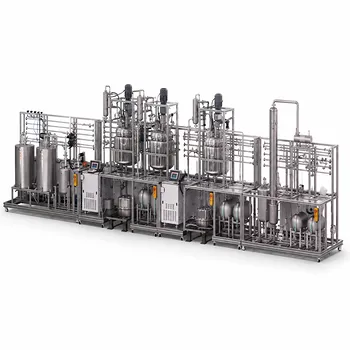
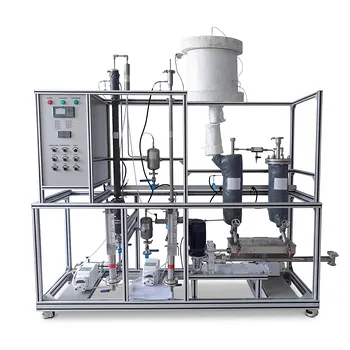
For deep purification to low-ppm levels, a higher-selectivity membrane can actually become the bottleneck. A membrane with slightly lower selectivity allows a small, controlled leak of the retained component into the permeate. This leak relieves the vapor‑pressure buildup on the permeate side and lets the critical impurity be pulled out far more efficiently, enabling retentate purities down to 10 ppm while still recovering nearly all of the purified product.
When your target is ultra‑low impurity levels, a tiny loss of product through a lower‑selectivity membrane breaks a fundamental physical barrier. This “selectivity compromise” makes final polishing practical where a perfectly tight membrane would stall.
The Paradox of Ultra‑Purification
Why Standard High‑Selectivity Membranes Hit a Wall
As the concentration of an impurity in the retentate falls below a few hundred ppm, the driving force for permeation collapses. In pervaporation or gas‑phase polishing, the impurity’s partial pressure on the feed side becomes vanishingly small.
A membrane with extremely high selectivity tries to block every molecule of the retained component. This starves the permeate side of the impurity and creates a tiny partial‑pressure differential. The result is that the separation process effectively stops.
The Real Limitation Is on the Permeate Side
The core obstacle is the vapor phase that builds up on the permeate side. If the membrane is too selective, the impurity that does manage to cross generates a local partial pressure that quickly approaches equilibrium with the feed. Further transport grinds to a halt.
In deep purification, you’re not fighting the bulk concentration—you’re fighting a mass transfer arrest caused by your own efficient rejection.
How Lower Selectivity Solves the Problem
A Controlled Leak Flushes the Permeate
A membrane with slightly lower selectivity intentionally lets a fraction of the retained component pass through.
At ultra‑low impurity levels, the absolute amount of product that leaks is minuscule. However, that leak is enough to dilute the permeate‑side concentration of the impurity and lower its partial vapor pressure. The impurity sees a larger, sustained driving force and keeps migrating out.
Minimizing Product Loss While Achieving 10‑ppm Purity
Because the impurity is already at trace levels, the product loss is so small it does not threaten overall recovery. The pilot plant can pull the retentate down to single‑digit ppm without losing more than a few percent of the purified stream.
The primary reference directly shows that this approach enables final purities of 10 ppm and below, where a membrane with ultra‑high selectivity would leave the system stuck in a ppm plateau.
Understanding the Trade‑offs
Recovery vs. Ultimate Purity
The membrane that gets you to 10 ppm inevitably sacrifices a tiny amount of product. For most chemical engineering pilot plants, losing 0.1–1% of the retentate is an acceptable price for hitting a purity target that was previously unreachable.
This is a deliberate choice: recovery declines in absolute terms, but impurity removal accelerates dramatically.
The Footprint and Energy Cost of Absolute Selectivity
If you insist on the highest‑selectivity membrane for deep polishing, you would need huge membrane area to compensate for the collapsed driving force. That inflated surface area can make the pilot plant uneconomical and mask the real process dynamics.
A moderately selective membrane often reduces both the required area and the compressor or vacuum pump load, because the mass transfer resistances drop and the system operates in a more favorable thermodynamic regime.
Solvent Stability and Selectivity Durability
In solvent‑laden streams, membrane stability is non‑negotiable. Advanced polymers like crosslinked polyimides or polybenzimidazoles maintain their molecular weight cut‑off even in harsh organic environments. A lower‑selectivity membrane that stays structurally sound over months of pilot‑plant runs is far more useful than a theoretically perfect film that degrades after hours.
The separation factor (α), defined as α = (y_A/y_B) / (x_A/x_B), still tells you the relative enrichment. But when targeting low ppm in the retentate, α is no longer the sole KPI—the ability to sustain a flux under near‑zero impurity partial pressures matters just as much.
Making the Right Choice for Your Pilot‑Plant Goal
The “best” membrane selectivity depends entirely on what your pilot plant is designed to demonstrate.
- If your primary focus is maximum recovery of the purified stream: Use the highest selectivity that still gives acceptable flux. Accept that the retentate impurity may plateau at a slightly higher ppm level.
- If your primary focus is demonstrating single‑digit ppm purification in the retentate: Evaluate a membrane with moderately lower selectivity and monitor the permeate loss. Often, a controlled leak makes the difference between hitting 10 ppm and getting stuck at 100 ppm.
- If your primary focus is studying process scale‑up and energy consumption: Map the selectivity–flux–purity curve for your solvent system. Lower selectivity can sharply reduce the required membrane area and compression power, making the economics of the pilot plant far more realistic.
Choose the membrane that solves the deepest constraint in your process, not the one with the highest number on its data sheet.
Summary Table:
| Feature / Parameter | High-Selectivity Membrane | Moderate/Lower-Selectivity Membrane |
|---|---|---|
| Target Impurity Level | Plateaus at higher ppm (e.g., >100 ppm) | Achieves deep purification (<10 ppm) |
| Permeate Driving Force | Collapses quickly due to low partial pressure | Sustained via controlled product leak/dilution |
| Required Membrane Area | Extremely large (uneconomical footprint) | Optimized (reduces area & compressor load) |
| Product Recovery Rate | Near 100% (but impure retentate) | Minor sacrifice (0.1–1% product leak) |
Optimize Your Process with LABPARK Pilot Plants
Are you looking to demonstrate advanced separation dynamics or train the next generation of engineers? LABPARK provides premium Educational and Vocational Unit Operations Pilot Plants in chemical engineering, bioprocess & biotech, and environmental & water treatment for universities, research institutes, and enterprises.
Whether you need to model deep membrane purification or study energy-efficient solvent recovery, our robust systems deliver reliable, real-world data. Contact LABPARK today to discuss your project requirements and get a customized solution!
Related Products
- Fixed Bed Gas Solid Catalytic Reaction Educational Pilot Plant
- Multi Pump Fluid Transport Process Piping Unit Operations Training Pilot Plant
- Carbon Dioxide Hydrogen Methanol Synthesis Educational Unit Operations Pilot Plant
- Ethyl Acetate Synthesis Unit Operations Pilot Plant for Practical Training
- Natural Product Extraction Unit Operations Training Pilot Plant
People Also Ask
- How do reactor pilot plants safely study gas-solid reactions? Master kinetics with thermal & flow control.
- How does the Mears criterion evaluate transport resistance? Key Guide to Intrinsic Kinetics
- Fluidized vs. Fixed Bed Reactors: Comparing Heat & Complexity in Pilot Plants
- Why is a multibed configuration necessary for exothermic reactions? Optimize your pilot plant trajectory.
- What are the differences between pseudohomogeneous and heterogeneous models in pilot plants?