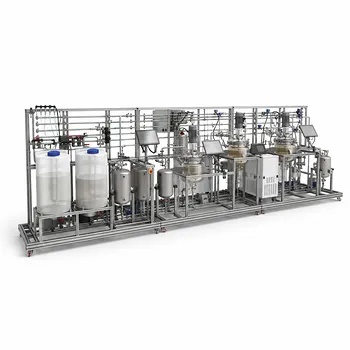
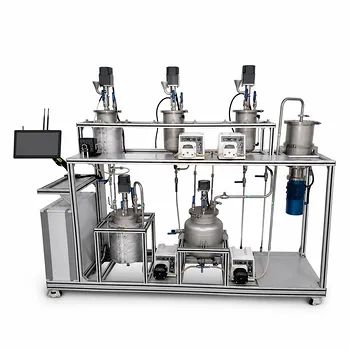
The single most important lesson a pilot plant teaches about catalysts isn’t about equilibrium—it’s about speed. While a catalyst never shifts the equilibrium position of a reaction, a unit operations pilot plant gives trainees the direct, hands-on ability to quantify exactly how catalysts accelerate reaction rates, boost reactor throughput, and slash the time needed to reach steady-state. By running side-by-side experiments with and without a catalyst, students move from an abstract rule of thermodynamics to measurable, industrial-scale performance data.
A catalyst leaves the ultimate equilibrium yield untouched, but the pilot plant makes one truth undeniable: practical process economics and throughput are ruled by kinetics, not just thermodynamics. This hands-on platform transforms the “catalyst does not shift equilibrium” mantra into a vivid, quantitative tool for optimizing real unit operations.
Beyond Equilibrium: What the Pilot Plant Actually Reveals
In a textbook, the statement “catalysts do not alter equilibrium” can feel like a limitation. In a pilot plant, trainees discover it is an invitation to focus on what truly drives production—the rate at which you approach that equilibrium.
Turning an Abstract Concept into Measurable Outcomes
A pilot-scale fixed-bed reactor or CSTR lets students collect real-time data on temperature, flow rates, and composition. They quickly see that while thermodynamics dictates the ceiling, the catalyst determines how fast you reach it. This bridges the gap between chemical theory and the operational decisions that govern plant design.
The Three Metrics That Matter Most
Trainees can manipulate and measure three key process variables that are directly influenced by a catalyst’s presence:
- Space‑velocity: With a catalyst, higher throughput can often be achieved without sacrificing conversion, because the reaction proceeds faster per unit volume of reactor.
- Reactor throughput: The total amount of feed processed per hour jumps when a catalyst shortens the residence time required to hit target conversion.
- Time‑to‑steady‑state: Comparative runs reveal that a catalytic system reaches stable outlet composition in a fraction of the time needed by a non‑catalytic system, demonstrating how catalysts dampen the inertia of slow kinetics.
Demonstrating Kinetic Advantages in a Tangible System
The pilot plant’s power lies in making kinetic concepts—not just equilibrium theory—visible, handleable, and optimizable.
Comparative Runs Reveal the Activation Energy Effect
By conducting identical reactions with and without a catalytic bed, students can observe how the catalyst lowers the activation energy barrier. They see that a catalytic reactor achieves the same conversion at a noticeably lower temperature or, at equal temperature, dramatically higher conversion rates—direct evidence that the catalyst provides an alternative, more efficient pathway.
Visualizing Selectivity and By‑Product Control
A pilot plant fed with realistic feedstocks—including impurities—enables trainees to evaluate not just how fast a catalyst works, but how selectively. They collect product samples to measure how catalyst formulation (e.g., silver content, carrier porosity, promoter loadings) suppresses unwanted side reactions. This hands-on experience teaches that in unit operations, a catalyst’s role is as much about steering the reaction to the desired product as it is about speed.
Observing Deactivation and Lifetime Trade‑offs
Over multiple runs, the pilot plant shows that catalytic performance is not static. Trainees can track deactivation rates by monitoring conversion decline, observe regeneration cycles, and link catalyst lifetime directly to operating conditions like temperature and impurity levels. This turns the catalyst into a dynamic operational variable rather than a fixed property.
Understanding the Trade‑offs
Focusing only on the kinetics a catalyst boosts can blind a trainee to equally important operational realities. Pilot plants make these trade‑offs concrete.
Throughput vs. Catalyst Deactivation
Pushing a reactor to high space‑velocities often accelerates deactivation due to coking, sintering, or poisoning. Trainees see that maximizing short‑term throughput may shorten the catalyst’s life, forcing a balanced economic decision.
Selectivity vs. Conversion
A catalyst formulation that maximizes conversion can generate more by‑products, increasing downstream separation costs. Students operating the pilot plant observe this directly by adjusting temperature or feed composition and analyzing the output, learning that the optimal unit operation is not always the one with the highest single‑pass conversion.
Temperature Sensitivity and Runaway Risks
A highly active catalyst lowers the reaction temperature requirement, which can save energy. But it can also make the reactor more sensitive to hot spots or thermal runaway if heat removal is inadequate. The pilot plant’s temperature profiles teach the importance of catalyst‑reactor pairing in a safe, observable environment.
Making the Right Choice for Your Learning or Design Goals
Pilot plants offer a sandbox where each goal leads to a distinct investigation. Use the following guide to align your experiments with what you need to learn about catalytic unit operations.
- If your primary focus is mastering reaction kinetics: Run comparative temperature‑ramp experiments to calculate activation energies and see how catalysts lower the barrier. The pilot plant’s real‑time data turns rate equations into tangible slopes and constants.
- If your primary focus is optimizing reactor throughput: Vary the space‑velocity and measure conversion, time‑to‑steady‑state, and product quality. The catalyst’s impact on production rate becomes an actionable number, not just a qualitative statement.
- If your primary focus is evaluating catalyst formulation: Test different catalysts (varied active metal loading, supports, promoters) under identical conditions. Let the pilot plant quantify selectivity, deactivation, and temperature stability so you can weigh lifetime against activity.
- If your primary focus is bridging to full‑scale economics: Collect energy‑use data at different temperatures and catalyst life extrapolations. The pilot plant provides the mass‑ and energy‑balance proof needed to justify a catalyst choice without relying on lab‑bench optimism.
When a trainee walks away from a unit operations pilot plant, they no longer see a catalyst as a mysterious substance that merely respects equilibrium. They hold a measured, practical grasp of how catalysis governs the speed, selectivity, and stability of the process—and that is the true role of a catalyst in any unit operation.
Summary Table:
| Evaluation Focus | What the Pilot Plant Demonstrates | Key Variables Measured |
|---|---|---|
| Reaction Kinetics | How catalysts lower activation energy pathways | Temperature, conversion rates |
| Reactor Throughput | The impact of space-velocity on production rates | Flow rate, residence time |
| Selectivity Control | How formulation suppresses unwanted side reactions | By-product yields, product purity |
| Deactivation & Life | Practical catalyst decay and regeneration cycles | Conversion decline over time |
Bring Hands-On Kinetics Training to Your Lab
Ready to bridge the gap between chemical theory and process economics? LABPARK provides state-of-the-art Educational and Vocational Unit Operations Pilot Plants in chemical engineering, bioprocess & biotech, and environmental & water treatment. Specifically tailored for universities, research institutes, and enterprises, our systems empower trainees to master catalyst evaluation, kinetics, and process optimization.
Contact LABPARK today to find the perfect pilot plant for your training and research needs!
Related Products
- Natural Product Extraction Unit Operations Training Pilot Plant
- Fixed-Bed Chemical Reaction and Gas Dust Tar Removal Unit Operations Pilot Plant
- Ethyl Acetate Synthesis Unit Operations Pilot Plant for Practical Training
- Methanol Synthesis and Catalyst Performance Evaluation Educational Unit Operations Pilot Plant
- Electrolytic Hydrogen Production Educational Unit Operations Pilot Plant
People Also Ask
- How to Demo Solubility Sensitivity in SFE Pilot Plants? Practical Thermodynamics
- How do pilot plants differentiate physical vs chemical extraction? Enhance Chemical Engineering Training
- How are HTU and NTU applied to determine extraction column height? Guide to Pilot Plant Scaling
- How do fluid transport principles apply to pilot plant configuration? Optimize your unit operations.
- What are the limitations of acentric factor models? Avoid pilot plant errors with polar fluids.