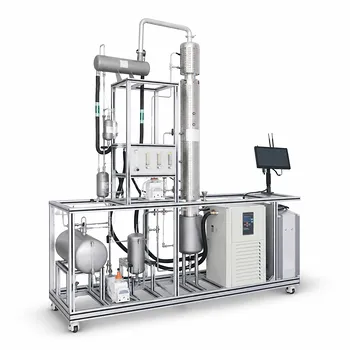
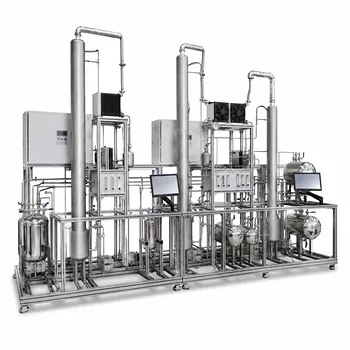
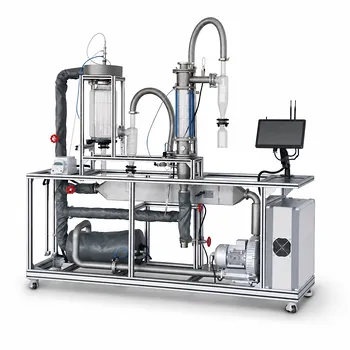
Shortcut calculation methods cannot safely operate or accurately characterize a multi-component distillation pilot plant because they are fundamentally blind to the real thermodynamics happening on each tray. In a pilot plant setting—where you are dealing with non-ideal chemicals, heat losses, and complex configurations—using simplified equations that assume constant molar overflow and fixed relative volatility will lead to erroneous predictions of product purity, temperature profiles, and energy loads. Rigorous MESH (Material, Equilibrium, Summation, Enthalpy) models are non-negotiable because they resolve the actual mass and energy balance for every single stage, accounting for the enthalpy changes and vapor-liquid equilibrium variations that define real-world separation.
The transition from theory to a physical pilot plant is where chemical engineering becomes tangible. While shortcut methods (Fenske-Underwood-Gilliland) provide a vital "first guess" for initializing a simulation, a rigorous MESH model is the only way to generate a mathematically convergent, thermodynamically valid solution that matches the physical behavior of a non-ideal, multi-component column. Using shortcuts in isolation to guide pilot plant operation is not an approximation—it’s a safety and operational risk.
The Fundamental Disconnect: Why Shortcuts Fail Physical Reality
Shortcut equations are elegant, but they are built on a foundation of assumptions that shatter when a pilot plant is turned on. The primary reason you cannot use them as the final design or operational guide is their inability to process the complexity of real heat and phase behavior.
The Enthalpy Blind Spot
The most critical failure of shortcut methods is the assumption of constant molar overflow. This assumption implies that the heat of vaporization for all components is identical and that heat losses or mixing effects are negligible. In a pilot plant separating non-ideal mixtures (like alcohols and water), the enthalpy of vaporization differs drastically between components.
A rigorous MESH model performs an enthalpy balance (the "H" in MESH) on every tray. This calculates the actual vapor and liquid flow rates, which can vary significantly across a column due to sensible heat changes and heat-of-solution effects. Without this, the predicted internal reflux ratio is wrong, making the entire separation profile invalid.
The Volatility Disconnect
Shortcut methods rely on a constant relative volatility, a number that rarely stays constant in a pilot plant. As the composition and temperature change from the top to the bottom of a column, the non-ideality of the mixture changes. For azeotropic or highly polar systems, the relative volatility can even cross 1.0 at some points.
Rigorous models use phase equilibrium equations (the "E" in MESH) tied to advanced thermodynamic packages like NRTL, Wilson, or UNIQUAC. These models recalculate the local thermodynamics at every stage. This is essential for predicting the exact composition where azeotropes form or where a trace impurity suddenly accumulates, a phenomenon shortcuts completely miss.
The MESH Framework: A Blueprint for Real Columns
The only way to capture the behavior of a pilot plant accurately is to solve the complete system of equations. The name "MESH" itself signifies the interdependent nature of the solution, where every stage’s performance is linked to its neighbors.
How Component Tracking Solves Operational Mysteries
Shortcut methods treat a column as a black box with ends. They can give you a rough idea of top and bottom product splits, but they cannot tell you the temperature or concentration on stage 12 versus stage 13. In a pilot plant with a side-stream draw or an intermediate heat exchanger, the exact location of a feed or withdrawal dictates the entire separation.
Rigorous models apply the material balance (the "M" in MESH) and summation equations (the "S" in MESH) in a stage-by-stage matrix. This pinpoints exactly where a secondary impurity will peak in concentration. In an educational setting, when a student measures a temperature profile that doesn't match the shortcut prediction, analyzing the rigorous model’s stage-by-stage data teaches them about the enthalpy saturation that occurs in specific zones of the column.
The Convergence Bridge: Shortcuts as Seed Values
While shortcuts can’t run the plant, they are indispensable for waking up the rigorous model. The most common failure in rigorous simulation is convergence failure. A computer solving complex tray-to-tray matrices using algorithms like the inside-out Jacobian method will crash if fed random or bad initial guesses for flow rates and temperatures.
A well-executed shortcut calculation generates the lifeline for the rigorous model. It provides accurate seed values for the minimum reflux ratio, theoretical stage count, and optimum feed location. By inputting these parameters derived from the Fenske-Underwood-Gilliland methods, the rigorous MESH model can mathematically converge quickly on a true physical solution, preventing the "garbage in, garbage out" scenario when trying to compare a simulation to actual pilot plant data.
Understanding the Trade-offs
Objectively, moving from a shortcut to a rigorous MESH model is not a frictionless upgrade. There are significant penalties in time, data, and expertise that must be managed.
The Cost of Rigor: Data and Time
A rigorous model is profoundly data-hungry. You cannot run a tray-by-tray simulation without validated binary interaction parameters for your specific activity coefficient model (like Wilson or UNIFAC). If experimental VLE data is missing for a binary pair, your rigorous simulation is essentially a sophisticated guess, albeit a better-structured one than a constant-alpha shortcut.
Shortcut methods are fast and transparent. If a shortcut equation gives a wrong answer, a student can easily isolate the variable. In a rigorous simulator, the fault could lie in faulty thermodynamics, a poorly linearized matrix, or a false convergence due to rounding errors. This makes physical pilot plant validation the absolute arbiter of truth—the real column data must be used to verify that the rigorous simulation has converged to a physically meaningful, not just mathematically stable, solution.
The Risk of Numerical Chaos
Keeping the component list manageable is critical for convergence. Trying to distill a complex mixture like crude oil in a rigorous model with hundreds of individual components will choke the Jacobian matrix. The industry relies on pseudo-components grouped by boiling range (e.g., from an ASTM D86 curve) to keep the problem tractable, typically under 40 final components. This balance between chemical fidelity and numerical stability is the art of modern simulation.
Making the Right Choice for Your Pilot Plant Goal
The decision to use a MESH model over a shortcut isn't about accuracy in the abstract; it's about what you need the model to do. The logic should guide your approach:
- If your primary focus is rapid, initial sizing and generating a fundamental understanding of "light-key" and "heavy-key" splits: Begin exclusively with shortcut methods. Use them to quickly estimate the minimum stages and reflux ratio to frame your thinking before any complex coding begins.
- If your primary focus is establishing physical feasibility, safely setting operating conditions, and avoiding thermal overload of the pilot plant: You must use a rigorous MESH model. Its ability to predict the real reboiler heat duty, condenser cooling load, and temperature profile prevents equipment damage and ensures the experiment is physically possible.
- If your primary focus is bridging education and reality by diagnosing pilot plant anomalies (like flat temperature profiles or impurity accumulation): You need both. First, use the shortcut output as the seed to successfully converge a MESH model; then, use the gap between the rigorous model’s predictions and the pilot plant’s physical data to identify non-idealities, heat losses, or equipment malfunctions.
The true power of a pilot plant is not just in producing a chemical, but in producing data that validates the theoretical model. Using rigorous MESH equations isn't just a simulation choice—it’s the difference between seeing a mathematical ideal and understanding the physical truth of separation.
Summary Table:
| Feature | Shortcut Calculation Methods | Rigorous MESH Models |
|---|---|---|
| Molar Overflow | Assumes constant molar overflow | Calculates enthalpy balance per stage |
| Volatility | Assumes constant relative volatility | Recalculates VLE at every stage (NRTL/Wilson) |
| Resolution | Column is a "black box" (ends only) | Full stage-by-stage profiles |
| Main Use Case | Initial sizing & quick estimates | Safe operation & physical plant validation |
Optimize Your Chemical Engineering Lab with LABPARK
Transitioning from theory to physical pilot plant operations requires precise simulation and reliable equipment. LABPARK provides state-of-the-art Educational and Vocational Unit Operations Pilot Plants in chemical engineering, bioprocess & biotech, and environmental & water treatment. Designed specifically for universities, research institutes, and enterprises, our systems bridge the gap between classroom calculations and real-world industrial processes.
Ready to enhance your research and teaching capabilities? Contact us today to find the perfect pilot plant solution for your facility!
Related Products
- Multi-Modal Distillation Unit Operations Training Pilot Plant
- Multi-Functional Special Distillation Educational Pilot Plant
- Multi Functional Membrane Crystallization Educational Unit Operations Pilot Plant
- Continuous Sieve-Plate Distillation Pilot Plant for Unit Operations Laboratory Education
- Continuous Batch Extractive Distillation Educational Pilot Plant
People Also Ask
- How can energy balance equations for condensers & reboilers be validated experimentally? Guide
- What are the primary reflux ratio control strategies? Master Distillation Unit Operations
- Why is vacuum operation capability an essential feature for a distillation unit operations pilot plant? Unlock Efficiency
- How does catalyst water concentration affect distillation pilot plant design? Key separation train choices.
- How can real-time carbon number prediction improve distillation pilot plants? Optimize control.