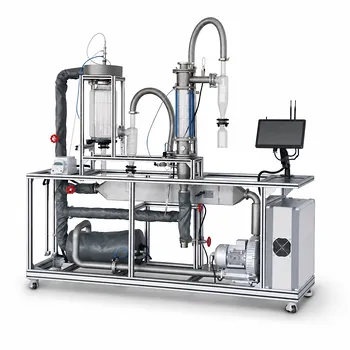
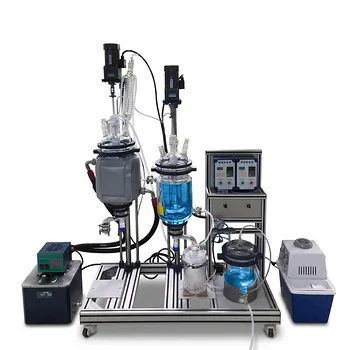
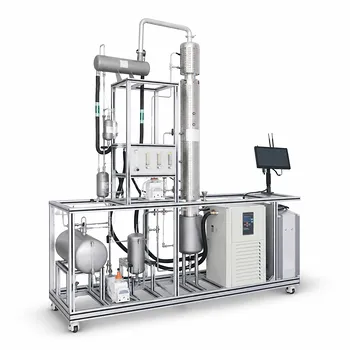
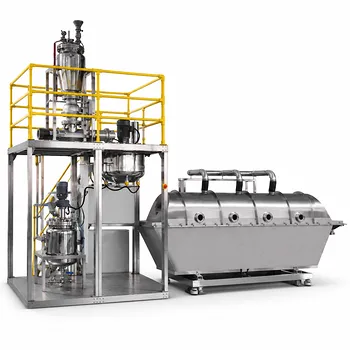
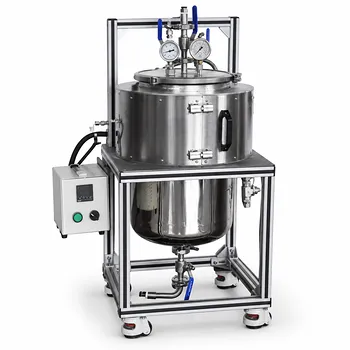
The core reason isn't just about collecting more data—it's about fundamentally shifting from testing quality into a product to designing quality into a manufacturing process. Including Process Analytical Technology (PAT) tools and closed-loop control in crystallization, drying, or synthesis pilot plants transforms them from simple demonstration units into powerful platforms for mastering modern, real-time process control. This hands-on integration allows researchers and students to practice continuous quality verification and real-time product release, which are now the standard in advanced industrial manufacturing.
The ultimate goal is to teach and prove the principle of Quality by Design (QbD). Rather than relying on slow, off-line lab tests after a batch is complete, PAT and closed-loop control provide instant data and automated adjustments. This trains operators to manage variability, understand complex parameter interactions, and maintain consistent product quality in real-time, directly in the pilot plant.
Moving Beyond Traditional Post-Production Testing
Traditional pilot plants often operate with a "black box" mentality. You set initial parameters, run the process, and then take a sample to the lab to see if you succeeded. This approach is slow, costly, and fails to capture the dynamic nature of chemical processes.
The Limitations of Offline Analysis
Offline testing creates a significant lag time between a process deviation and its detection. By the time you receive a failing lab result, an entire pilot-scale batch of material may be produced out of specification.
This method teaches students only "post-mortem" troubleshooting. It fails to demonstrate how a process actually behaves moment-to-moment or how to correct it on the fly, a critical skill in modern chemical and pharmaceutical industries.
Introducing Real-Time Analytical Insight
PAT tools, such as Near-Infrared (NIR) and Raman spectroscopy, act as the pilot plant's "eyes and ears." These non-destructive sensors can monitor Critical Quality Attributes (CQAs) like moisture content, particle size, and reaction progression in seconds.
This real-time feedback loop is the foundation for Continuous Quality Verification (CQV) . The goal is no longer to simply test the final product. The goal is to continuously verify that the process is in a state of control, guaranteeing the final product's quality at every single moment.
The Power of a Closed-Loop Control Strategy
Collecting data is only the first step. The transformational power comes from using that data to create an automated, self-correcting system. A closed-loop control strategy directly links a PAT sensor’s measurement to a process actuator, such as a valve, pump, or heater.
Automating Expert Decision-Making
A closed-loop system acts on defined rules. For example, in a crystallization pilot plant, an ATR-FTIR spectroscope can monitor supersaturation levels.
A primary control loop sets a cooling rate, while a secondary feedback loop directly adjusts a heater/chiller’s setpoint to stay within the optimal "metastable zone." This automated, precise control prevents unwanted agglomeration or spontaneous nucleation, leading to a reproducible crystal size distribution that manual control could never achieve.
Managing Process Variability Feedforward
Raw material properties can vary from batch to batch. A well-tuned PID or model predictive controller uses real-time sensor data to compensate for this variability.
If a drying operation's NIR sensor detects an unexpected spike in inlet material moisture, the control system can automatically increase residence time or drying temperature. This feedforward action corrects the disturbance before it can impact the final product’s quality, moving from reactive quality assurance to active, in-process control.
Understanding the Trade-offs
While the benefits are profound, implementing PAT and closed-loop control is not without its challenges. A successful educational or research program must address these head-on.
The Initial Complexity Hurdle
A PAT-enabled pilot plant is more complex to set up and calibrate. It requires developing chemometric models that correlate spectral data from an NIR or Raman probe to a specific physical property.
For students, the initial cognitive load is higher. They must learn not only the unit operation but also sensor integration, signal processing, and basic control loop programming. This can be daunting without a structured training program.
Sensor and Model Maintenance
PAT sensors and their predictive models are not plug-and-play. An NIR probe’s calibration model, for instance, can drift over time or become invalid if raw material suppliers change.
Environmental factors like ambient temperature or probe fouling in a reactor can also introduce noise. This teaches a critical lesson: a poorly maintained PAT system can generate bad data faster than a human can, and feeding that data into a closed-loop controller can automate the production of out-of-spec material at alarming speed.
Making the Right Choice for Your Goal
The decision to integrate PAT and closed-loop control should be driven by your primary educational or research objective. The technology must serve the goal, not the other way around.
- If your primary focus is demonstrating modern industrial compliance: Invest in integrated PAT systems like in-line Raman or FBRM with direct feedback to the DCS. This allows users to practice real-time product release and continuous process verification, mirroring the most advanced regulatory standards.
- If your primary focus is fundamental process science and parameter interaction: Start with simple but robust temperature and pressure sensors in closed feedback loops. Add a single, well-understood PAT tool like a UV-Vis probe to give students a clear, uncluttered view of the direct link between a process parameter adjustment and its effect on a CQA.
- If your primary focus is proving a new synthesis or crystallization pathway: Use the pilot plant for feasibility studies. The goal is to generate a proof of concept under realistic dynamic conditions, evaluating sensor compatibility and defining a robust design space before you even consider scaling up.
The true value of a modern unit operations pilot plant is not just in manufacturing a product, but in manufacturing data-driven certainty. By integrating PAT and closed-loop control, you transform the plant into the ultimate platform for learning the most critical skill in chemical engineering: how to guarantee quality by design, in real-time.
Summary Table:
| Feature | Traditional Pilot Plants | PAT & Closed-Loop Enabled |
|---|---|---|
| Quality Strategy | Quality tested after production (reactive) | Quality by Design (QbD) in real-time (proactive) |
| Process Control | Manual, post-mortem troubleshooting | Automated, self-correcting closed-loop control |
| Data Collection | Slow, offline lab tests with lag time | In-line/on-line sensors (NIR, Raman) for instant data |
| Key Benefit | High risk of out-of-spec batches | Continuous quality verification & minimized waste |
Elevate Your Chemical Engineering Lab with LABPARK
Ready to transition from traditional teaching to advanced, industry-ready training? LABPARK provides state-of-the-art Educational and Vocational Unit Operations Pilot Plants in chemical engineering, bioprocess & biotech, and environmental & water treatment. Designed specifically for universities, research institutes, and enterprises, our solutions integrate advanced PAT tools and closed-loop control to help your students and researchers master Quality by Design (QbD) in real-time.
Contact us today to customize your pilot plant system and bring modern industrial standards to your facility!
Related Products
- Carbon Dioxide Hydrogen Methanol Synthesis Educational Unit Operations Pilot Plant
- Ethyl Acetate Synthesis Unit Operations Pilot Plant for Practical Training
- Multi-Functional Drying Educational Unit Operations Pilot Plant
- Potassium Salt Thermal Dissolution and Crystallization Separation Educational Unit Operations Pilot Plant
- Aspirin API Synthesis Unit Operations Training Pilot Plant
People Also Ask
- How do temp & pressure affect methanol synthesis pilot plants? Optimize equilibrium and catalyst performance.
- Why is a purge system necessary when operating a gas recirculation loop in a methanol synthesis pilot plant? (Guide)
- Why do modern methanol pilot plants operate at lower pressures? Catalyst & Feed Requirements Explained
- What are the operational requirements for catalyst activation? Safe Methanol Pilot Plant Operation
- Why is the chemical plant startup schedule crucial? De-risk scale-up with pilot plants.