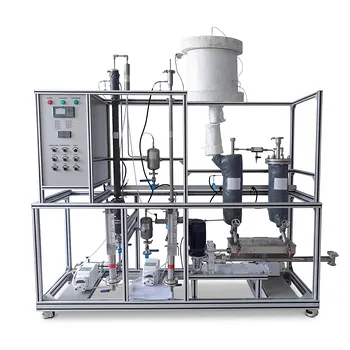
Liquid viscosity and surface tension are not mere physical properties; they are the hidden architects of every fluid flow and mass transfer experiment.
In chemical engineering pilot plants—whether you are running a distillation column, an absorption tower, or a liquid-liquid extractor—these two properties dictate how fluids move, how phases interact, and how efficiently components separate. Ignoring them means designing an experiment that operates outside reality: pressure drops will be miscalculated, mass transfer rates will be wrong, and your pilot plant may flood or perform unpredictably. Researchers must therefore treat viscosity and surface tension as design inputs, not afterthoughts.
Viscosity governs internal friction, flow regime, and pump energy, while surface tension controls interfacial area, droplet formation, and wetting behavior. Together, they set the physical limits for mass transfer coefficients, flooding points, and column hydraulics—making their accurate measurement and consideration the bedrock of a trustworthy pilot‑scale experiment.
The Dual Role of Viscosity and Surface Tension in Fluid Flow
Pilot‑plant experiments exist to generate scalable, physical insight. That insight can only be trusted when you faithfully replicate the fluid dynamics that will occur at larger scales, and the starting point for that replication is a deep understanding of how a fluid resists flow and how its surface behaves at phase boundaries.
Viscosity: The Governor of Flow Regimes and Pressure Drop
Viscosity represents a fluid’s internal friction. It directly determines whether the flow through a pipe or a packed bed is laminar or turbulent by controlling the Reynolds number.
- High‑viscosity fluids (e.g., glycerol at $1490\ \text{mPa}!\cdot!\text{s}$) create large velocity gradients, require significantly more pump power, and increase pressure drop dramatically.
- Low‑viscosity fluids (e.g., methanol at $0.597\ \text{mPa}!\cdot!\text{s}$) transition to turbulence more easily, alter residence times, and change the mixing profile in columns.
If you design your piping, pumps, or control valves without accounting for the true viscosity of your working fluid, you will mis‑size everything from rotameters to centrifugal pumps, leading to inaccurate flow rates and wasted experimental runs.
Surface Tension: The Interfacial Architect
Surface tension determines how a liquid wets a solid surface, how droplets or bubbles form, and how much interfacial area you can create. In a pilot‑scale column, it dictates:
- Wetting on packings: Poor wetting leads to channeling, drastically reducing mass transfer efficiency.
- Droplet and bubble size: In spray columns and on trays, surface tension sets the characteristic size of dispersed phases, directly controlling the specific interfacial area ($a$) available for mass transfer.
- Capillary rise: Inside structured packings or small-diameter tubes, surface tension can alter liquid holdup and distribution in ways that simple pressure-drop correlations miss.
Ignoring surface tension means you might select a packing that never fully wets with your specific liquid, or you might misjudge the stability of foam or froth on a tray.
Bridging Fluid Dynamics and Mass Transfer
The real reason these two properties are non‑negotiable for researchers is their combined influence on the mass transfer coefficient itself. The film theory and penetration theory both show that diffusion, convection, and interfacial renewal—all modulated by viscosity and surface tension—set the overall resistance to mass transport.
Impact on Column Internals and Tray Efficiency
On an industrial tray, liquid viscosity directly raises liquid‑phase resistance. High‑viscosity liquids slow down solute diffusion and produce larger gas bubbles with smaller interfacial area, lowering tray efficiency. This is why distillation at elevated temperatures (where viscosity drops) often outperforms room‑temperature gas absorption.
Surface tension, meanwhile, governs froth height and stability on a tray. If your pilot plant operates with a hydrocarbon that has a surface tension of about $20\ \text{dyn/cm}$, you must factor that into the calculation of the slope of the equilibrium curve ($M$) and the number of transfer units. Otherwise, the tray efficiency data you collect will be useless for scale‑up.
The Marangoni Effect: When Gradients Rewrite the Rules
Surface tension gradients along a column—the Marangoni effect—can stabilize or destroy an interface, independently of the average surface tension.
- Positive systems ($d\sigma/dx < 0$, surface tension increases down the column) form exceptionally stable films and foam, providing huge interfacial areas ideal for bubble‑cap or sieve tray operation.
- Negative systems ($d\sigma/dx > 0$) produce unstable films that readily rupture into droplets, making them better suited for spray‑regime contactors.
- Neutral systems show no significant gradient effect.
A researcher who only measures bulk surface tension and ignores these gradients risks selecting the exact wrong column internals—for example, installing high‑surface‑area structured packing in a negative system where it will simply never create the intended liquid film.
From Pilot Plant to Full Scale: Why These Properties Matter in Design
Pilot‑plant experiments are not academic curiosities; they must generate accurate design data for commercial units. Viscosity and surface tension are the “translators” between the pilot and the full‑scale world.
Sizing Piping, Pumps, and Valves Correctly
Every flowmeter, control valve, and pump in your pilot plant is specified using fluid density and viscosity. Even small errors in viscosity data can lead to incorrect calibration of a mass flow controller or a rotameter. Moreover, for non‑ideal mixtures (polar/nonpolar systems), excess molar volume can further distort volumetric flow rate estimations. If you ignore this, you build a pilot plant that inherently introduces a systematic error into every flow measurement.
Avoiding Operational Catastrophes: Flooding and Phase Separation
Viscosity and surface tension together define the flooding point in packed and tray columns. Higher viscosity liquids increase pressure drop and encourage premature flooding. Conversely, surface‑tension‑driven phenomena like unexpected liquid‑liquid phase separation at lower temperatures can suddenly blind a packed bed, causing a flood and destroying the separation.
In bioprocess pilot plants, a fermentation broth that becomes progressively more viscous as cells grow presents an evolving challenge: the mass transfer coefficient ($k$) for oxygen plummets, threatening aerobic cultures. Unless you designed the agitation system with that viscosity trajectory in mind, your pilot‑scale fermenter will under‑deliver oxygen, and your results will never represent a viable scaled‑up bioreactor.
The Hidden Pitfalls and Trade‑offs
Every design choice based on these properties comes with a compromise. Ignoring this reality leads to an experiment that is either unphysical or impossible to scale.
- High viscosity can sometimes be an asset: it stabilizes froth and can increase interfacial area in bubble columns, yet the same high viscosity demands excessive pump power and slows molecular diffusion.
- Low surface tension promotes smaller droplets and better wetting, but it can also lead to excessive foaming that carries contaminants overhead and fouls pressure taps.
- Temperature‑dependent viscosity corrections, like the $(\mu/\mu_w)^{0.14}$ factor in heat transfer correlations, are negligible for water‑like fluids but catastrophic to omit when testing heavy oils. An uncorrected pilot plant will give heat transfer coefficients that are completely wrong for real industrial conditions.
- Simple fluids (nitrogen, light hydrocarbons) can be modeled with kinetic theory, but complex industrial mixtures often lack reliable transport property data, forcing you to combine corresponding‑states approximations with pilot‑plant measurements. Accepting that gap is essential; pretending you can calculate everything from first principles leads to overconfidence.
Applying These Insights to Your Pilot Plant Experiments
Your experimental design must not start with the equipment; it must start with the fluid’s transport properties. A few practical guidelines:
- If your primary focus is distillation optimization: Measure the liquid viscosity at the column’s operating temperature, because the enhanced efficiency you observe at the boiling point is largely a viscosity story. Use that value to calculate tray efficiency and flooding limits.
- If your primary focus is gas absorption or stripping: Characterize surface tension extensively—including its gradient if your mixture is non‑ideal. Select packings or trays that match whether your system is positive, negative, or neutral to avoid interfacial instability.
- If your primary focus is liquid‑liquid extraction or bioprocessing: Track viscosity as a function of time or concentration, because the mass transfer coefficient will change during the run. Design for the worst‑case viscosity to ensure sufficient agitation and oxygen transfer.
- If your primary focus is pilot‑scale heat transfer with viscous fluids: Always apply the viscosity correction factor and measure wall and bulk temperatures, or your data will never scale reliably.
- If your primary focus is plant safety and operability: Account for possible liquid‑liquid phase splits and the viscosity of the denser phase; cold spots in a pilot plant can induce phase separation that a naive model would miss.
Your pilot plant is a physical argument for a full‑scale design, and that argument collapses if the fluid properties that control flow and mass transfer are left undefined. Measure them first, design around them second, and your experiments will reflect reality—not just equipment.
Summary Table:
| Property | Key Fluid Dynamics Impact | Mass Transfer & Scale-Up Effect |
|---|---|---|
| Viscosity | Controls Reynolds number, flow regime, pressure drop, and pump power. | Directs liquid-phase resistance, diffusion rates, and tray/column efficiency. |
| Surface Tension | Governs wetting, droplet/bubble size, and capillary rise in packing. | Influences specific interfacial area, froth stability, and Marangoni effects. |
Optimize Your Pilot-Scale Experiments with LABPARK
Are you designing complex mass transfer and fluid flow experiments? Ensure accurate scale-up and reliable experimental data with LABPARK. We provide industry-standard Educational and Vocational Unit Operations Pilot Plants in chemical engineering, bioprocess & biotech, and environmental & water treatment.
Tailored specifically for universities, research institutes, and enterprises, our systems help you bridge the gap between laboratory theory and industrial reality. Contact us today to find the perfect pilot plant solution for your lab!
Related Products
- Fixed Bed Gas Solid Catalytic Reaction Educational Pilot Plant
- Multi Pump Fluid Transport Process Piping Unit Operations Training Pilot Plant
- Carbon Dioxide Hydrogen Methanol Synthesis Educational Unit Operations Pilot Plant
- Ethyl Acetate Synthesis Unit Operations Pilot Plant for Practical Training
- Natural Product Extraction Unit Operations Training Pilot Plant
People Also Ask
- How do reactor pilot plants safely study gas-solid reactions? Master kinetics with thermal & flow control.
- How does the Mears criterion evaluate transport resistance? Key Guide to Intrinsic Kinetics
- Fluidized vs. Fixed Bed Reactors: Comparing Heat & Complexity in Pilot Plants
- Why is a multibed configuration necessary for exothermic reactions? Optimize your pilot plant trajectory.
- How is the friction factor determined for fixed-bed pilot plants? Select the best pressure drop correlation.