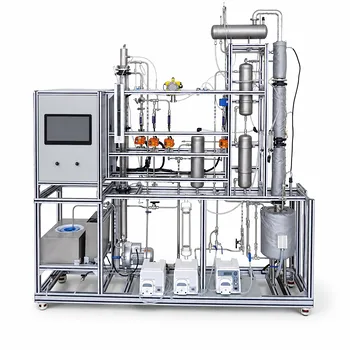
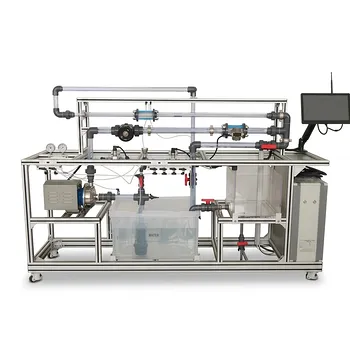
Ignoring boiling point elevation (BPE) when designing or operating an educational evaporation pilot plant will directly falsify your heat transfer calculations, causing the actual evaporation rate to fall dramatically short of the predicted value. BPE reduces the effective temperature driving force because the solution boils at a higher temperature than pure solvent at the same pressure. In a pilot plant, this means the temperature difference between the condensing steam and the boiling liquid is smaller than you think, leading to an undersized heat transfer area and insufficient evaporation capacity.
Core Takeaway: Failing to account for boiling point elevation transforms a carefully calculated pilot plant into an unreliable teaching tool. BPE is not a minor correction; it is a definitive thermal loss that must be quantified through the combined effects of solute concentration, liquid hydrostatic head, and vapor line pressure drop. Mastering this concept separates textbook theory from industrial reality.
The Physics of Boiling Point Elevation in Evaporation
The Fundamental Definition
Boiling point elevation (BPE) is the increase in the boiling temperature of a solution compared to the pure solvent at the same applied pressure. It occurs because non-volatile solutes lower the vapor pressure of the liquid, requiring a higher temperature to reach the boiling condition.
For dilute solutions, this elevation follows a simple linear relationship: ΔTb = Kb * m, where Kb is the ebullioscopic constant unique to the solvent, and m is the solute molality. As evaporation proceeds and the solution concentrates, BPE rises continuously.
Why It's a Showstopper in Pilot Plants
In an educational pilot plant, the surface goal is often to demonstrate steady‑state evaporation or to measure heat transfer coefficients. But if you assume the boiling liquid is pure water, the apparent temperature difference between the steam side and the process side is artificially large.
The actual temperature of the boiling solution is higher, so the true thermal driving force is always smaller. A pilot plant built on this overestimated ΔT will deliver lower distillate flow, longer concentration times, and misleading performance data — exactly the wrong lesson for students.
Dissecting the Total Temperature Loss
What engineers often call “BPE” in an evaporator is really the sum of three distinct thermal penalties. An educational plant must be instrumented to reveal all three.
Concentration-Dependent BPE (Colligative Property)
The intrinsic BPE caused by dissolved solids is purely a function of solution composition. As the solvent boils away, the molality increases, and the boiling point climbs.
Because Kb depends only on the solvent (e.g., water’s Kb = 0.512 °C·kg/mol), students can calculate the theoretical boiling curve for a given solute. This is the baseline temperature loss, and it forms the core of the thermodynamic penalty.
Hydrostatic Head Effects
In a vertical-tube evaporator, the liquid level above the heating surface creates a static pressure that increases the boiling point at the bottom of the tubes. For example, a 2.3‑meter liquid depth can introduce an additional 7–8 °C of temperature loss due to hydrostatic head alone.
This effect is often the largest single contributor to temperature loss in a pilot plant, yet it is invisible without sensors placed at different elevations. Measuring it transforms the plant into a powerful demonstration of how liquid depth directly steals effective temperature difference.
Vapor Line Pressure Drop
The rising secondary vapor must flow through demisters and connecting piping before it reaches the condenser. This flow resistance causes a pressure drop.
Even a modest pipeline pressure drop can translate to an additional 1.0–1.5 °C saturation temperature loss. While smaller than hydrostatic head, it is real and must be accounted for in any honest energy balance.
The Direct Impact on Heat Transfer Design
The Driving Force Equation
The heat duty of an evaporator can be expressed as Q = U * A * ΔTm, where ΔTm is the mean temperature difference between the heating steam (T_steam) and the actual boiling liquid (T_solution). BPE directly shrinks ΔTm because T_solution = T_solvent_sat + BPE.
If you design to a target Q using the pure solvent saturation temperature, you will select a ΔTm that is too large. In operation, the real ΔTm is lower, so the evaporator cannot transfer the required heat — evaporation rate drops, steam demand appears low, and the plant underperforms.
The Heat Transfer Area Calculation
Rearranging the fundamental equation gives the required area: A = Q / (U * ΔTm). A falsely elevated ΔTm leads to a calculated area that is too small.
In a pilot plant with shell‑and‑tube bundles and a typical U around 1500 W/(m²·K), the error can be severe. Students who ignore BPE might conclude that a compact heat exchanger will suffice, only to find that the actual plant needs substantially more surface area. This gap between calculated and required area is one of the most powerful learning moments the equipment can provide.
Common Pitfalls and Trade-offs When Ignoring BPE
When BPE is neglected, operators often respond by raising the steam pressure to compensate for the missing driving force. This may boost evaporation temporarily, but it also increases wall temperatures and can accelerate fouling or damage heat‑sensitive solutes.
Another frequent mistake is treating BPE as a constant. During a batch evaporation, the concentration — and therefore the BPE — continuously rises. A fixed steam pressure setting that works at the start will become insufficient by the end. An educational pilot plant without concentration tracking fails to teach the dynamic nature of the temperature profile.
Ignoring hydrostatic head is an equally dangerous oversimplification. A plant that runs with a deep tube liquid level to prevent dryout will experience a significantly larger total temperature loss than one operated with a thin film. The trade‑off between wetting and thermal penalty is a genuine engineering dilemma that students must learn to quantify.
Making BPE a Learning Opportunity in Educational Plants
Properly instrumented evaporation pilot plants turn BPE from an abstract lecture topic into a measurable, visceral reality. The choice of sensors and operating protocols determines how well the plant teaches the underlying physics.
- If your primary focus is accurate heat transfer area sizing: Install precision temperature sensors at the steam side, at the top surface of the boiling liquid, and near the bottom tube sheet; calculate the mean effective ΔTm including all BPE components.
- If your primary focus is teaching real industrial design margins: Operate the plant at different liquid levels and vapor line configurations to let students isolate and measure the separate contributions of solute concentration, hydrostatic head, and pipeline pressure drop.
- If your primary focus is demonstrating multi‑effect evaporation: Show how the temperature loss in the first effect robs the driving force for the second effect, making BPE the critical parameter that dictates the maximum number of economic effects.
- If your primary focus is process control education: Vary the steam pressure dynamically as concentration increases, teaching students to maintain a constant thermal driving force by responding to the continuously climbing BPE.
A pilot plant that makes boiling point elevation tangible equips students with the diagnostic instinct to never confuse a calculated ΔT with the real one.
Summary Table:
| Source of Temperature Loss | Cause & Description | Impact on Evaporator Sizing & Design |
|---|---|---|
| Concentration-Dependent BPE | Dissolved solids lower solvent vapor pressure as concentration rises. | Baseline thermodynamic penalty that reduces the effective temperature driving force ($\Delta T_m$). |
| Hydrostatic Head | Liquid depth creates static pressure at the bottom of the heating tubes. | Major thermal penalty, often introducing a loss of 7–8 °C in vertical-tube evaporators. |
| Vapor Line Pressure Drop | Flow resistance through demisters, separators, and connecting piping. | Minor saturation temperature loss (typically 1.0–1.5 °C) that must be accounted for in energy balances. |
Bridge the Gap Between Theory and Industry with LABPARK
Accurately demonstrating thermodynamic challenges like boiling point elevation (BPE) requires high-precision, industrial-grade equipment. LABPARK designs and manufactures premium Educational and Vocational Unit Operations Pilot Plants in chemical engineering, bioprocess & biotech, and environmental & water treatment.
Engineered specifically for universities, research institutes, and enterprises, our pilot plants feature advanced instrumentation that allows students to isolate, measure, and master complex heat transfer processes and real-world design margins.
Ready to upgrade your lab's hands-on training capabilities? Contact LABPARK today to explore our pilot plant solutions!
Related Products
- Supercritical High-Gravity Flash Evaporation Educational Unit Operations Pilot Plant
- Rising and Falling Film Evaporation Educational Unit Operations Pilot Plant
- Natural Product Extraction Unit Operations Training Pilot Plant
- Continuous Batch Extractive Distillation Educational Pilot Plant
- Green Anhydrous Ethanol Purification Extractive Distillation Unit Operations Training Pilot Plant
People Also Ask
- How is the heat transfer area calculated for an evaporation unit operations pilot plant during experimental design? Guide
- How to select educational evaporator pilot plants for thermal & scaling solutions? Complete Guide
- What is the practical significance of Kb in pilot plant evaporation? Master process design.
- How do flash calculations relate to flash evaporation pilot plants? Bridge Theory and Practice
- Vacuum vs. Atmospheric Evaporation: Key Pilot Plant Trade-Offs to Evaluate