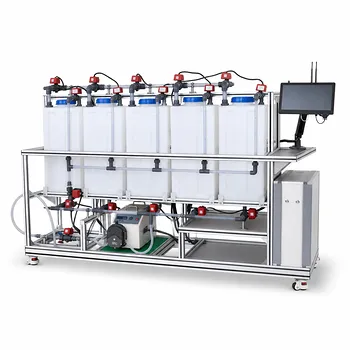
The straightforward answer: Nitrification and denitrification are fundamentally incompatible processes that cannot occur efficiently in the same reactor at the same time. Nitrification demands a well-oxygenated environment to convert ammonia into nitrate, while denitrification requires a strict absence of oxygen to turn that nitrate into harmless nitrogen gas. A pilot plant must use separate reactor stages to independently manage these opposing conditions, making each process visible and controllable.
Nitrogen removal is a two-step biological tango where the partners need radically different environments—oxygen and its complete absence. A single tank forces these partners to collide; separate stages let each one perform its role cleanly, unlocking the full removal pathway for clear demonstration and study.
The Biochemical Divide: Why One Tank Can’t Do Both
The core reason for separate stages lies in the metabolic demands of the bacteria responsible for each step. These microorganisms are specialists, not generalists, and their survival depends on the precise chemical conditions you provide.
The Aerobic Engine of Nitrification
Nitrification is an aerobic oxidation process. Specialized bacteria, such as Nitrosomonas and Nitrobacter, use oxygen as the terminal electron acceptor to convert ammonium (NH₄⁺) first to nitrite (NO₂⁻) and then to nitrate (NO₃⁻).
A continuous supply of dissolved oxygen is non-negotiable. Without it, these organisms simply cannot gain energy and the reaction stalls. The high oxygen demand drives the need for dedicated aeration equipment and monitoring in that stage.
The Anoxic Sanctuary of Denitrification
Denitrification, in contrast, is an anaerobic respiratory pathway. Facultative bacteria, when deprived of free oxygen, switch to using nitrate as their electron acceptor, reducing it stepwise to nitrogen gas (N₂).
This process requires an oxygen-free (anoxic) environment. Even trace amounts of dissolved oxygen will push the bacteria to use the oxygen instead of nitrate, shutting down denitrification completely. The tank must be sealed or designed to prevent any air intrusion.
The Inhibitory Effect of Oxygen
Oxygen is a catabolic repressor for denitrifying enzymes. The synthesis and activity of enzymes like nitrate reductase are suppressed the moment dissolved oxygen becomes available.
This creates a direct conflict: the oxygen needed for nitrification will instantly poison the denitrification stage if they share the same liquid volume. A pilot plant cannot demonstrate this inhibitory phenomenon without a physical barrier between the two zones.
The Engineering Imperative: Independent Control for Reliable Demonstration
Beyond basic biochemistry, a pilot plant built for teaching or process development must be a model of transparency and control. Separate stages transform theoretical concepts into observable, manageable truths.
Disentangling Dissolved Oxygen Levels
A single reactor forces a compromise that satisfies neither process. With separate stages, you can maintain a high dissolved oxygen setpoint (e.g., 2–3 mg/L) in the aerobic zone and a true zero reading in the anoxic zone.
This independence proves the direct relationship between oxygen and reaction rate. Students can manipulate aeration in one tank and watch the ammonia concentration fall, without any unintended impact on nitrate reduction in the next.
Decoupling Organic Carbon Dosing
Denitrification requires a readily biodegradable organic substrate, such as methanol or acetic acid, to donate electrons. Adding this carbon source to a combined tank would cause uncontrolled aerobic heterotrophic growth, consuming the oxygen meant for nitrifiers.
Separate stages let you inject the carbon source precisely into the anoxic zone, where it feeds denitrifiers without competing with nitrification. This targeted dosing demonstrates the stoichiometric link between carbon and nitrate removal.
Creating a Clear Pedagogical Narrative
A multi-stage pilot plant physically maps the chemical pathway. You can sample at the end of the aerobic stage to see nitrate peak, and then again after the anoxic stage to see it vanish.
This visible, stepwise transformation teaches process kinetics, mass balances, and troubleshooting in a way no single-tank system can. The equipment itself reinforces the biological logic.
Understanding the Trade-offs
While separate stages are non-negotiable for demonstration, this design choice comes with real-world footnotes that any thoughtful technologist should consider.
- Increased complexity: Separate tanks mean more pumps, pipes, sensors, and control loops. This demands more operator skill and has more potential failure points.
- Larger physical footprint: Two or more vessels occupy significantly more space, which can be a constraint in a teaching laboratory or mobile pilot unit.
- Internal recycle requirements: Denitrification consumes alkalinity, and nitrification produces acidity. A recycle stream from the aerobic to the anoxic stage is often needed to balance pH and return nitrate—adding another layer of design.
- Start-up and stability challenges: Developing and maintaining two distinct biomass populations (autotrophic nitrifiers and heterotrophic denitrifiers) takes longer and is more sensitive to shock loads than a single mixed community.
These challenges are precisely why the pilot plant must demonstrate separation—because the engineering solutions (recirculation, carbon dosing, DO control) are the lessons themselves.
Making the Right Choice for Your Pilot Plant Goal
Your decision to implement separate stages should be driven by what you need the pilot plant to prove. Not all objectives demand the same level of compartmentalization.
- If your primary focus is teaching the core biology: A simple two-tank sequence (aerobic followed by anoxic) is perfect. It isolates each process in its purest form for observation.
- If your primary focus is process optimization: You might need additional stages, like a pre-anoxic tank for denitrification ahead of the aerobic zone, plus internal recirculation lines to study the Ludzack-Ettinger or other configurations.
- If your primary focus is demonstrating inhibition: Separate stages are the only way to create a controlled experiment where you can spike oxygen into the anoxic tank and immediately measure the denitrification rate crash.
- If your primary focus is resource efficiency: You might explore sequencing batch reactor concepts that separate the processes in time rather than space, but recognize this sacrifices the continuous, steady-state visibility that makes the biological sequence so obvious.
The pilot plant is a message. Build it with distinct stages, and the story of nitrogen removal will be impossible to misunderstand.
Summary Table:
| Process | Environment | Key Bacteria | Role of Oxygen | Carbon Source |
|---|---|---|---|---|
| Nitrification | Aerobic (Oxygen-rich) | Nitrosomonas, Nitrobacter | Required (DO 2–3 mg/L) | Autotrophic (CO2) |
| Denitrification | Anoxic (Oxygen-free) | Facultative heterotrophs | Inhibitor (DO must be 0) | Heterotrophic (Methanol/organic carbon) |
Bridge the Gap Between Wastewater Theory and Practice with LABPARK
Demonstrating complex biological pathways like nitrification and denitrification requires pilot plants designed for precise control. LABPARK offers state-of-the-art Educational and Vocational Unit Operations Pilot Plants in chemical engineering, bioprocess & biotech, and environmental & water treatment.
Tailored for universities, research institutes, and enterprises, our modular systems provide the visibility and flexibility needed to teach advanced process kinetics and control.
Ready to enhance your hands-on curriculum or research capabilities? Contact the LABPARK team today to discuss your pilot plant needs!
Related Products
- Solid Waste Pyrolysis and Refining Educational Pilot Plant for Unit Operations
- Thermal Desorption Exhaust Gas and Tail Water Treatment Educational Pilot Plant
- Dual-Mode Rectification Pilot Plant for Practical Training Unit Operations
- Electrochemical Water Treatment Educational Unit Operations Pilot Plant
- Natural Product Extraction Unit Operations Training Pilot Plant
People Also Ask
- How do educational unit operations pilot plants bridge theory and design? Bridge the Engineering Gap
- How do unit operation requirements differ between traditional chemical processes and bioprocesses? Build Better Pilot Plant Curricula
- How do educational unit operations pilot plants address safety and waste management when scaling up?
- How do educational unit operations pilot plants bridge theory and industrial process development? Hands-On Learning
- How can unit operations pilot plants demonstrate simultaneous removal of light and heavy impurities? Configure a modular setup