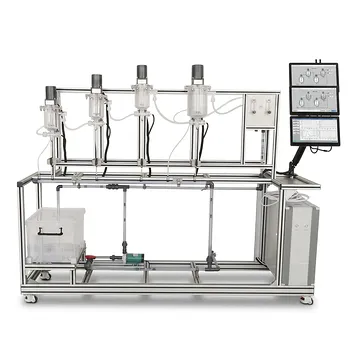
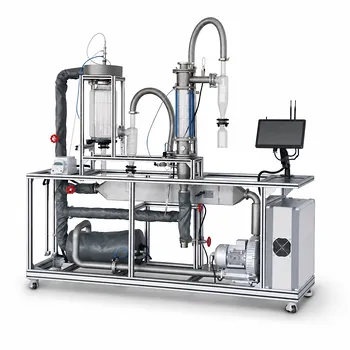
The most insidious mixing failures are the ones you never see. When you analyze only a small, convenient portion of a powder blend or liquid mixture from a pilot-plant experiment, you risk missing localized non-uniformities—hot-spots of active ingredient or segregated zones—that can quietly ruin scale-up batches and invalidate your entire research campaign. Whole-sample analysis eliminates this blind spot by forcing you to inspect every part of the mixture, delivering the statistically robust data that chemical engineers need to design reliable, reproducible processes.
Spot-sampling can hide the very mixing defects you are trying to find. Whole-sample or volumetric analysis—examining the entire product surface or peeling back layers to assess internal uniformity—is the only way to guarantee that your blend truly meets its target homogeneity and that your pilot-plant data faithfully represents the process as it will behave at production scale.
The Hidden Danger of Localized Non-Uniformities
Why “Hot-Spots” Escape Spot-Checking
A small scoop from the top of a powder bed or a single aliquot from a stirred vessel gives you a snapshot of one tiny region, not the whole picture. Hot-spots created by incomplete dispersion or segregation often concentrate in corners, dead zones, or in layers that are not visually obvious. If your analytical method only looks at a gram or a milliliter taken from a convenient location, those defects remain invisible, and the mixture appears perfectly uniform when it is not.
How Whole-Sample Analysis Works as a Diagnostic
Instead of extracting a tiny subsample, whole-sample analysis involves examining the entire surface of the blend or performing volumetric analysis by revealing interior surfaces. For powders, this can mean scraping away successive layers and quantifying composition at each level. For liquids, it may involve using full-field imaging or multiple probes to map concentration gradients across the whole geometry. This approach turns a potential false negative into a definitive answer.
Connecting to Process Analytical Technology (PAT)
Modern pilot plants often integrate spectroscopic or tomographic sensors like electrical resistance tomography (ERT) or near-infrared (NIR) imaging that inherently capture data from large cross-sections rather than single points. Training students to rely on these whole-sample diagnostics reinforces the principle that good process monitoring begins with a representative field of view—not a convenient one.
How Spot-Sampling Sabotages Scale-Up
The Illusion of Success at Small Scale
A bench-scale study might suggest a 5-minute mixing time is sufficient because the grabbed sample happens to be well-mixed. At pilot scale, however, mixing dynamics change with impeller type, vessel geometry, and the flow behavior of non-Newtonian fluids. A mixing defect that occupied only 5% of the laboratory vessel can balloon into 30% of the larger reactor. Whole-sample analysis forces you to find that 5% before you scale up, preventing a catastrophic batch failure in a 500-liter pilot reactor.
The Raw Material Variable You Overlooked
Granular solids from different suppliers may have seemingly minor differences in particle size distribution, surface roughness, or density. These variations can change how particles segregate during blending. If you only spot-check, you may never realize that a new lot of raw material is creating density-driven stratification that only becomes apparent when the entire bed is analyzed. A laboratory-scale pre-qualification run using the exact material lot, combined with whole-sample analysis, eliminates this hidden variable.
When Correlation Is Just as Important as Concentration
In granulation or wet mixing, attributes like moisture content, particle size, and binder distribution are highly correlated. A univariate check of one component might look acceptable, but a multivariate pattern could be severely skewed. A proper whole-sample analysis—especially when fed into a multivariate model (like Principal Component Analysis)—lets you see whether the entire covariance structure of the blend matches historical norms, catching subtle imbalances that simple spot samples would never reveal.
The Educational Imperative in Pilot Plant Training
Teaching the Cost of a Non-Representative Sample
In process industry applications, upwards of 80% of all sampling system maintenance problems stem from poor initial design or incorrect handling. A pilot plant that trains chemists and engineers to ignore whole-sample principles is teaching them to accept false security. Emphasizing full-volume or full-surface analysis ingrains the habit of questioning the sample itself, a skill that pays massive dividends when practitioners move to industrial process monitoring or quality control.
Building Intuition for Chaotic Mixing
Static mixers with SMX elements create chaotic advection that spreads fluid elements exponentially fast, but the final blend may still show subtle radial gradients if flow rates are not optimized. By pairing an in-situ diagnostic like ERT with whole-cross-section mapping, students learn how velocity ratios and rheology impact true uniformity. They see that measuring a single point downstream can miss a persistent streak of unblended material that hugs the pipe wall.
Understanding the Trade-Offs
The Destructive Nature of Volumetric Analysis
Scraping off layers or dissolving an entire batch for analysis destroys the sample, making it impossible to perform further downstream tests. For expensive materials or small pilot batches, you must decide whether the completeness of the data justifies losing the entire batch. In many cases, a statistically designed sampling plan that tests multiple strategic locations may be an acceptable compromise, but it is still a compromise—never as definitive as analyzing the whole.
Time and Cost vs. Risk of Undetected Failure
Whole-sample methods can be labor-intensive. Manually sectioning a powder bed or performing slice-by-slice spectroscopy takes far longer than dipping a probe into a single spot. However, the cost of one undetected segregation event that leads to a failed scale-up campaign can be orders of magnitude higher. Pilot plants are the right place to spend this time, because the learning and the prevention of future scale-up errors far outweigh the incremental effort.
When a Sampling System Makes Whole-Sample Analysis Difficult
Some units are not designed for easy access; extracting a representative partial sample from a pressurized, high-temperature stream requires an extractive fast-loop system with precise temperature control to maintain sample integrity. Whole-sample analysis in these environments may be impractical. Training should therefore include the parallel skill of designing and operating sampling systems that deliver the most representative sample possible under such constraints, while acknowledging the inherent limitation of not being able to inspect every particle.
Making the Right Choice for Your Pilot Plant Goal
Your decision to adopt whole-sample analysis should align with what you are trying to achieve:
- If your primary focus is validating a new mixing protocol for scale-up: Commit to whole-sample or volumetric analysis at the pilot stage. This is the only way to confidently claim that your mixing time, RPM, and geometry specifications eliminate dead zones and segregation.
- If your primary focus is training engineers on industrial best practices: Use whole-sample exercises to demonstrate why spot-checking fails, then contrast with a well-designed multi-point sampling plan. The lesson is not just about analysis but about the critical thinking required to design a sampling strategy.
- If your primary focus is process R&D with expensive or hazardous materials: Combine whole-sample destruction on a small number of runs with a statistically designed partial-sampling plan for routine batches. Use the whole-sample data to calibrate and validate the partial-sampling approach.
- If your primary focus is integrating PAT for real-time control: Select sensor configurations—like full-plane ERT or multi-point NIR flow cells—that naturally provide the closest equivalent to whole-sample data, and design your pilot plant sampling interface accordingly.
By treating the entire sample as the true result, rather than trusting a tiny fraction to speak for the whole, you build a foundation of data integrity that will support every process decision you make from pilot-scale to production.
Summary Table:
| Feature | Whole-Sample Analysis | Spot-Sampling |
|---|---|---|
| Detection Capability | Identifies all localized non-uniformities & segregation | Misses hidden "hot-spots" and dead zones |
| Scale-Up Reliability | High; delivers predictive data for large-scale design | Low; risks false positives and batch failures |
| Data Richness | Statistically robust, supporting multivariate models | Single-point snapshot, limited process insight |
| Best For | Protocol validation & PAT sensor calibration | Routine monitoring of highly verified processes |
Optimize Your Unit Operations with LABPARK
Are you looking to bridge the gap between laboratory research and industrial-scale success? LABPARK provides state-of-the-art Educational and Vocational Unit Operations Pilot Plants in chemical engineering, bioprocess & biotech, and environmental & water treatment. Designed specifically for universities, research institutes, and enterprises, our pilot plants enable students and researchers to master critical concepts like whole-sample analysis, mixing dynamics, and PAT integration.
Why Partner with LABPARK?
- Hands-on Training: Equip your labs with industry-grade pilot plants that foster critical process engineering skills.
- Reliable Scale-Up: Get precise, reproducible data to confidently scale up your chemical and environmental processes.
- Tailored Solutions: Custom-engineered systems designed to meet your specific research and educational curricula.
Ready to elevate your engineering training and research capabilities? Contact LABPARK today to request a catalog or consult with our technical experts!
Related Products
- Multi-Stage Stirred Tanks in Series Residence Time Distribution and Mixing Performance Determination Educational Pilot Plant
- Methanol Synthesis and Catalyst Performance Evaluation Educational Unit Operations Pilot Plant
- Ethyl Acetate Synthesis Unit Operations Pilot Plant for Practical Training
- Multi-Functional Special Distillation Educational Pilot Plant
- Polymerization Granulation and Pellet Processing Educational Unit Operations Pilot Plant
People Also Ask
- How does MRF model impeller rotation in CFD? Key Boundary Conditions Explained
- How can a CSTR pilot plant demonstrate reactor staging? Visualize volume savings.
- What parameters to monitor transitioning from Batch to CSTR? Master Pilot Plant Setup
- How does steady-state multiplicity affect the operation and safety of exothermic reactions within a CSTR pilot plant? - Guide
- Why is temperature regulation via a cooling jacket a critical feature in CSTR pilot plants used for laboratory training?