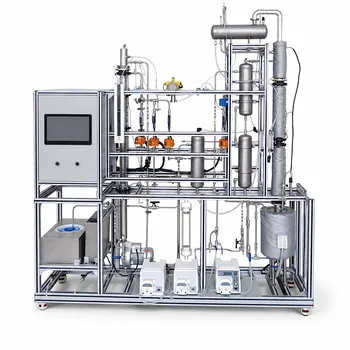
Water is commonly used as the primary reference fluid because its thermodynamic behavior is exceptionally well documented and experimentally accessible. Reliable vapor-pressure data are available from sub-freezing conditions through water’s critical temperature of 374.14°C (705.5°F). This gives students and researchers a dependable baseline for mass balances, energy balances, boiling-point calculations, and evaporator performance analysis.
Water functions as a common thermodynamic yardstick: its accurate reference data make complex evaporation and thermal calculations easier to validate, compare, and extend to other fluids.
Why Training Modules Need a Reference Fluid
Establishing a Reliable Baseline
Evaporation experiments depend on relationships among temperature, pressure, vaporization, concentration, and heat transfer. Using a fluid with well-established properties lets learners compare measured plant behavior with trusted theoretical values.
Water provides that baseline across a broad operating range. When experimental results differ from reference behavior, students can investigate instrumentation, heat losses, concentration effects, or operating errors rather than questioning the basic property data.
Supporting Reproducible Learning
A shared reference fluid makes results more comparable between different pilot plants, laboratories, and training exercises. An evaporation experiment performed with water can be interpreted using established vapor-pressure and boiling-point information.
This is important in education because the learning objective is often the unit operation itself, rather than the uncertainty associated with poorly characterized fluid properties.
Connecting Theory With Practical Operation
Water is also familiar and readily available, so learners can connect thermodynamic concepts with observable process behavior. Its use helps demonstrate boiling, condensation, steam heating, vacuum evaporation, and multi-effect operation without introducing unnecessary material-handling complexity.
How Water Supports Evaporation Calculations
Vapor-Pressure Relationships
Vapor pressure determines the temperature at which water boils at a given pressure. Because water’s vapor-pressure characteristics are accurately documented over a wide temperature range, they can be used to interpret boiling behavior in both atmospheric and vacuum systems.
This makes water particularly useful for showing how reducing pressure lowers the boiling temperature and changes the operating conditions of an evaporator.
Dühring Plots
Water reference data form the basis for empirical tools such as Dühring plots. These plots help estimate the boiling temperature of a solution relative to the boiling temperature of pure water at the same pressure.
That relationship is useful for analyzing boiling-point elevation, which becomes important as dissolved solids concentrate during evaporation.
Calingaert-Davis Correlations
Reference behavior for water also supports empirical correlations such as the Calingaert-Davis equation, which can be used to relate vapor-pressure behavior across related higher-boiling substances.
The value of such correlations is not that water behaves identically to every process fluid. Rather, water provides a well-characterized comparison point from which behavior can be estimated and evaluated.
How Water Supports Pilot-Plant Training
Performing Mass and Energy Balances
Water-based experiments allow students to perform balances using reliable phase-change behavior and measurable flow rates. They can calculate evaporation rates, steam consumption, condensate production, and heat duty with a clear reference basis.
Accurate property data are essential because small errors in enthalpy, vapor pressure, or boiling temperature can distort the apparent performance of the entire system.
Evaluating Multi-Effect Evaporators
In a multi-effect evaporator, vapor generated in one effect supplies heat to the next effect, usually at a lower pressure. Water provides a consistent basis for studying this pressure and temperature cascade.
Students can use water reference data to evaluate steam economy, heat-transfer performance, overall evaporation capacity, and the effect of operating pressure.
Validating Empirical Models
Pilot plants are used to compare theoretical predictions with actual equipment behavior. Water’s established properties make it possible to distinguish between errors in a model and deviations caused by real equipment factors such as heat loss, fouling, nonuniform flow, or imperfect vacuum control.
That distinction is central to process engineering training.
Why Water Is Practical as Well as Accurate
Broad Availability
Water is inexpensive, widely available, and easy to handle in most instructional environments. Its availability supports repeated experiments without the procurement, disposal, or storage requirements associated with specialized process fluids.
Straightforward Handling
Water generally presents fewer handling concerns than corrosive, toxic, flammable, or highly reactive fluids. This allows training modules to focus on process operation, instrumentation, and calculations while reducing avoidable laboratory risk.
Familiar Process Relevance
Many industrial processes involve aqueous feeds, water removal, steam heating, or condensation. Even when the final process fluid is not pure water, water-based training develops directly relevant skills for designing and operating thermal equipment.
Understanding the Trade-offs
Water Is Not a Universal Substitute
Pure-water results cannot automatically predict the behavior of every industrial solution. Dissolved solids, nonvolatile components, viscosity, foaming, crystallization, and boiling-point elevation can substantially change evaporation performance.
Water is therefore a reference fluid, not a complete representation of every process feed.
Reference Data Do Not Remove Measurement Error
Accurate property tables do not correct for faulty temperature sensors, pressure measurement errors, heat loss, leaks, or unstable flow conditions. Experimental data still require calibration, uncertainty analysis, and careful interpretation.
Concentration Changes the Operating Behavior
As evaporation proceeds, a solution becomes more concentrated and may depart significantly from pure-water behavior. Training modules must account for this when using Dühring plots or other correlations to estimate solution boiling temperatures.
Critical-Point Data Have Limited Routine Use
Water’s documented behavior extends to its critical temperature, but ordinary evaporator training generally operates well below the critical point. The broad range demonstrates the quality and reach of the reference data; it does not mean that critical-point operation is typical or necessarily practical for a pilot plant.
How to Apply This to Your Project
Water is most useful when it is treated as a validated benchmark within a broader modeling and experimental method.
- If your primary focus is fundamental training: Use water to teach vapor-pressure behavior, boiling, condensation, mass balances, energy balances, and pressure effects with minimal property-data uncertainty.
- If your primary focus is pilot-plant evaluation: Use water to establish baseline heat-transfer and evaporator-performance behavior before testing more complex process solutions.
- If your primary focus is solution evaporation: Use water data as the reference for Dühring plots and boiling-point-elevation calculations, then incorporate concentration-dependent properties for the actual solution.
- If your primary focus is model validation: Compare measured results with reliable water-property data first, then separate equipment deviations from limitations in the process model.
Using water as the reference fluid gives thermal and evaporation training a dependable foundation while making clear where real process fluids require additional data and analysis.
Summary Table:
| Key factor | Value in training | Practical application |
|---|---|---|
| Reliable properties | Well-documented vapor pressure, boiling point, and enthalpy data | Supports accurate mass and energy balances |
| Reproducibility | Consistent results across laboratories and pilot plants | Enables reliable comparison of experiments and models |
| Process relevance | Demonstrates boiling, condensation, steam heating, and vacuum operation | Builds skills for industrial thermal systems |
| Calculation support | Provides the reference basis for Dühring plots and boiling-point elevation | Helps analyze concentrated solutions and multi-effect evaporators |
| Safe and practical handling | Affordable, accessible, and generally low-risk | Enables repeated instructional experiments |
| Important limitation | Pure water does not represent every process solution | Additional data are needed for viscosity, fouling, foaming, and concentration effects |
Build More Effective Thermal Process Training with LABPARK
Ready to provide students, researchers, or process engineers with hands-on evaporation and heat-transfer experience? Contact LABPARK to discuss your requirements.
LABPARK supplies Educational and Vocational Unit Operations Pilot Plants for chemical engineering, bioprocess and biotech, and environmental and water treatment applications. Our systems help universities, research institutes, and enterprises teach and evaluate mass balances, energy balances, boiling, condensation, vacuum evaporation, steam economy, multi-effect operation, heat transfer, and process control using reliable, practical equipment.
Tell us your target process, teaching objectives, scale, and instrumentation needs. LABPARK can help you select a training platform that supports repeatable experiments, clearer theory-to-practice connections, and safer, more effective process engineering education.
Related Products
- Supercritical High-Gravity Flash Evaporation Educational Unit Operations Pilot Plant
- Rising and Falling Film Evaporation Educational Unit Operations Pilot Plant
- Natural Product Extraction Unit Operations Training Pilot Plant
- Continuous Batch Extractive Distillation Educational Pilot Plant
- Green Anhydrous Ethanol Purification Extractive Distillation Unit Operations Training Pilot Plant
People Also Ask
- How is the heat transfer area calculated for an evaporation unit operations pilot plant during experimental design? Guide
- How to select educational evaporator pilot plants for thermal & scaling solutions? Complete Guide
- How to Connect Benchtop Evaporation to Pilot Plants in Chemical Engineering Education
- What is the practical significance of Kb in pilot plant evaporation? Master process design.
- How are Dühring plots applied in evaporation pilot plants? Practical guide to boiling point prediction