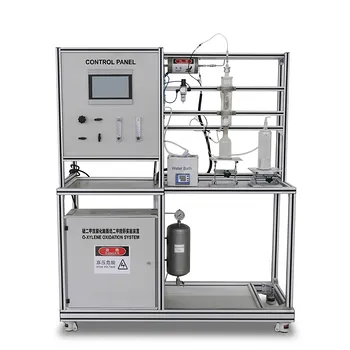
Activation energy is crucial because it determines how strongly reaction rates respond to temperature changes. In a pilot plant, a reaction with high activation energy can accelerate sharply after a small temperature increase, especially at relatively low operating temperatures. That sensitivity affects temperature-control requirements, heat-exchanger sizing, kinetic measurements, scale-up decisions, and the risk of thermal runaway.
Activation energy converts temperature variation into reaction-rate risk. Understanding its value allows engineers to predict rate changes, design adequate heating and cooling systems, and establish control and safety measures before operating at pilot or industrial scale.
Why Activation Energy Controls Temperature Sensitivity
The Arrhenius relationship
The relationship between activation energy and reaction rate is described by the Arrhenius equation:
[ k = A e^{-E/(RT)} ]
Here, (k) is the reaction-rate constant, (A) is the frequency factor, (E) is the activation energy, (R) is the gas constant, and (T) is absolute temperature.
Because temperature appears in the exponential term, a moderate temperature change can produce a much larger change in reaction rate.
High activation energy creates greater sensitivity
For two reactions at the same temperature, the reaction with the higher activation energy generally experiences the larger rate change for a given temperature increase.
This means high-activation-energy reactions require tighter temperature control, faster detection of deviations, and sufficient cooling capacity.
Temperature sensitivity also depends on operating temperature
The temperature sensitivity can be expressed approximately as:
[ \frac{d\ln k}{dT} = \frac{E}{RT^2} ]
For the same reaction and the same absolute temperature change, this sensitivity is greater at lower absolute temperatures because of the (T^2) term in the denominator.
The common rule that reaction rates double for every 10 °C increase is therefore only a rough approximation. The actual change depends on both activation energy and operating temperature.
How E Supports Safe Temperature Control
Small deviations can become large rate increases
In an exothermic reaction, an increase in temperature can increase the reaction rate. The faster reaction may then release heat more quickly, causing a further temperature increase.
This positive feedback can lead to thermal runaway if heat removal cannot keep pace with heat generation.
Cooling capacity must match reaction behavior
Activation energy helps engineers estimate how much the reaction rate may increase during a temperature excursion. That estimate is essential when selecting reactor jackets, coils, heat exchangers, and emergency cooling systems.
A cooling system designed only for normal operating conditions may be inadequate during an upset if the reaction rate rises sharply.
Control systems must respond quickly and accurately
Highly temperature-sensitive reactions require precise sensors, stable temperature control, and automated responses to deviations.
Pilot plants equipped with thermostatic jackets, digital temperature monitoring, and automated controllers allow engineers to evaluate whether the control system can maintain an isothermal condition under realistic operating disturbances.
Operating limits become more meaningful
Knowing (E) allows engineers to connect a temperature limit to a predicted reaction-rate limit. This supports the definition of alarm points, shutdown temperatures, maximum heating rates, and allowable operating ranges.
Without kinetic information, those limits may be based on general rules rather than the behavior of the specific reaction.
Why Pilot Plants Are the Right Testing Ground
Pilot plants reveal real thermal behavior
A pilot plant provides more realistic heat-transfer, mixing, residence-time, and control behavior than a small laboratory experiment.
This matters because reaction heat generation and heat removal may not scale proportionally. A system that is easy to control at laboratory scale can become more difficult to cool as throughput and equipment dimensions increase.
Controlled experiments identify activation energy
Engineers can operate the reaction at several controlled temperatures, measure the corresponding rate constants, and use the linearized Arrhenius form:
[ \ln k = -\frac{E}{RT} + \ln A ]
Plotting (\ln k) against (1/T) gives a slope of (-E/R), allowing the activation energy to be estimated.
Accurate temperature control is essential because temperature fluctuations distort the measured rate constants and reduce the reliability of the resulting Arrhenius plot.
Pilot data supports scale-up
Measured activation energy helps engineers predict how the reaction may behave at different temperatures during scale-up.
It can also reveal whether an apparent kinetic change is caused by temperature, transport limitations, mixing effects, or a change in reaction mechanism.
Operators can observe safety dynamics
Educational and research pilot plants make it possible to observe how controlled temperature changes affect concentration, reaction rate, and heat generation.
This connects kinetic calculations to operational decisions, such as when cooling must begin, how quickly a controller must act, and when a process should be stopped.
How E Improves Reactor and Heat-Transfer Design
Exothermic reactions require runaway analysis
For an exothermic reaction, engineers compare the rate of heat generation with the rate of heat removal.
Activation energy helps determine how rapidly heat generation may increase as temperature rises. A high value of (E) indicates that this comparison must be evaluated carefully over the full operating range, including abnormal conditions.
Endothermic reactions still need thermal analysis
Endothermic reactions consume heat, so their main concern may be maintaining the required reaction temperature rather than preventing runaway.
However, activation energy still determines how much the reaction slows when the temperature falls and how much heating capacity is needed to maintain the desired conversion and throughput.
Heat exchangers must handle transient conditions
Design should account for startup, shutdown, feed changes, control failures, and other transients, not only steady-state operation.
A reaction with strong temperature sensitivity may demand more rapid heat removal or a larger safety margin than steady-state calculations alone suggest.
Understanding the Trade-offs
Tight control improves safety but adds complexity
High-precision temperature controllers and redundant monitoring improve control of sensitive reactions.
They also increase equipment cost, instrumentation requirements, maintenance demands, and the need for properly configured alarms and interlocks.
Higher temperature may improve productivity
Increasing temperature often increases the reaction rate and can improve throughput or reduce required reactor volume.
The same increase may also accelerate unwanted reactions, reduce selectivity, increase heat release, or move the process closer to an unsafe operating condition.
Arrhenius data has practical limits
The Arrhenius equation is useful for a defined reaction and operating range, but its parameters should not be extrapolated blindly.
Changes in reaction mechanism, phase behavior, mixing, mass transfer, or heat transfer can cause the observed kinetics to deviate from a simple Arrhenius relationship.
Measured E may reflect more than intrinsic chemistry
If a pilot plant has transport limitations, the measured activation energy may be an apparent value rather than the intrinsic activation energy of the chemical reaction.
Accurate interpretation therefore requires attention to mixing, concentration measurement, heat transfer, and whether the reactor is genuinely operating under kinetic control.
Making the Right Choice for Your Goal
The activation energy should be treated as a design and safety parameter, not merely as a value calculated from laboratory data.
- If your primary focus is temperature control: Use the activation energy and operating temperature to estimate rate sensitivity, then select sensors, controllers, and heat-transfer equipment that can manage expected deviations.
- If your primary focus is thermal safety: Evaluate how increased reaction rates affect heat generation during temperature excursions, and provide alarms, shutdowns, emergency cooling, and sufficient heat-removal capacity.
- If your primary focus is kinetic measurement: Run experiments at several stable temperatures, measure rate constants consistently, and use an Arrhenius plot while checking for transport limitations.
- If your primary focus is scale-up: Combine activation-energy data with pilot-plant heat-transfer and mixing behavior before extrapolating reaction performance to industrial equipment.
Understanding activation energy gives engineers the evidence needed to control temperature deliberately, interpret pilot-plant data correctly, and manage reaction hazards before they become operational emergencies.
Summary Table:
| Key area | Why activation energy matters | Pilot-plant application |
|---|---|---|
| Temperature control | Predicts how strongly reaction rates change with temperature | Select precise sensors, controllers, alarms, and operating limits |
| Thermal safety | Estimates how quickly heat generation may rise during a temperature excursion | Assess runaway risk, emergency cooling, shutdowns, and interlocks |
| Heat-transfer design | Helps match heat removal capacity to reaction behavior | Size jackets, coils, heat exchangers, and cooling systems |
| Kinetic measurement | Supports calculation of rate constants and activation energy using Arrhenius data | Run stable experiments at multiple temperatures |
| Scale-up | Connects laboratory kinetics with pilot-scale mixing and heat-transfer behavior | Improve reactor design and predict industrial performance |
| Data interpretation | Reveals when measured kinetics are affected by transport limitations | Distinguish intrinsic chemistry from mixing or mass-transfer effects |
Design Safer, More Reliable Reaction Processes with LABPARK
Need to evaluate temperature sensitivity, reaction kinetics, or thermal safety before scaling up? Contact LABPARK to discuss your requirements.
LABPARK provides Educational and Vocational Unit Operations Pilot Plants for chemical engineering, bioprocess and biotechnology, and environmental and water-treatment applications. Our pilot plants help universities, research institutes, and enterprises measure reaction behavior, test temperature-control strategies, evaluate heat-transfer performance, and build practical scale-up data.
With the right pilot-scale equipment, your team can identify rate changes, assess cooling capacity, validate alarms and control systems, and reduce the risk of costly or unsafe process decisions.
Related Products
- Multi-Reactor Educational Pilot Plant for Reaction Engineering Unit Operations
- Fixed Bed Gas Solid Catalytic Reaction Educational Pilot Plant
- Fixed-Bed Chemical Reaction and Gas Dust Tar Removal Unit Operations Pilot Plant
- Tubular Reactor Flow Characteristics Determination Educational Unit Operations Pilot Plant
- Residence Time Distribution and Reactor Flow Characteristics Determination Educational Pilot Plant
People Also Ask
- How do reactor pilot plants define QbD design space? Master chemical process scale-up.
- When configuring a reactor unit operations pilot plant for highly exothermic reactions, how to prevent thermal runaway?
- How do metal ion-catalyzed reaction mechanisms inform chemical engineering pilot plant design? From kinetics to scale-up
- What are the barriers to process intensification & how do pilot plants help?
- What role do educational pilot plants play in scaling green chemistry? Bridging the Lab-to-Industry Gap