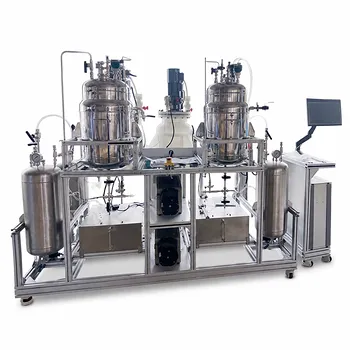
The total reflux operating state is the ultimate diagnostic tool for a distillation pilot plant. It strips away all feed and product variables, creating a pristine, steady-state condition that reveals the column’s intrinsic separation capability. During these runs, the Fenske equation directly converts measured endpoint compositions into the minimum number of theoretical stages required for that separation. Comparing this theoretical minimum to the actual stage count or packing height then yields a definitive measure of overall column efficiency and the Height Equivalent to a Theoretical Plate (HETP).
Total reflux is not about production—it’s about performance benchmarking. Operating under infinite reflux eliminates external disturbances, giving you a clear, feed‑free baseline of the column’s maximum separation limit. The Fenske equation then transforms laboratory samples into a precise efficiency metric, enabling you to pin down HETP and overall column effectiveness before tackling more complex partial‑reflux operations.
Why Total Reflux is the Laboratory’s Most Trusted Operating Point
A Self‑Stabilizing Condition for Teaching and Calibration
Total reflux requires zero operator intervention to maintain steady state.
No feed enters the column and no product is withdrawn, so the liquid and vapor inventories remain constant. The column naturally drives itself toward thermodynamic equilibrium, making it the perfect state for student experiments, instrument calibration, and control‑loop verification.
The Quickest Path to a Stable Startup
Engineers use total reflux to “condition” the column before introducing feed.
By running at total reflux during startup, the vapor‑liquid equilibrium profile establishes itself rapidly across all trays. Once stable, switching to a finite reflux ratio with feed introduction is far simpler, because the temperature and composition gradients are already in place.
The Only Way to Measure the True Separation Limit
At total reflux, the column achieves its minimum number of theoretical stages for a given separation.
No other operating mode can extract more separation power from the same hardware. This thermodynamic limit depends solely on the mixture’s relative volatility and the desired purities. Once you know this benchmark, every subsequent test at finite reflux can be measured against the ideal, revealing exactly how much efficiency is sacrificed when you dial back the reflux ratio.
How the Fenske Equation Turns Composition Data into Design Insight
Translating Distillate and Bottoms Samples into a Stage Count
The Fenske equation is a concise logarithmic relationship that uses only two measured mole fractions—the light key in the distillate (x_D) and in the bottoms (x_W)—alongside the average relative volatility (α_m).
By simply sampling the overhead and bottom vessels during a total reflux run, you calculate N_min, the theoretical number of equilibrium stages the column would need to achieve those purities under total reflux. No dynamic data, no flow measurements—just a clean snapshot of separation capability.
Bridging the Gap Between Theory and Real Hardware
Pilot columns are built with real trays, structured packing, or random packing—none of which behave as ideal equilibrium stages.
The Fenske‑derived N_min becomes your theoretical yardstick. If your column has 20 physical trays but N_min = 12, the overall tray efficiency is 60%. For packed columns, dividing the packed bed height by N_min gives the Height Equivalent to a Theoretical Plate (HETP). This single number—HETP—is the practical metric that engineers use to size industrial columns with confidence.
Evaluating Column Performance Beyond the Numbers
Visualizing the Separation on a McCabe‑Thiele Diagram
At total reflux the operating lines collapse onto the 45° diagonal, providing the maximum possible mass‑transfer driving force at every point.
The number of theoretical stages on the diagram matches the Fenske prediction exactly. When you later run the same column at a finite reflux ratio, you can see directly how much extra hardware is needed to compensate for the reduced driving force—making the abstract concept of “efficiency” tangible for students and operators alike.
From Pilot Data to Reliable Scale‑Up
HETP and overall stage efficiency are the two parameters that allow you to project the height and tray count of a full‑scale column.
By running a total reflux test on the pilot unit with your actual process mixture, you obtain a mixture‑specific efficiency. This substitutes generic vendor data with measured performance, de‑risking scale‑up because you now know exactly how your system separates—not how a “standard” system might behave.
Understanding the Trade-offs
Total reflux produces zero overhead product and consumes the full energy input in the reboiler and condenser, making it impractical for any production campaign.
Its value is entirely diagnostic and educational. Moreover, hydraulic behavior (flooding, weeping, liquid distribution) can differ substantially when feed and product streams are active. A column that performs beautifully at total reflux might still face operability issues under normal operation. Always supplement total reflux data with finite‑reflux tests to validate the complete operating envelope.
How to Apply This to Your Pilot Plant Goals
After a total reflux run, the path from raw composition samples to actionable insights is straightforward. The right follow‑up depends on your primary objective.
- If your primary focus is education or workforce training: Use total reflux as the first hands‑on experiment. The absence of feed‑and‑product balancing eliminates confusion, letting students focus purely on steady‑state operation, sampling, and the thermodynamic core of the Fenske equation.
- If your primary focus is pilot‑scale process development: Schedule a total reflux test early in your campaign to capture the mixture‑specific N_min and HETP. This baseline then anchors your reflux‑ratio optimization and energy‑consumption trade‑offs for all subsequent runs.
- If your primary focus is column troubleshooting or debottlenecking: Repeat the total reflux test and compare the measured HETP against the original design expectation. A significant increase in HETP is a clear signal of fouling, maldistribution, or mechanical damage that demands inspection.
- If your primary focus is scaling up to a commercial unit: Use the pilot‑plant‑derived HETP from the total reflux test to size the production column, then combine it with hydraulic data from finite‑reflux runs to stay safely within the operating window.
By mastering total reflux and the Fenske equation, you transform a simple pilot‑plant test into a precise diagnostic that underpins confident scale‑up, efficient operation, and a deep understanding of separation fundamentals.
Summary Table:
| Key Metric / Concept | Operational Definition | Application in Column Evaluation |
|---|---|---|
| Total Reflux | Zero feed input and zero product withdrawal. | Establishes a stable, disturbance-free baseline of maximum separation capability. |
| Fenske Equation | Calculates minimum theoretical stages (N_min) from endpoint compositions. | Translates distillate and bottoms purity data into theoretical stage requirements. |
| Stage Efficiency | Ratio of theoretical stages (N_min) to actual physical trays. | Benchmarks physical column tray performance against thermodynamic limits. |
| HETP | Packed bed height divided by N_min. | Provides the core scaling metric needed to design full-scale industrial packed columns. |
Optimize Your Separation Processes with LABPARK
Are you looking to enhance your laboratory's training capabilities or scale up your chemical processes with precision?
LABPARK provides state-of-the-art Educational and Vocational Unit Operations Pilot Plants in chemical engineering, bioprocess & biotech, and environmental & water treatment. Designed specifically for universities, research institutes, and enterprises, our pilot plants help you:
- Deliver hands-on training using safe, self-stabilizing total reflux operations.
- Acquire accurate baseline data (HETP and stage efficiency) for reliable scale-up.
- Calibrate and troubleshoot distillation columns with high-precision instrumentation.
Let us help you bridge the gap between theory and industrial reality. Contact our experts today to find the perfect pilot plant solution for your facility!
Related Products
- Continuous Sieve-Plate Distillation Pilot Plant for Unit Operations Laboratory Education
- Multi-Functional Special Distillation Educational Pilot Plant
- Continuous Batch Extractive Distillation Educational Pilot Plant
- Multi-Modal Distillation Unit Operations Training Pilot Plant
- Electrolyte Distillation Purification and Formulation Educational Pilot Plant
People Also Ask
- What are the primary reflux ratio control strategies? Master Distillation Unit Operations
- Why is vacuum operation capability an essential feature for a distillation unit operations pilot plant? Unlock Efficiency
- How does catalyst water concentration affect distillation pilot plant design? Key separation train choices.
- How to select the right activity coefficient model (Wilson, NRTL, UNIQUAC) for distillation pilot plants?
- How can real-time carbon number prediction improve distillation pilot plants? Optimize control.