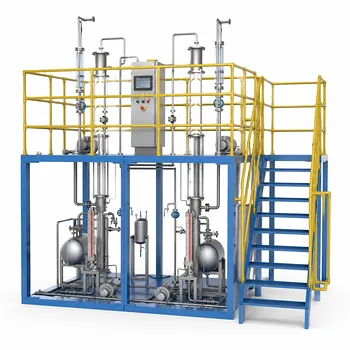
Aqueous solution thermodynamics isn’t just a classroom abstraction—it is the fundamental operating system that governs every reaction, separation, and transport process inside an environmental or water treatment pilot plant. Without a rigorous grasp of how dissolved ions, weak electrolytes, and minerals behave under real, non-ideal conditions, students cannot predict when a membrane will foul, a scaling event will occur, or a chemical dose will fail. Training on pilot plants transforms thermodynamic principles into direct, observable cause-and-effect relationships that are essential for designing robust purification and waste treatment processes.
The true value of thermodynamics in student training lies in its power to reveal the difference between idealized assumptions and the messy reality of multi-component, high-ionic-strength waters. Students who learn to model and measure that difference on a pilot plant emerge not just as operators, but as engineers who can anticipate and control critical process limits.
The Hidden Complexity of Real Aqueous Solutions
Water in environmental systems is never pure. It carries a cocktail of dissociated ionic species—sodium, chloride, heavy metals, carbonates, ammonium—that create a chemically reactive, electrically active matrix. The stability of these dissociated ions in water is what drives corrosion, electrochemical reactions, and the neutralization of pollutants.
When a student first assumes that a solution behaves “ideally,” they miss the very phenomena that dictate process success. Real solutions deviate dramatically from ideality because each ion interacts with its neighbors, altering the effective concentration available for any given reaction.
Why Ionic Strength Changes Everything
The total concentration of charged species, captured by the ionic strength (I), dictates how far a solution strays from ideal behavior. At low ionic strengths, dilute solution approximations may hold, but many environmental streams—landfill leachate, brine, industrial effluent—push ionic strength into regimes where ideal models fail completely.
In a pilot plant, a student can measure this failure directly. They might dose a chemical according to a simple stoichiometric prediction, only to discover that precipitation occurs at a completely unexpected solubility limit. That moment of surprise is the lesson that thermodynamic non-ideality is not a footnote—it is the central design constraint.
The Dominance of Multi-Component Interactions
A single contaminant rarely exists in isolation. Multi-component solutions containing weak electrolytes like ammonia or hydrogen sulphide simultaneously participate in phase equilibria and chemical reactions. For example, in steam stripping of wastewater, the distribution of volatile weak electrolytes between liquid and vapor phases depends on both physical volatility and the local pH-controlled speciation.
Training on pilot plants forces students to connect those dots. They see that adjusting the pH to drive off ammonia also shifts the carbonate equilibria, which in turn alters scaling potential. This interplay cannot be appreciated from a textbook alone.
Bridging Theory and Reality: Why Pilot Plants Are Essential
Classroom thermodynamics provides equations. A pilot plant turns those equations into physical consequences—a column flooding, a membrane losing flux, a rapid pressure rise. This lived experience is what builds true engineering judgment.
Defining the System to Control Energy and Safety
Before any meaningful experiment can occur, students must define the thermodynamic system, its boundaries, and the surroundings. In a pilot plant, the system is often the fluid inside a reactor or membrane housing, and the boundary is the vessel wall. Knowing whether that boundary is rigid or flexible, and how heat or work crosses it, is non-negotiable for calculating energy balances and preventing overpressure or thermal runaway.
Students who skip this step risk misdiagnosing a temperature spike as a “faulty heater” when it is actually an exothermic neutralization exceeding the cooling capacity. Thermodynamic discipline makes the invisible exchanges visible.
From Activity Coefficients to Process Decisions
The concepts that make aqueous solutions challenging—activity coefficients (molality-based (\gamma), molarity-based (y), or mole fraction-based (f)) and the osmotic coefficient ((\phi))—become tangible when a student collects data from a reverse osmosis unit. They can calculate the theoretical driving force assuming ideality, compare it with actual salt rejection, and watch the gap widen as ionic strength rises.
With guidance, they can apply virial expansion models like the Pitzer model or the classic Debye-Hückel equations (using empirical constants (A), (B), and ion-size parameters). This is not software busywork; it is the difference between ordering a membrane that will last two years and one that will scale in two weeks.
Key Thermodynamic Concepts Students Master Through Pilot Plant Training
A well-designed training sequence uses the pilot plant as a physical canvas to paint each core thermodynamic concept in observable color.
Activity Coefficients and Ionic Strength: The Calibration of Reality
Students measure ionic strength from conductivity or composition data, then compute activity coefficients. They learn that a divalent ion like (Ca^{2+}) depresses the activity coefficient far more than a monovalent ion of the same concentration, and they see this effect in altered precipitation pH values.
The pilot plant lets them validate whether the Debye-Hückel limiting law, an extended form, or a full Pitzer model is required. This calibration exercise grounds them in the vital practice of choosing the right level of model complexity for the stream at hand.
Osmotic Pressure and Membrane Processes
In membrane-based pilot plants—reverse osmosis, nanofiltration, forward osmosis—the osmotic coefficient directly controls the required operating pressure. A high-salinity stream creates an enormous osmotic pressure that must be overcome to produce permeate.
Students who calculate osmotic pressure using ideal assumptions will dangerously undersize pumps. Those who incorporate measured osmotic coefficients and account for concentration polarization at the membrane surface will understand the true energy cost and the physical limit of recovery. This is the practical translation of thermodynamic principles into equipment sizing and energy optimization.
Vapor-Liquid Equilibria with Reactive Species
Steam stripping of volatile weak electrolytes like ammonia, carbon dioxide, or hydrogen sulphide perfectly illustrates the marriage of phase equilibria and chemical reaction equilibria. The equilibrium condition—where the change in Gibbs free energy ((\Delta G)) is zero at constant temperature and pressure—defines the speciation and the partial pressures driving separation.
Students operating a stripping column learn that minimizing steam consumption is not just a heat balance exercise. It requires positioning the operating line relative to a VLE surface that shifts with pH and temperature. Thermodynamic insight is what prevents them from wasting steam by trying to strip a species that remains predominantly in a non-volatile ionic form.
Predicting Scale and Precipitation Before It Happens
Mineral precipitation, especially of sparingly soluble salts like calcium carbonate or barium sulphate, is a leading cause of downtime in water treatment. The thermodynamics of multi-component electrolyte solutions allow prediction of the saturation index.
Students train by taking a brine sample from the pilot plant, measuring composition and temperature, and calculating whether a particular mineral is under- or super-saturated. They then adjust chemical dosing—acid, antiscalant, or softener—and observe the result. This closes the loop between thermodynamic prediction and operational action, embedding a proactive mindset.
Understanding the Trade-offs
No single thermodynamic model or approach is universally sufficient, and pilot plant training must teach students to navigate these inherent tensions.
- Model Complexity vs. Operational Simplicity: The Pitzer model handles high ionic strengths and complex salt mixtures but requires extensive interaction parameters. Simpler models like Debye-Hückel are easier to implement but fail in concentrated brines. Students must learn to judge when additional accuracy justifies the computational and data-collection burden.
- Equilibrium Assumptions vs. Kinetics: Thermodynamics tells them if a reaction can happen and where equilibrium lies, but not how fast. In a pilot plant, a student might calculate that a certain precipitation is thermodynamically favored, yet see no solids form within the residence time. Recognizing this gap between thermodynamic potential and kinetic reality is critical for troubleshooting.
- Safety Margins Derived from Energy Balances: A perfectly calculated thermodynamic equilibrium can still lead to a dangerous thermal runaway if the system boundaries are poorly defined. Training must emphasize that neglecting heat exchange across a poorly insulated boundary can turn a benign endothermic mixing process into a locally overheated, exothermic event.
- Destructive vs. Non-Destructive Validation: In a pilot plant, students may want to push a stream to its precipitation limit to test a model. Teachers must emphasize that deliberately fouling a membrane or scaling a column imposes lost training time and cost, so students must develop the judgment to collect just enough data near the boundary without crossing into damaging territory.
Making the Right Choice for Your Training Focus
The specific thermodynamic emphasis in pilot plant training should align with the intended outcome for the student or research group.
- If your primary focus is training future plant operators: Emphasize practical correlations that translate ionic strength and temperature into actionable limits—maximum recovery, minimum antiscalant dose, and safe pH windows—so they develop rapid, rule-of-thumb judgment.
- If your primary focus is preparing process design engineers: Require deep engagement with activity coefficient models and the Pitzer framework so they can simulate high-salinity streams, predict scale, and specify equipment that remains robust across the full range of expected water chemistries.
- If your primary focus is developing water treatment researchers: Pair pilot plant operation with direct use of computational thermodynamic databases, challenging them to refine model parameters from experimental data and to propose improved operating regimens based on free-energy minimization.
- If your primary focus is safety and troubleshooting competence: Design experiments that deliberately expose students to off-specification conditions—within controlled limits—so they learn to recognize early thermodynamic warning signs such as unexpected heat release, pH drift, or pressure anomalies.
Mastering aqueous solution thermodynamics on a pilot plant does not mean memorizing equations; it means learning to read the story that the ions are telling you, and using that story to make water treatment processes predictable, efficient, and safe.
Summary Table:
| Thermodynamic Concept | Pilot Plant Application | Key Learning Outcome |
|---|---|---|
| Activity & Ionic Strength | Chemical dosing & solubility limits | Understand non-ideal solution behavior |
| Osmotic Pressure | Membrane separation (RO/NF) | Size pumps and predict membrane fouling |
| Vapor-Liquid Equilibria | Steam stripping of weak electrolytes | Optimize pH and steam consumption |
| Mineral Precipitation | Saturation index calculation | Predict and prevent system downtime |
Equip Your Institution with LABPARK Pilot Plants
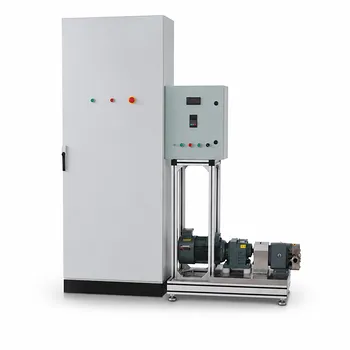
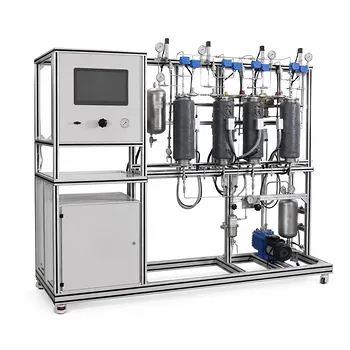
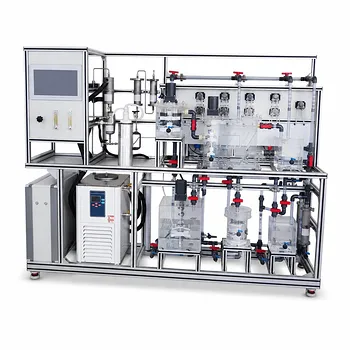
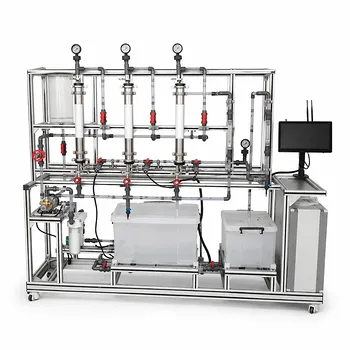
Bridging classroom thermodynamics with the realities of water treatment requires robust, hands-on training tools. LABPARK provides premium Educational and Vocational Unit Operations Pilot Plants across chemical engineering, bioprocess & biotech, and environmental & water treatment.
Specially designed for universities, research institutes, and enterprises, our pilot plants empower students and researchers to safely analyze ionic strength, mitigate scaling, and master real-world process boundaries.
Ready to elevate your training and research capabilities? Contact LABPARK today to discuss your customized pilot plant configuration.
Related Products
- Electrochemical Water Treatment Educational Unit Operations Pilot Plant
- Ion Exchange Water Purification Educational Pilot Plant for Engineering Unit Operations
- Multi-Functional Membrane Separation Educational Pilot Plant for Unit Operations Lab
- Dual-Mode Rectification Pilot Plant for Practical Training Unit Operations
- Solid Waste Pyrolysis and Refining Educational Pilot Plant for Unit Operations
People Also Ask
- What design features do educational electrochemical pilot plants utilize to manage gas liberation and water loss?
- How can unit operations pilot plants show lead-acid concentration vs state of charge? Real-time monitoring guide.
- How do educational electrochemical pilot plants scale up electrolysis? Master industrial engineering.
- How to Estimate Sulfate in Water Treatment Pilot Plant Deposits: Gravimetric Guide
- How can foaming be managed during steam generation experiments in water treatment unit operations pilot plants? Tips