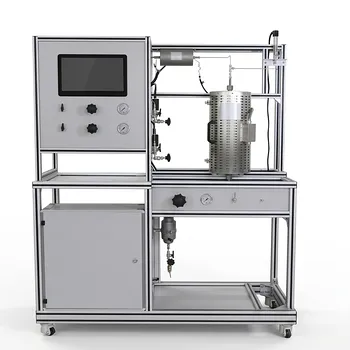
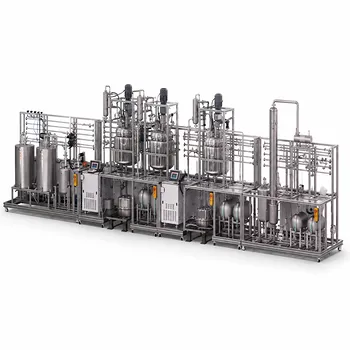
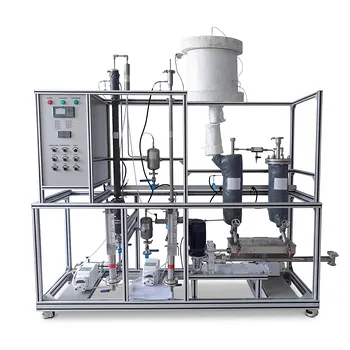
The choice is not an academic detail—it is the critical linchpin connecting your simulation software to the physical reality of your pilot plant. Selecting between NRTL, Wilson, or UNIQUAC directly determines whether your predicted temperature and concentration profiles will match the data from your distillation column, extraction unit, or decanter. An incorrect model forces your simulation to solve a different set of equations than the physics that govern your actual equipment, making experimental validation impossible.
Selecting an activity coefficient model is a binary decision that defines the fundamental limits of your pilot plant’s simulation. Before evaluating a single simulation result, you must recognize that choosing Wilson mathematically prohibits the prediction of liquid-liquid phase splitting, while selecting NRTL or UNIQUAC enables modeling of both vapor-liquid (VLE) and liquid-liquid equilibria (LLE).
The Cost of a Wrong Selection
Data Mismatch and Lost Validation
A pilot plant’s core function is to de-risk scale-up by validating physical behavior. When you simulate an ethanol-water distillation, the vapor-liquid equilibrium curve is the mathematical backbone of the separation.
If your chosen activity coefficient model inaccurately describes the liquid-phase non-idealities, the simulation will predict an incorrect number of theoretical stages or a faulty reflux ratio. This mismatch between the simulated and experimentally measured profiles means the pilot plant data cannot be trusted to design a commercial column.
The Hidden Boundary of the Wilson Equation
The most common pitfall is using the Wilson equation across the entire pilot plant by default. The Wilson equation is mathematically incapable of predicting liquid-liquid phase splitting.
It performs brilliantly for vapor-liquid equilibrium in completely miscible systems, such as alcohol-hydrocarbon mixtures. However, if your process forms two liquid phases—as in butanol-water extraction or a heteroazeotropic distillation with a decanter—Wilson will fail. The simulation will show a single liquid phase where two exist in reality, corrupting molar balance calculations and mass transfer rate predictions.
Matching Model Capability to Physics
Capturing Two Liquid Phases with NRTL
The NRTL (Non-Random Two-Liquid) model is preferred when you must characterize both VLE and LLE. It uses three binary interaction parameters to account for the local non-randomness of molecular interactions.
This allows NRTL to accurately calculate activity coefficients for highly non-ideal, partially miscible systems. In a pilot plant performing an extraction, this capability translates directly to accurately predicting solute partition coefficients. It lets you mathematically model the formation of two liquid phases and heterogeneous azeotropes, which is essential for sizing decanters and extraction stages.
Handling Molecular Size Differences with UNIQUAC
While NRTL is powerful, ambiguity can arise when regressing its three parameters from limited mutual solubility data. The UNIQUAC model solves this by separating the excess Gibbs energy into a combinatorial term and a residual term.
The combinatorial term accounts for molecular size and shape, while the residual term accounts for energetic interactions. This structure requires only two adjustable binary parameters, which can be uniquely determined from mutual solubility data. UNIQUAC is therefore mathematically more complex but more reliable for representing both VLE and LLE in multi-component mixtures with molecules of significantly different sizes.
Bridging the Data Gap
Generating Parameters from Pilot Plant Runs
These models are only frameworks—they require accurate Binary Interaction Parameters (BIPs). A pilot plant equipped with a VLE cell or a fractional distillation column exists to generate this data.
By measuring real-world temperature, pressure, and concentration data during plant operation, you can regress the experimental data to fit the chosen model. This correlation process transforms raw pilot plant measurements into simulation-ready parameters, directly enabling the scale-up from lab-scale unit operations to industrial columns.
Prediction When Data is Scarce
In the early stages of pilot plant testing, experimental data may be unavailable. This is where the UNIFAC group-contribution method becomes a critical bridge, integrated with the UNIQUAC model.
UNIFAC estimates the necessary binary interaction parameters by deconstructing molecules into functional groups. This allows you to build a working predictive simulation before any experimental run, which then guides the initial pilot plant trial planning.
Understanding the Trade-offs
Complexity vs. Reliability
No model provides absolute accuracy without cost. The NRTL model’s third parameter provides flexibility for strongly non-ideal systems but can lead to issues with parameter non-uniqueness when the data set used for regression is too narrow.
The Wilson equation is mathematically simpler and highly reliable for its niche (miscible VLE), but its inability to describe LLE is a hard, non-negotiable limitation. Users must resist the temptation to apply a single familiar model to every unit operation in the plant.
The Extraction-Specific Requirement
In liquid-liquid extraction, the governing thermodynamic principle is the isoactivity relationship. The concentration of solute in one phase multiplied by its activity coefficient must equal that in the second phase.
Accurate prediction of these activity coefficients is non-optional. It is the calculation that directly determines the partition coefficient, the solvent selection, and the required number of extraction stages. Selecting a model that cannot predict the liquid-phase split makes it impossible to optimize mass transfer rates under varying temperatures.
Making the Right Choice for Your Goal
The selection must be driven by the specific physics of your pilot plant’s mixture, not by software default settings.
- If your primary focus is a miscible distillation (e.g., alcohol-hydrocarbon): The Wilson equation provides excellent, reliable VLE predictions and is the most straightforward choice.
- If your primary focus is liquid-liquid extraction or decanting: You must use NRTL or UNIQUAC. Wilson is mathematically incompatible with this operation.
- If your primary focus is fitting limited mutual solubility data accurately: UNIQUAC’s two-parameter structure allows for a unique and reliable regression, avoiding the ambiguity of NRTL.
- If your primary focus is a heterogeneous azeotropic distillation: Select NRTL or UNIQUAC to model the vapor-liquid-liquid equilibrium and simulate the decanter’s phase split correctly.
The physical reality of your pilot plant does not change based on your menu selection in the simulator, but the simulator’s ability to perceive that reality does.
Summary Table:
| Thermodynamic Model | Phase Capability | Key Strengths | Best Application |
|---|---|---|---|
| Wilson | VLE only (Incapable of LLE) | Mathematically simple and highly reliable for miscible systems | Alcohol-hydrocarbon distillation |
| NRTL | VLE & LLE | Excellent flexibility for highly non-ideal, partially miscible systems | Liquid-liquid extraction, decanting |
| UNIQUAC | VLE & LLE | Accounts for molecular size/shape; requires only 2 parameters | Multi-component mixtures with diverse molecular sizes |
Bridge the Gap Between Simulation and Physical Reality with LABPARK
To ensure your simulations match real-world physical behavior, you need reliable experimental data. LABPARK provides state-of-the-art Educational and Vocational Unit Operations Pilot Plants in chemical engineering, bioprocess & biotech, and environmental & water treatment for universities, research institutes, and enterprises.
Our pilot plants are designed to help you accurately validate thermodynamic models, regress binary interaction parameters, and de-risk your commercial scale-up process.
Contact LABPARK today to equip your facility with the ultimate tools for hands-on learning and precise physical validation!
Related Products
- Fixed Bed Gas Solid Catalytic Reaction Educational Pilot Plant
- Multi Pump Fluid Transport Process Piping Unit Operations Training Pilot Plant
- Carbon Dioxide Hydrogen Methanol Synthesis Educational Unit Operations Pilot Plant
- Ethyl Acetate Synthesis Unit Operations Pilot Plant for Practical Training
- Natural Product Extraction Unit Operations Training Pilot Plant
People Also Ask
- How do reactor pilot plants safely study gas-solid reactions? Master kinetics with thermal & flow control.
- How does the Mears criterion evaluate transport resistance? Key Guide to Intrinsic Kinetics
- Fluidized vs. Fixed Bed Reactors: Comparing Heat & Complexity in Pilot Plants
- Why is a multibed configuration necessary for exothermic reactions? Optimize your pilot plant trajectory.
- How is the friction factor determined for fixed-bed pilot plants? Select the best pressure drop correlation.