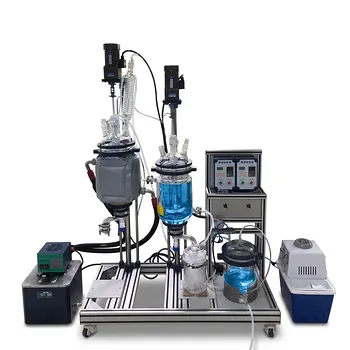
Efficiency is the driving force behind solvent screening for complex molecules. In a chemical engineering pilot plant, the NRTL-SAC model is preferred over UNIFAC because it directly addresses the fundamental failure of group-contribution methods for novel, rigid, or polyfunctional compounds. UNIFAC often fails when a molecule's functional groups are undefined or interact in a non-additive way, whereas NRTL-SAC simplifies the problem by characterizing the molecule using only four conceptual segments derived from a minimal set of experimental solubility data.
The core problem is that traditional predictive models break down for novel complex molecules, forcing researchers into costly trial-and-error experimentation. NRTL-SAC bridges this gap by using a handful of data points to create a semi-predictive framework that accurately maps non-ideal phase behavior, directly minimizing physical trial runs and solvent waste in a pilot plant setting.
The Fundamental Failure of Traditional Models for Novel Compounds
When working with a newly synthesized molecule in a pilot plant, you rarely have the luxury of extensive historical data. Traditional thermodynamic methods hit an immediate roadblock.
The Data Scarcity Problem with NRTL and UNIQUAC
Traditional correlative models, like the NRTL or UNIQUAC equations, are mathematically robust but data-hungry.
To use them for a new, complex solute, you would need to regress binary interaction parameters against an extensive set of experimental data for every solvent-solute pair. For a pilot plant study aiming to screen ten candidate solvents, this data simply doesn't exist. The experimental load to generate it would be so large it defeats the purpose of running a targeted pilot plant.
The Structural Limitations of UNIFAC
The UNIFAC model was designed to be predictive, eliminating the need for experimental data by using group contributions. However, it makes a critical assumption: a molecule's behavior is the sum of its functional groups.
For complex molecules, this breaks down. The necessary functional groups often aren't in the UNIFAC database. More importantly, proximity effects and molecular rigidity destroy the additivity rule. A bulky active pharmaceutical ingredient (API) with multiple ring structures will have strong intramolecular interactions that a list of independent functional groups cannot capture.
How the NRTL-SAC Model Addresses the Deep Need for Speed and Accuracy
NRTL-SAC bypasses structural complexity by focusing on thermodynamic surface interactions. This shift in philosophy is what makes it so powerful for crystallization and solvent screening.
The Four Conceptual Segments: A Universal Solvent Language
NRTL-SAC doesn't try to draw a molecular structure. Instead, it characterizes every molecule by its interaction with four "conceptual segments":
- Hydrophobic (X): Repels water.
- Hydrophilic (Y): Attracts water.
- Polar (Y-): Electrostatic interactions.
- Solvation (Y+): Other non-ionic, attractive interactions.
A molecule is defined solely by the relative strength of these four numbers. This framework translates a complex structural problem into a solvation chemistry problem.
Minimal Calibration, Maximal Prediction
This is the critical advantage for pilot plant operation. You don't need an exhaustive database.
You only need to measure the solubility of your complex molecule in a small, carefully chosen set of four to six reference solvents. From this minimal data, you regress the molecule's four segment numbers. Once characterized, you can accurately predict solubility in hundreds of other solvents and solvent mixtures, identifying optimal compositions for crystallization before stepping into the pilot plant.
Predicting Non-Ideal Behavior in Mixed Solvents
Crystallization from mixed solvents often reveals a non-intuitive solubility peak, where the mixture dissolves more than either pure solvent. This is a non-ideal, highly favorable phenomenon often missed by simpler models.
NRTL-SAC, built on the segment-based NRTL framework, is inherently designed to capture these non-ideal interactions. It can accurately map these peaks, allowing you to rationally screen for mixed-solvent systems that maximize yield in a cooling, evaporative, or drowning-out crystallization process, directly addressing the goal of controlling polymorphic selectivity and crystallization yield.
Connecting Model Selection to Pilot Plant Control and Polymorphs
The choice of model is not purely academic; it directly impacts the physical outcome in the pilot plant and the quality of the product.
Rational Solvent Screening Before the First Run
By using NRTL-SAC to identify the true solubility landscape, you fundamentally change the pilot plant workflow. You can use the model to rank solvents and rank mixed-solvent ratios to define the operating window for crystal growth before a single liter of solvent is heated or cooled.
This eliminates guesswork, minimizes solvent waste, and drastically reduces the experimental time required on the pilot plant.
The Link Between Solvation and Polymorphic Selectivity
Solvent selection is a primary driver of conformational polymorphism. As a target molecule, like an API, saturates a solution, the solvent environment stabilizes specific molecular conformations.
A higher population of a specific conformer in solution feeds the nucleation of the corresponding solid-form polymorph. By using NRTL-SAC to understand the molecule's solvation segment profile, you can rationally select solvents that are more likely to stabilize the target conformer, helping to avoid unexpected phase transitions during scale-up and ensuring the desired solid form is produced.
Understanding the Trade-offs and Practical Limitations
For all its power, NRTL-SAC is a simplifying model. Building trust requires a clear-eyed view of where it falls short.
The Limitation of Four Parameters
Characterizing a complex molecule with only four numbers is an abstraction. It treats molecules as smooth surfaces, but in reality, they are "bumpy" on an atomic scale.
The model can sometimes miss very specific, directional molecular interactions like a strong hydrogen-bonding donor-acceptor pair that creates a highly specific, one-off solvation shell. It's a powerful screening tool, not a perfect quantum-mechanical simulation.
The Garbage-In, Garbage-Out Principle
The accuracy of NRTL-SAC is entirely dependent on the quality of the small calibration dataset. You are shifting the experimental burden, not eliminating it.
If the solubility measurements in your reference solvents are inaccurate, or if you choose a poor set of reference solvents that doesn't represent the chemical space you want to explore, the predictions will be misleading. The model requires thoughtful experimental design upfront.
Computational Cost vs. Simpler Methods
While vastly more practical than UNIFAC for complex molecules, NRTL-SAC calculations are typically performed within process simulators. For a quick, back-of-the-envelope estimate, using a handful of known experimental data points is faster. NRTL-SAC's value proposition is its power to predict the unknown across a vast design space, not to replace a single measurement.
Making the Right Choice for Your Crystallization Goal
The decision to use NRTL-SAC should be driven by the nature of your molecule and the goal of your pilot plant study. It is a targeted tool for a specific, high-value problem.
- If your primary focus is screening for a novel, rigid API with unknown group contributions: NRTL-SAC is your only predictive modeling option. Use solubility data from a few reference solvents to build the model and screen a wide solvent space in silico first.
- If your primary focus is on a well-known molecule with standard functional groups: A traditional method like UNIFAC, if applicable, may be a valid starting point. However, always validate its prediction for solubility in pure solvents before trusting it for mixtures.
- If your primary focus is on liquid-liquid extraction (LLE) with well-defined components: The standard NRTL or UNIQUAC models, regressed from binary LLE data, are the workhorses. NRTL-SAC is for solute characterization, not for defining the phase behavior of the extracting solvent system itself.
- If your primary focus is accuracy at the expense of speed: There is no substitute for high-quality experimental data. Use NRTL-SAC predictions to intelligently narrow a field of 100 solvents down to 3 promising candidates, and then perform physical validation runs on those 3 in the pilot plant.
The model is a compass, not the destination. Use it to navigate the overwhelming complexity of solvent selection so your pilot plant time is spent on confirmation, not exploration.
Summary Table:
| Thermodynamic Model | Characterization Basis | Experimental Data Required | Ideal Application |
|---|---|---|---|
| NRTL-SAC | 4 Conceptual Segments (Hydrophobic, Polar, etc.) | Minimal (4-6 reference solvents) | Novel complex molecules, crystallization, & solvent screening |
| UNIFAC | Sum of independent functional groups | None (Predictive database-driven) | Simple, standard molecules with defined groups |
| Traditional NRTL/UNIQUAC | Binary interaction parameters | Extensive regressed binary data | Well-characterized systems, liquid-liquid extraction (LLE) |
Optimize Your Process Scale-Up with LABPARK
Transitioning from thermodynamic models to physical pilot plant validation requires reliable equipment. LABPARK provides premium Educational and Vocational Unit Operations Pilot Plants in chemical engineering, bioprocess & biotech, and environmental & water treatment.
Specifically designed for universities, research institutes, and enterprises, our pilot plants enable researchers to validate crystallization pathways, solvent screening models, and scale-up parameters with absolute precision.
Ready to elevate your engineering lab? Contact LABPARK today to find the perfect pilot plant solution for your institution.
Related Products
- Multi Functional Membrane Crystallization Educational Unit Operations Pilot Plant
- Potassium Salt Thermal Dissolution and Crystallization Separation Educational Unit Operations Pilot Plant
- Carbon Dioxide Absorption and Desorption Educational Pilot Plant for Carbon Capture Studies
- Multi-Functional Special Distillation Educational Pilot Plant
- Ethyl Acetate Synthesis Unit Operations Pilot Plant for Practical Training
People Also Ask
- Control Crystallization Pilot Plant Secondary Nucleation: 4 Key Adjustments
- Why is precise temperature control critical in crystallization pilot plants? Key to Scale-Up Success
- What key factors should be considered when configuring a crystallization unit operations pilot plant?
- How Crystal vs Amorphous Solids Guide Crystallization Pilot Plant Objectives
- What are the benefits of integrating online PAT tools like ATR-FTIR into crystallization unit operations pilot plants?