Knowledge Chemical Engineering Education Why is a multi-layer design preferred for gravity settling chambers? Boost pilot plant efficiency.
Author avatar

Tech Team · LABPARK

Updated 1 month ago

Why is a multi-layer design preferred for gravity settling chambers? Boost pilot plant efficiency.


The multi-layer design isn’t just an incremental improvement—it’s a fundamental engineering solution that multiplies capacity without expanding the equipment’s footprint. In gravity settling chambers used in chemical engineering separation pilot plants, a single-layer design’s processing capacity is capped by its horizontal floor area. Adding multiple horizontal plates creates a stack of parallel settling zones, effectively multiplying the total settling area by the number of gaps between plates. This directly boosts the volumetric flow rate the chamber can handle, while keeping the external dimensions compact—a critical advantage in crowded laboratory settings.

While a single-layer settling chamber’s capacity depends solely on its footprint area, inserting internal horizontal plates transforms the same physical volume into a stacked array of shallow settling zones. This dramatically increases throughput and separation efficiency by reducing the vertical distance particles must fall, making the multi-layer design indispensable for pilot‑scale demonstrations of gas‑solid separation.

Understanding the Limits of a Single-Layer Design

The Settling Area Bottleneck

In laminar flow, the maximum volumetric processing capacity ($V_s$) of a gravity settler is given by $V_s \le b \cdot l \cdot u_t$, where $b \cdot l$ is the horizontal settling area and $u_t$ is the particle’s terminal settling velocity. The chamber height ($H$) does not appear in this equation. This means that no matter how tall you build the chamber, its throughput can’t exceed what the floor area allows.

Why Height Doesn’t Help

Making a single‑layer chamber taller may increase gas residence time, but it doesn’t change the planar projection that determines capture. In fact, an excessively tall chamber can worsen performance by allowing settled particles to become re‑entrained or by creating stagnant zones that waste the extra volume. The footprint—and the footprint alone—caps the gas‑handling rate.

How Multi-Layer Chambers Overcome the Limitation

Multiplying the Effective Settling Area

Install $n$ horizontal plates, and you create $n+1$ distinct settling gaps. The capacity equation becomes $V_s \le (n+1) \cdot b \cdot l \cdot u_t$. This is identical to having multiple single‑layer settlers working in parallel, but all housed inside one vessel. The multiplication factor is purely geometric: more plates, more surface area, more throughput.

Shortening the Particle Settling Path

In a single‑layer chamber, a particle must fall the full height $H$ to be captured. Adding plates spaced 40–100 mm apart drastically reduces this distance. Because settling time is proportional to the falling distance, particles are removed much faster. This allows higher gas velocities while still achieving complete separation, further increasing the capacity per unit volume.

Compact Footprint for Pilot Plants

Pilot‑plant environments are tight on bench space. A multi‑layer chamber delivers the throughput of a much larger single‑layer unit in a benchtop‑sized module. It makes it practical to run unit operations experiments without needing large‑bay equipment, and it enables modular reconfiguration—students can swap plates or adjust spacing to directly measure the impact of increased settling area on dust removal efficiency.

Understanding the Trade‑offs

No design is without compromises. Multi‑layer chambers introduce a few practical considerations:

  • Plate spacing must be carefully chosen to avoid particle plugging. Educational units typically use 40–100 mm gaps as a balance between capacity and cleanability.
  • Cleaning and disassembly become more involved than a simple open chamber. Plates may need to be removable for thorough cleaning between runs involving coarse or sticky powders.
  • Flow distribution can become uneven if plates are not perfectly horizontal or if inlet geometry is poor. Uneven flow reduces the effective number of active layers and can hurt separation.
  • Pressure drop increases slightly due to the additional flow constrictions, though this is usually negligible compared to the capacity gain.
  • Weight and material cost rise with each added plate, but in pilot‑scale equipment the benefit of dramatically higher throughput per footprint outweighs these costs.

Making the Right Choice for Your Pilot Plant

  • If your primary focus is maximizing throughput in a limited space: Choose the multi‑layer design without hesitation. Optimize the plate count and spacing to meet your target capacity while keeping the unit easy to service.
  • If your primary focus is demonstrating separation principles: A modular multi‑layer chamber is ideal. It allows students to visually grasp how increasing settling area directly improves efficiency—a core concept in unit operations education.
  • If your primary focus is handling sticky or fibrous particles: Consider a single‑layer design with generous spacing, or use a multi‑layer chamber with easily removable plates and wider gaps. Always test for fouling before committing to a fixed configuration.

Ultimately, the multi‑layer settling chamber turns a fundamental geometric constraint into an elegant demonstration of process intensification, making it the go‑to choice for modern chemical engineering pilot plants.

Summary Table:

Feature Single-Layer Design Multi-Layer Design
Effective Settling Area Limited to chamber floor footprint ($b \cdot l$) Multiplied by number of internal plates ($(n+1) \cdot b \cdot l$)
Settling Distance Full height of the chamber ($H$) Shortened plate spacing (40–100 mm)
Throughput Capacity Lower (capped by floor area) Significantly higher within the same footprint
Footprint Efficiency Low (requires large space for high flow) High (ideal for compact lab bench spaces)
Maintenance & Cleaning Simple and direct Requires plate disassembly for sticky materials

Optimize Your Unit Operations Training with LABPARK

Maximize your laboratory space and training efficiency with LABPARK. We provide premium Educational and Vocational Unit Operations Pilot Plants in chemical engineering, bioprocess & biotech, and environmental & water treatment for universities, research institutes, and enterprises.

Whether you need modular gravity settling chambers or fully integrated process systems, our equipment delivers hands-on, industry-relevant learning in a highly compact footprint.

Contact us today to discuss your laboratory or training requirements!

Related Products

People Also Ask

Related Products

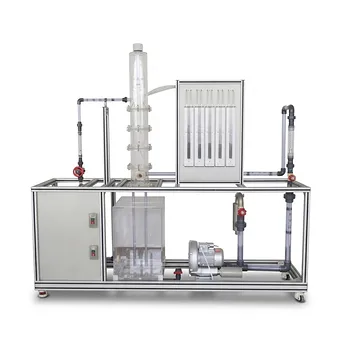
Gas-Solid Heterogeneous Separation Demonstration Educational Unit Operations Pilot Plant

Gas-Solid Heterogeneous Separation Demonstration Educational Unit Operations Pilot Plant

Comprehensive visual transparent gas-solid separation pilot plant for chemical engineering labs. Demonstrates gravity settling inertial settling cyclone and bag filter technologies. Enables real-time analysis of fluid-particle mechanics pressure drop and collection efficiency. Ideal for undergraduate unit operations courses.

Constant Pressure Filtration Educational Unit Operations Pilot Plant

Constant Pressure Filtration Educational Unit Operations Pilot Plant

Hands-on educational pilot plant for constant pressure filtration. Classic plate and frame filter press allows students to study kinetics, determine specific cake resistance, perform cake washing and evaluate washing rates. Ideal for chemical engineering curriculum. Mobile, customizable, safety-compliant design.

Rising and Falling Film Evaporation Educational Unit Operations Pilot Plant

Rising and Falling Film Evaporation Educational Unit Operations Pilot Plant

Hands-on educational pilot plant for studying rising and falling film evaporation, flow regimes, and heat transfer. Customizable for university labs with industrial instrumentation and data acquisition. Enables comparative evaluation of evaporation modes and energy efficiency.

Centrifugal Pump Performance and Orifice Flowmeter Calibration Educational Pilot Plant

Centrifugal Pump Performance and Orifice Flowmeter Calibration Educational Pilot Plant

This versatile educational pilot plant enables engineering students to conduct centrifugal pump performance tests, orifice flowmeter calibration, and fluid mechanics experiments using a transparent flow loop, industrial HMI, and 3D virtual simulation for a comprehensive hands-on learning experience.

Supercritical High-Gravity Flash Evaporation Educational Unit Operations Pilot Plant

Supercritical High-Gravity Flash Evaporation Educational Unit Operations Pilot Plant

Bench-scale integrated teaching system for advanced separation and mass transfer, combining supercritical high-gravity flash evaporation with heating, chemical reaction, and material collection, featuring modular design, Stainless Steel 316L construction, transparent visualization, touchscreen control, and safety systems for chemical engineering education.

Hot Filtration Educational Unit Operations Pilot Plant Laboratory System

Hot Filtration Educational Unit Operations Pilot Plant Laboratory System

This integrated laboratory bench-scale hot filtration pilot plant enables students to study solid-liquid separation under thermal conditions, featuring a stainless steel vessel, removable heating jacket, and multi-layer filter plates for unit operations education, ideal for chemical engineering laboratory curriculum.

Two-Dimensional Fluidization Hydrodynamics Educational Pilot Plant for Unit Operations Training

Two-Dimensional Fluidization Hydrodynamics Educational Pilot Plant for Unit Operations Training

Explore gas-solid and liquid-solid fluidization hydrodynamics with our transparent 2D educational pilot plant. Ideal for chemical engineering unit operations labs, it demonstrates fixed to fluidized bed regimes, measures pressure drop, and integrates QR-code digital learning for enhanced student training.

High-Gravity Emulsification and Mass Transfer Educational Pilot Plant

High-Gravity Emulsification and Mass Transfer Educational Pilot Plant

This integrated educational pilot plant utilizes rotating packed bed technology to demonstrate high-gravity emulsification and mass transfer, providing engineering students with hands-on experience in process intensification and unit operations through a modular, customizable design with digital monitoring.

Educational Rotary Disc Liquid-Liquid Extraction Pilot Plant

Educational Rotary Disc Liquid-Liquid Extraction Pilot Plant

A transparent rotary disc column for educational liquid-liquid extraction experiments. This pilot plant enables students to study mass transfer, droplet dynamics, and flooding behavior, bridging theory and practice in chemical engineering unit operations education. Features variable-speed agitation and PLC control.

Multi-Functional Membrane Separation Educational Pilot Plant for Unit Operations Lab

Multi-Functional Membrane Separation Educational Pilot Plant for Unit Operations Lab

The Multi-functional Membrane Separation Educational Unit Operations Pilot Plant is an integrated bench-scale laboratory system designed for teaching undergraduate engineering education. It features Ultrafiltration, Nanofiltration, and Reverse Osmosis modules in a compact, mobile unit for practical hands-on learning.

Two Phase Flow Pattern Velocity Resistance Measurement Educational Pilot Plant

Two Phase Flow Pattern Velocity Resistance Measurement Educational Pilot Plant

Benchtop educational pilot plant for university labs studying gas-liquid two-phase flow patterns, velocity, and resistance across circular, square, and rectangular conduits. Features 15.6-inch touchscreen, 5G connectivity, differential pressure sensors, safe water-air operation. Supports chemical engineering curricula.

Fluid Friction Resistance Determination Educational Unit Operations Pilot Plant

Fluid Friction Resistance Determination Educational Unit Operations Pilot Plant

Engineered bench-scale system for university engineering labs. Provides hands-on fluid mechanics experience: quantitative energy loss analysis, flow regime observation, friction coefficient determination. Features four-point pressure measurement, transparent sections, industrial touchscreen PLC, 3D virtual simulation. Ideal for chemical, mechanical, civil engineering.

Multi-Stage Stirred Tanks in Series Residence Time Distribution and Mixing Performance Determination Educational Pilot Plant

Multi-Stage Stirred Tanks in Series Residence Time Distribution and Mixing Performance Determination Educational Pilot Plant

Explore residence time distribution and mixing performance in series stirred tanks with this educational pilot plant. Real-time conductivity sensors, interactive 3D simulation, and industrial-grade PC for chemical engineering lab training. Customizable to curricula.

Centrifugal Pump Performance Determination Educational Unit Operations Pilot Plant

Centrifugal Pump Performance Determination Educational Unit Operations Pilot Plant

This lab system determines centrifugal pump performance curves for unit operations. Students configure dual pumps in series or parallel for hands-on learning. Includes industrial controls, clear piping, and data logging. Customizable for chemical, mechanical, and environmental engineering programs.

Orifice and Venturi Flowmeter Calibration Educational Pilot Plant for Fluid Mechanics Laboratory

Orifice and Venturi Flowmeter Calibration Educational Pilot Plant for Fluid Mechanics Laboratory

Enhance fluid dynamics education with the Orifice and Venturi Flowmeter Calibration Educational Unit Operations Pilot Plant, featuring transparent orifice and Venturi meters, industrial sensors, touchscreen interface for real-time data analysis and automatic coefficient calculations in engineering student laboratories.

Multi-Functional Special Distillation Educational Pilot Plant

Multi-Functional Special Distillation Educational Pilot Plant

Versatile multi-functional special distillation pilot plant for chemical engineering education. Supports continuous, vacuum, azeotropic, reactive, extractive distillation. Transparent glass columns enable real-time visual observation of hydrodynamics and separation processes.

Plate Column Hydrodynamics Tray Demonstration Educational Pilot Plant

Plate Column Hydrodynamics Tray Demonstration Educational Pilot Plant

Advanced transparent educational pilot plant for chemical engineering labs demonstrates plate column hydrodynamics with industrial sieve bubble cap serrated valve trays for visual observation of gas-liquid contact pressure drop measurement and operational limit analysis including flooding weeping entrainment

Bernoulli Equation Demonstration Unit Operations Pilot Plant

Bernoulli Equation Demonstration Unit Operations Pilot Plant

Laboratory pilot plant for Bernoulli's equation demonstration with transparent PVC pipes, 23 piezometer tubes for pressure measurement, and hands-on experiments. Designed for engineering education to study energy conservation, hydraulic grade line, and localized losses in fluid steady-flow systems.

Liquid-Liquid Mass Transfer Coefficient Determination Educational Pilot Plant

Liquid-Liquid Mass Transfer Coefficient Determination Educational Pilot Plant

This bench-scale educational pilot plant for liquid-liquid mass transfer coefficient determination offers precise control of phase boundary, temperature, and agitation, enabling hands-on study of transport phenomena and unit operations in chemical engineering labs for teaching.

Multifunctional Membrane Separation Educational Pilot Plant with Ultrafiltration, Nanofiltration, Reverse Osmosis

Multifunctional Membrane Separation Educational Pilot Plant with Ultrafiltration, Nanofiltration, Reverse Osmosis

An integrated laboratory bench-scale membrane separation system for higher education engineering labs combining Ultrafiltration, Nanofiltration, and Reverse Osmosis processes. Features industrial PLC control with touch-screen HMI, transparent piping, and academic assessment software. Ideal for chemical and environmental engineering curricula.


Leave Your Message