Knowledge Environmental and Water Treatment Education Why is the measurement of P-alkalinity and M-alkalinity critical in water softening pilot plants?
Author avatar

Tech Team · LABPARK

Updated 3 weeks ago

Why is the measurement of P-alkalinity and M-alkalinity critical in water softening pilot plants?


Alkalinity isn’t just a number—it’s the blueprint for your entire softening strategy.
In a water treatment unit operations pilot plant, measuring P-alkalinity (titrated to pH 8.3) and M-alkalinity (titrated to pH 3.9) is critical because these two values mathematically resolve the water’s true chemical identity. They tell you the exact split between hydroxide, carbonate, and bicarbonate ions. Without that breakdown, you cannot calculate the precise doses of lime or soda ash needed to precipitate calcium and magnesium hardness, making effective softening impossible.

The relationship between P and M alkalinity is the single most consequential diagnostic in a softening pilot plant. It determines which alkalinity species are present, dictates the exact chemical treatment pathway, and prevents both scale formation and caustic corrosion. Skipping these measurements strips away the control needed to turn solubility theory into reliable process performance.

Decoding the Alkalinity Puzzle

The Two-Point Titration Method

P-alkalinity (P) is the volume of standard acid required to lower the sample pH to 8.3.
At this point, all hydroxide is neutralized and any carbonate is exactly halfway converted to bicarbonate.
M-alkalinity (M, often called total alkalinity) is the additional acid needed to reach pH 3.9, completing the conversion of all bicarbonate to carbonic acid.
By comparing the P-to-M ratio, you immediately classify the alkalinity species present without guesswork.

The Five Diagnostic Relationships

The P and M values produce five clear chemical fingerprints:

  • P = 0: Only bicarbonate ions. No carbonate or hydroxide.
  • P < ½ M: A mixture of bicarbonate and carbonate. No hydroxide.
  • P = ½ M: Carbonate only. Virtually no bicarbonate or hydroxide.
  • P > ½ M: Carbonate plus hydroxide. Bicarbonate absent.
  • P = M: Hydroxide only. This is rare in natural waters.

These relationships are the pilot plant operator’s compass. They immediately reveal whether the water will consume lime, soda ash, or both during softening.

Why Alkalinity Directs the Softening Reactions

The Hardness Precipitation Puzzle

Chemical softening relies on converting soluble calcium and magnesium ions into insoluble precipitates.
Lime (Ca(OH)₂) supplies hydroxide to react with bicarbonate alkalinity and raises pH, while soda ash (Na₂CO₃) contributes carbonate to precipitate non‑carbonate hardness.
You cannot dose correctly without knowing which alkalinity forms—and how much—are already present.

Dosing Logic Tied to P and M

The stoichiometry is built directly on the P/M fingerprint:

  • P < ½ M (bicarbonate‑carbonate mix): You need lime to convert bicarbonate to carbonate so that calcium carbonate can form. Soda ash may still be needed for non‑carbonate magnesium.
  • P = ½ M (carbonate only): Lime demand drops dramatically because the water already contains the carbonate needed to precipitate calcium. Soda ash might be required for residual hardness.
  • P > ½ M (carbonate‑hydroxide): Excess hydroxide already exists; you likely need soda ash, not more hydroxide. Adding unnecessary lime could push pH into the caustic corrosion zone.

Using these relationships, students in a pilot plant calculate precise chemical dosages and directly observe the practical application of solubility product principles.

Practical Imperatives in a Pilot Plant Setting

Manual Titration as a Process Calibration Baseline

Before an online pH sensor can trust its own reading, it must be checked against the definitive manual alkalinity titration.
In educational pilot plants, the manual method with a mixed indicator (methyl red‑bromocresol green) is the bedrock for calibrating automated pH sensors and configuring dosing pumps.
Without mastering this baseline, students lose the ability to verify that an automation system is making correct real‑time decisions.

Real‑Time Process Control Feedback

Monitoring P and M alkalinity throughout a softening run provides a direct performance feedback loop.
If the treated water’s alkalinity shifts—say P climbs above half M—the operator immediately knows caustic overdosing has occurred.
This closes the gap between theory and dynamic process troubleshooting.

Avoiding After-Precipitation and System Fouling

Incomplete softening or improper alkalinity balance leads to calcium carbonate forming downstream in pipes, heat exchangers, or boiler feedwater lines.
By maintaining the correct carbonate/hydroxide balance validated through P and M, the pilot plant produces stable water that will not scale or corrode.

Understanding the Trade‑offs and Limitations

Interference from Other Buffering Ions

Phosphates, silicates, or organic acids can contribute to alkalinity or skew the P‑to‑M relationship.
In such cases, the simple five‑fingerprint model may over‑simplify the true buffer system, requiring supplementary tests or speciation software.

Temperature Sensitivity of the pH Endpoints

The pH at which carbonate and bicarbonate equivalence occurs shifts with temperature.
Pilot plant operators must use temperature‑compensated pH sensors, because a titration conducted at 80°C will not give the same P and M values as one run at 20°C unless corrected.

Not a Standalone Solution

Alkalinity measurements, while foundational, do not replace other essential analyses.
To prevent caustic embrittlement or foaming‑induced turbine deposits in boiler systems, the sulfate‑to‑alkalinity ratio and free hydroxide (B value) must be measured in addition.
Similarly, residual aluminum from upstream coagulation must be monitored separately; if it enters a lime‑soda softener’s effluent, it forms intractable analcite or gehlenite scales, regardless of alkalinity control.

Making Alkalinity Data Work for Your Pilot Plant

Strategies shift based on your educational or operational goal. Use the following to guide your experiments:

  • If your primary focus is precision softening: Let the P‑to‑½M comparison define the split between lime and soda ash demand. Adjust dosing in small increments while continuously re‑measuring P and M to stay within the carbonate‑stability window.
  • If your primary focus is process control education: Treat the manual titration as the reference standard for calibrating online pH analyzers and automated chemical feed systems. Log both manual and sensor data to quantify instrument drift and response time.
  • If your primary focus is industrial boiler feedwater protection: Expand beyond alkalinity to monitor the sulfate‑alkalinity ratio and free hydroxide (B value) after barium chloride addition, directly preventing caustic embrittlement and deposit formation.

Mastering the deceptively simple P and M titration gives you the confidence to translate a century‑old softening theory into a living, controllable pilot plant process.

Summary Table:

P vs. M Relationship Predominant Species Dosing & Process Implication
P = 0 Bicarbonate Requires lime to convert bicarbonate to carbonate
P < ½ M Bicarbonate & Carbonate Requires lime dosing; soda ash may be needed for magnesium
P = ½ M Carbonate Minimal lime needed; soda ash used for residual hardness
P > ½ M Carbonate & Hydroxide Hydroxide is in excess; avoid extra lime to prevent corrosion
P = M Hydroxide Hydroxide only; rare in natural waters, indicates caustic hazard

Bring hands-on water treatment theory to life with LABPARK. We provide advanced Educational and Vocational Unit Operations Pilot Plants in chemical engineering, bioprocess & biotech, and environmental & water treatment. Designed specifically for universities, research institutes, and enterprises, our systems help operators master critical processes like alkalinity titration, chemical dosing, and system calibration. Contact LABPARK today to discuss your laboratory's pilot plant needs!

Related Products

People Also Ask

Related Products

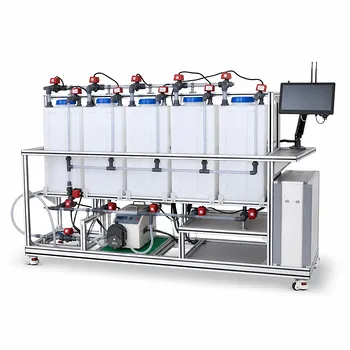
Electrochemical Water Treatment Educational Unit Operations Pilot Plant

Electrochemical Water Treatment Educational Unit Operations Pilot Plant

Enhance engineering education with this pilot-scale electrochemical water treatment plant. Designed for hands-on learning of efficient salt removal, electrolytic reactions, and real-time data acquisition. Features multi-mode control, corrosion-resistant PVC, low-voltage safety, and wireless connectivity for modern teaching labs.

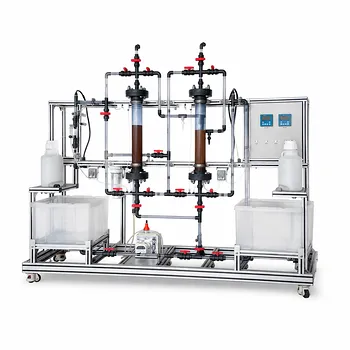
Ion Exchange Water Purification Educational Pilot Plant for Engineering Unit Operations

Ion Exchange Water Purification Educational Pilot Plant for Engineering Unit Operations

This bench-scale ion exchange pilot plant trains engineering students in water purification. Dual transparent columns simulate industrial softening and demineralization. Students observe fluid dynamics, perform resin regeneration, and analyze breakthrough curves. The corrosion-resistant frame ensures durability in unit operations experiments.

Dual-Mode Rectification Pilot Plant for Practical Training Unit Operations

Dual-Mode Rectification Pilot Plant for Practical Training Unit Operations

Industrial-scale dual-mode rectification pilot plant for chemical engineering practical training. Features real-material and simulated-material operation modes, sieve-plate column with sight glasses for visual observation of hydrodynamics, and customizable SCADA control for safe, hands-on learning of unit operations and mass transfer.

Multi-Functional Membrane Separation Educational Pilot Plant for Unit Operations Lab

Multi-Functional Membrane Separation Educational Pilot Plant for Unit Operations Lab

The Multi-functional Membrane Separation Educational Unit Operations Pilot Plant is an integrated bench-scale laboratory system designed for teaching undergraduate engineering education. It features Ultrafiltration, Nanofiltration, and Reverse Osmosis modules in a compact, mobile unit for practical hands-on learning.

Alkaline Membrane Water Electrolysis Educational Pilot Plant Unit Operations Training System

Alkaline Membrane Water Electrolysis Educational Pilot Plant Unit Operations Training System

Hands-on educational pilot plant for alkaline membrane water electrolysis hydrogen production, integrating unit operations training with industrial PLC control, real-time data logging, customizable design, durable 316L stainless steel construction, explosion-proof safety, and modern 5G connectivity for university laboratories.

Thermal Desorption Exhaust Gas and Tail Water Treatment Educational Pilot Plant

Thermal Desorption Exhaust Gas and Tail Water Treatment Educational Pilot Plant

Bench-scale educational pilot plant for treating thermal desorption exhaust gas and tail water integrates condensation, Fenton oxidation, precipitation, filtration, and carbon adsorption. Ideal for chemical engineering and environmental labs, teaching unit operations, process control, and real-time data analysis.

Multi-Modal Distillation Unit Operations Training Pilot Plant

Multi-Modal Distillation Unit Operations Training Pilot Plant

Multi-modal distillation pilot plant for practical unit operations training in chemical engineering education. Features real, analog, and semi-physical simulation modes, industrial construction, customizable for university labs. Hands-on fractionation columns, SCADA control, safety systems. Includes sight glasses, sampling ports, closed-loop recycling.

100L Continuous Loop Hydrogenation Educational Unit Operations Pilot Plant

100L Continuous Loop Hydrogenation Educational Unit Operations Pilot Plant

This 100L continuous loop hydrogenation pilot plant is designed for chemical engineering education, featuring 316 stainless steel construction, advanced gas-liquid mass transfer components, explosion-proof safety systems, and a 15.6-inch touchscreen with 5G connectivity, cloud data logging, bridging theory and industry.

Multi Pump Fluid Transport Process Piping Unit Operations Training Pilot Plant

Multi Pump Fluid Transport Process Piping Unit Operations Training Pilot Plant

Industrial-scale multi-pump pilot plant for unit operations training in fluid transport and process piping, featuring real-material and semi-physical simulation modes, comprehensive pump and flowmeter calibration, and safety-enhanced two-tier platform, bridging academic theory and industrial practice for chemical engineering education.

Electrolytic Hydrogen Production Educational Unit Operations Pilot Plant

Electrolytic Hydrogen Production Educational Unit Operations Pilot Plant

Bench-scale electrolytic hydrogen production pilot plant designed for university engineering labs. Provides hands-on training in water electrolysis, gas-liquid separation, and process safety. Fully customizable system with digital PID control, corrosion-resistant components, and hydrogen gas detector. Ideal for chemical engineering curricula.

Quantitative Dosing and Liquid Flow Control Educational Unit Operations Pilot Plant

Quantitative Dosing and Liquid Flow Control Educational Unit Operations Pilot Plant

Explore industrial fluid transport and automated process control with this quantitative dosing and liquid flow control educational pilot plant, featuring local and remote control cabinets, variable speed metering pump, high-precision flow sensors, and PLC-based SCADA integration for engineering students.

Multi-Reactor Educational Pilot Plant for Reaction Engineering Unit Operations

Multi-Reactor Educational Pilot Plant for Reaction Engineering Unit Operations

Integrated bench-scale educational pilot plant for chemical engineering teaching featuring fixed bed fluidized bed and stirred tank reactors with web-based digital twin controls and safety interlocks for hands-on unit operations and reaction engineering comparative studies in one compact system.

Natural Product Extraction Unit Operations Training Pilot Plant

Natural Product Extraction Unit Operations Training Pilot Plant

Integrated natural product extraction pilot plant for chemical engineering training bridges theory and industrial practice with modular extraction and evaporation/concentration units, hybrid touchscreen and manual control, realistic process simulation, and self-contained softened water and vacuum utilities.

Fixed-Bed Chemical Reaction and Gas Dust Tar Removal Unit Operations Pilot Plant

Fixed-Bed Chemical Reaction and Gas Dust Tar Removal Unit Operations Pilot Plant

Integrated educational pilot plant for studying catalytic gas-solid reactions and downstream gas purification. Features dual fixed-bed reactor, three-stage heating, and touchscreen control for hands-on engineering training. Ideal for chemical and environmental engineering curricula.

Comprehensive Fluid Mechanics Educational Unit Operations Pilot Plant

Comprehensive Fluid Mechanics Educational Unit Operations Pilot Plant

Hands-on fluid mechanics pilot plant for engineering education covering over 13 principles including pipe flow, minor losses, flowmeter calibration, and pump performance with industrial-grade components, smooth and rough piping, venturi and orifice flowmeters, and centrifugal pump testing and analysis.

Solid Waste Pyrolysis and Refining Educational Pilot Plant for Unit Operations

Solid Waste Pyrolysis and Refining Educational Pilot Plant for Unit Operations

This pilot plant for solid waste pyrolysis and refining integrates pyrolysis, separation, distillation, and catalytic hydrogenation into one educational unit. It provides visual process observation, smart data logging, and industrial safety for hands-on learning of engineering unit operations.

Dual Mode Heat Transfer Pilot Plant for Unit Operations Training

Dual Mode Heat Transfer Pilot Plant for Unit Operations Training

Engineering-scale dual-mode heat transfer pilot plant for hands-on unit operations training in chemical engineering. Features real and simulated modes, multiple heat exchanger types, comprehensive coefficient determination, and advanced process control with data acquisition for engineering students and researchers.

Multi-Functional Drying Educational Unit Operations Pilot Plant

Multi-Functional Drying Educational Unit Operations Pilot Plant

Versatile multi-functional drying educational unit operations pilot plant integrating tunnel, fluidized bed, and spray drying. Enables hands-on study of drying curves, psychrometry, and gas-solid separation for chemical engineering curriculum in higher education labs.

Tubular Reactor Flow Characteristics Determination Educational Unit Operations Pilot Plant

Tubular Reactor Flow Characteristics Determination Educational Unit Operations Pilot Plant

Educational pilot plant for investigating tubular reactor flow characteristics and residence time distribution Features adjustable recycle for plug flow and backmixing studies industrial touchscreen interface and real-time data acquisition Ideal for chemical engineering unit operations laboratory training and education

Bio-fermentation Ethanol Production Practical Training Unit Operations Pilot Plant

Bio-fermentation Ethanol Production Practical Training Unit Operations Pilot Plant

Bio-fermentation ethanol production pilot plant for hands-on training in unit operations: fermentation, solid-liquid filtration, membrane separation, and distillation. Bridges theory with industrial practice using industrial-grade components, customizable for university labs. Hybrid automated and manual control for comprehensive learning.


Leave Your Message