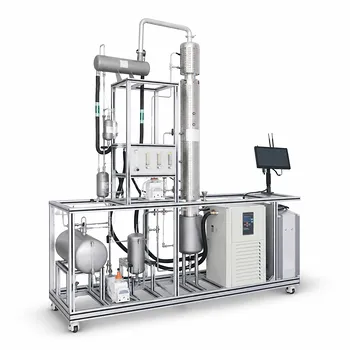
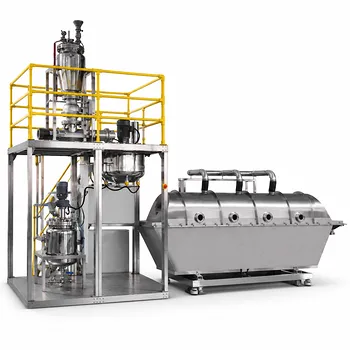
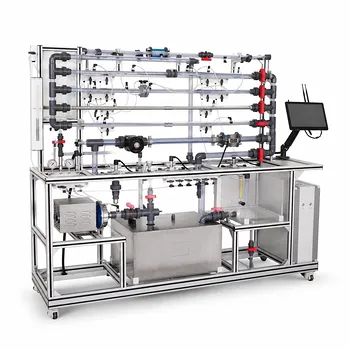
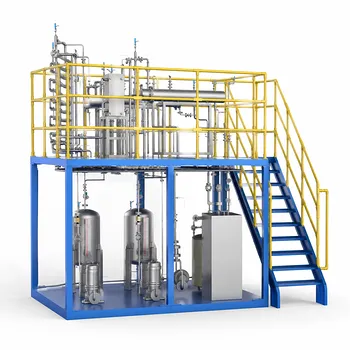
The integration of process economic analysis software transforms a pilot plant from a mere experimental apparatus into a powerful business simulator. By connecting the hands-on operation of unit operations with immediate cost estimation tools, students don't just learn how to run a distillation column—they learn how to judge if running it a certain way is profitable. This creates a complete learning loop, marrying the physical reality of pump curves and temperature profiles with the financial reality of capital investment and raw material costs.
The core value is in closing the critical skills gap. A pilot plant provides process data (the "what"), but economic software provides business judgment (the "so what"). This integration teaches students to see every operational adjustment—like a 5% yield change—as a line item on a cash flow statement, directly bridging the gap between the shop floor and the boardroom.
Understanding the Complete Learning Loop
The power of this integration lies in connecting two halves of an engineer's brain that are often trained separately. The physical pilot plant provides the concrete, tactile data, while the software provides the abstract, strategic context. Neither is complete on its own.
From Operational Data to Financial Metrics
A pilot plant generates streams of raw data: temperatures, pressures, flow rates, and product purity levels. In isolation, these are just numbers. Economic analysis software acts as a universal translator for this data. It turns operational performance into the language of business—capital expenditure (CAPEX), operating expenditure (OPEX), and return on investment (ROI). For instance, a student might record a specific steam flow rate to a reboiler. The software instantly translates that utility consumption into an operating cost per hour, making the financial weight of that energy use viscerally clear.
Simulating Inside Battery Limits (ISBL) Investment
The primary reference highlights how tools like Aspen ICARUS-based software allow students to move beyond basic cost equations. They can input parameters directly from their pilot runs to estimate equipment procurement and installation costs. This demystifies the concept of ISBL investment for a separation or reactor system. Students learn that a higher-efficiency column that saves on utilities might demand a prohibitive upfront capital investment, a trade-off that forms the bedrock of process design economics.
Preparing for Real-World EPC Projects
Engineering, procurement, and construction (EPC) projects are driven by rigorous economic gatekeeping. By using these tools in an educational setting, students rehearse for this reality. They learn to justify a process modification not just with a better yield percentage, but with a calculated simple payback period. As the supplementary references note, this involves dividing the total pilot-scale investment by the real annual savings from, for example, reduced raw material use. This practiced workflow is directly transferable to justifying capital projects in industry.
Making Theory Concrete with Payback Calculations
A central educational benefit is turning an abstract concept like "payback period" into a tangible exercise grounded in physical reality. The student becomes a mini-CFO for their own experiment.
The 5% Yield Improvement Case Study
Consider a student who tweaks a reactor's temperature, raising yield from 70% to 75%. The economic software forces the next logical question: "What is that 5% actually worth?" The supplementary references detail this exact scenario. The student must calculate the annual value of the saved raw material or the extra product. They then divide the hypothetical investment needed for that temperature adjustment (a new controller, more heating tape) by that annual savings. The result is a concrete payback period, turning a theoretical performance gain into a defensible business case.
Connecting Sensitivity to Profitability
Process economics software enables dynamic sensitivity analysis. Students can perturb key variables—raw material price, product selling price, utility cost—and watch the project's net present value (NPV) or payback period react in real time. This teaches a crucial lesson: a process design that is profitable under one set of economic assumptions can be a disaster under another. It shifts their thinking from absolute performance to risk-managed performance, a hallmark of a mature engineer.
Bridging the Gap to Industrial Retrofitting
Integrating these tools with pilot plants also unlocks the ability to teach plant revamping, a critical industrial skill that is notoriously difficult to replicate in academia due to a lack of live plant data.
Pilot Plants as Data Sources for Revamp Projects
The supplementary references are clear on this: live industrial operating data for revamps is scarce. A fully instrumented pilot plant solves this problem. It becomes the live plant students are tasked with "revamping." They can establish baseline mass and energy balances from their physical runs, build a validated simulation model, and then use economic software to evaluate the cost viability of a simulated revamp, like adding a parallel heat exchanger to debottleneck the process. The economic tool provides the go/no-go criterion for their engineering fix.
Addressing the Hidden Cost of Sustainability
Modern unit operations must account for environmental impact, and economic software turns a regulatory obligation into a quantitative design parameter.
Pricing the Treatment of the "Three Wastes"
Physically integrating an environmental treatment unit, as mentioned in the references, teaches the process. Integrating the economic software teaches the business driver behind it. Students learn that treating wastewater or scrubbing an exhaust gas isn't free. They can model the capital cost of a neutralization system and the ongoing cost of sorbent material. This quantifies the financial penalty of pollution, making sustainability a tangible line item in their process economics rather than an abstract ideal. They are trained to optimize for both profit and planet, seeing the cost-benefit directly.
Understanding the Trade-offs
This approach, while powerful, is not without its pedagogical risks. A balanced implementation is key to building true expertise rather than superficial competence.
The "Black Box" Danger
Economic software, if used without critical thought, can become a black box. A student might input numbers and accept a "payback period" output without understanding the underlying estimating methodology or its assumptions. The primary reference implies this by focusing on the "how" of inputting data. Educators must ensure the curriculum peels back the layers of the calculation.
The Pitfall of Spurious Accuracy
Pilot plant data contains errors, fluctuations, and scale-specific phenomena. Feeding this imperfect data into a detailed economic model can create a dangerous illusion of spurious accuracy. A student might report a payback period of 2.37 years, but the real value might be between 1.5 and 3.5 years. The critical lesson, therefore, is to interpret the output within a probabilistic and sensitivity-driven framework, not as a deterministic, absolute truth. The goal is sound judgment, not impressive but meaningless precision.
Making the Right Choice for Your Curriculum
Integrating these tools should be a deliberate strategy tailored to your specific educational outcomes. The focus should always be on the decision-making skill being built, not just the software button being pressed.
- If your primary focus is cultivating EPC-ready graduates: Prioritize the CAPEX estimation modules. Have students design a separation sequence on the pilot plant and then cost the entire ISBL using their own operational data as the design basis. The assessment is the capital cost justification document they produce.
- If your primary focus is strengthening process design economics: Anchor the integration around payback period and sensitivity analysis exercises. Task students with a specific physical modification on the pilot plant and require them to justify its funding with a one-page ROI analysis drawn directly from their before-and-after pilot data.
- If your primary focus is teaching sustainable engineering: Combine the economic software with the environmental treatment unit specifically. The core assignment should be an economic evaluation of different waste treatment trains, proving that compliant, profitable operation is the ultimate design goal.
The ultimate aim is to graduate an engineer who can touch a valve, see the data on a screen, and instantly perceive the economic pulse of the entire process.
Summary Table:
| Key Integration Aspect | Educational Impact | Real-World Application |
|---|---|---|
| Data Translation | Converts raw pilot data (yield, utilities) into CAPEX, OPEX, and ROI. | Simulates industrial budgeting and cost control. |
| Payback Calculations | Teaches students to calculate payback periods for physical modifications. | Prepares graduates for project justification in EPC firms. |
| Risk & Sustainability | Models the cost of waste treatment and runs dynamic profitability sensitivity analyses. | Teaches risk management and economic sustainability. |
Empower the Next Generation of Engineers with LABPARK
Ready to bridge the gap between engineering theory and industrial business reality? LABPARK provides state-of-the-art Educational and Vocational Unit Operations Pilot Plants across chemical engineering, bioprocess & biotech, and environmental & water treatment.
Designed specifically for universities, research institutes, and enterprises, our advanced pilot plant systems help students master both physical process operations and financial economic analysis.
Contact LABPARK today to explore how our pilot plants can enhance your engineering curriculum!
Related Products
- Multi-Reactor Educational Pilot Plant for Reaction Engineering Unit Operations
- Carbon Dioxide Hydrogen Methanol Synthesis Educational Unit Operations Pilot Plant
- Ethyl Acetate Synthesis Unit Operations Pilot Plant for Practical Training
- Multi Pump Fluid Transport Process Piping Unit Operations Training Pilot Plant
- Multi-Modal Distillation Unit Operations Training Pilot Plant
People Also Ask
- How do educational unit operations pilot plants address safety and waste management when scaling up?
- How do educational unit operations pilot plants bridge theory and design? Bridge the Engineering Gap
- Why Compare Predicted and Experimental Excess Enthalpy? Key to Accurate Pilot Plant Scale-up
- How to study gasification in pilot plants? Compare exit gas composition & efficiency
- Why Use PTFE & Hastelloy in Chemical Pilot Plants? Prevent Corrosion & Ensure Safety