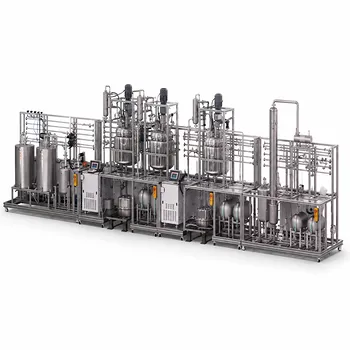
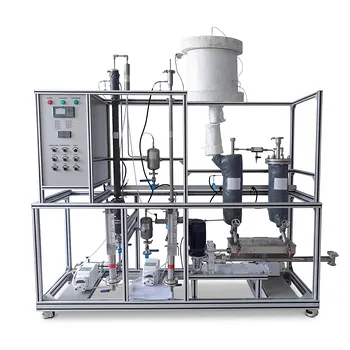
Automating safety is not an optional upgrade—it’s the foundational element that transforms a pilot plant from a potential hazard into a powerful educational tool. In educational chemical engineering and environmental pilot plants, integrating automatic interlocks and protection systems is essential because they act as an unforgiving digital guardian. When a student inevitably makes a setup error or a process veers toward a dangerous state, the system intervenes in milliseconds—shutting down pumps, cutting off heat, or opening relief paths—to prevent equipment damage and, most critically, to protect the learner from the very hazards they are studying.
The integration of automatic safety interlocks solves a fundamental tension in education: you must expose trainees to realistic industrial processes involving high pressures, temperatures, and corrosive chemicals, but you cannot expose them to real-world risk. An automated protection system bridges this gap, safeguarding both people and capital equipment while teaching the discipline of industrial safety protocols.
The Unblinking Guardian: What an Interlock Does Physically and Pedagogically
The immediate value of an automatic interlock is its speed and impartiality. Educational pilot plants in chemical and water treatment often handle high-temperature, high-pressure, or corrosive media. A student who is still learning to scan multiple gauges can easily miss a critical trend. The interlock system never blinks.
It Removes Human Reaction Time from the Equation
When a process parameter—like reactor pressure or a low raw material flow that could lead to a thermal runaway—crosses its safe limit, a human operator might take tens of seconds to notice, diagnose, and act. An automatic interlock triggers alarms, de-energizes heating elements, or closes solenoid valves within seconds. This speed is the difference between a harmless alarm and a burst pressure relief disc.
It Embeds the Concept of Independent Protection Layers
A core principle of industrial safety is that the primary control loop should not be the only line of defense. Supplementary references highlight the need for an independent shutdown path—for example, a dedicated low-liquid-level switch that hardwires a pump shutdown, separate from the PLC’s software alarm. Experiencing this hardware-layer redundancy in a pilot plant teaches students that safety is not a feature you program into the primary controller; it's a separate, failsafe architecture.
It Transforms a Mistake into a Memorable Lesson
In a purely manual setup, a serious error might simply damage a pump or shatter a glass column—an expensive and demoralizing event. With an interlock, the same mistake triggers a sequential response: a flashing light and horn activate, the fuel or power cuts off, the system enters a safe lockout state, and the student must physically press a silence button and then a manual reset only after the fault is corrected. This ritualistic recovery process cements the cause-and-effect relationship of industrial safety procedures far more effectively than any textbook warning.
Building a Foundation for Modern, Automated Industry
Pilot plants are not just safety classrooms; they are miniature replicas of the automated facilities students will eventually operate. Interlocks are the entry point to understanding the full spectrum of digital process control.
From Simple Shutdowns to Programmable Logic Controllers (PLCs)
An interlock system as described in the references is essentially a PLC-based Emergency Shutdown (ESD) logic loop. Inputs from sensors (flame detectors, flow switches, temperature transmitters) are continuously evaluated. If the logic detects a violation—such as a flame-out in a combustion heater—it immediately executes a predefined matrix of actions: cutting off the fuel supply via a solenoid valve while simultaneously triggering audiovisual alarms. By working with these systems, students learn how ladder logic translates physical conditions into safety actions, a skill directly transferable to overseeing entire SCADA-driven production lines.
The Bridge to Real-Time Quality and Green Chemistry
Once students understand that a sensor signal can trigger an immediate shutdown, they can grasp the next evolutionary step: a sensor signal triggering an immediate process adjustment to prevent waste. Online sensors for pH, spectroscopy, or turbidity, integrated with the same PLC infrastructure, enable real-time monitoring of reaction kinetics and product purity. This allows for immediate parameter corrections that stop the formation of unwanted by-products, minimize off-spec batches, and reduce raw material consumption—directly applying the green chemistry principle of pollution prevention through real-time analysis.
Mastering the Full Data Story
Industrial sensors measure more than just trip values; they output continuous data for viscosity (mPa·s), pressure (kPa), and flow (m³/h). Interlock systems force students to interact with these physical units during commissioning and testing. They must perform real-time data acquisition, convert signals, and verify that a low-flow trip point actually prevents a pump from cavitating. This hands-on work with industrial-grade transmitters and digital control systems is the most effective way to train competent process troubleshooters who can perform accurate mass and energy balances.
From Plant Safety to Planetary Responsibility
The protective logic of an interlock extends naturally to environmental unit operations that are now standard in modern chemical engineering curricula.
Containing the "Three Wastes" Within a Safe Learning Loop
Pilot plants that incorporate treatment modules for exhaust gases, wastewater, and solid residues rely on the same interlock philosophy. A scrubber system may have a low-pH interlock that stops the exhaust fan if the neutralizing solution fails, preventing the release of untreated fumes into the lab. A neutralization tank may have a high-level interlock that closes the influent valve. These automated guards allow students to safely operate processes like precipitation and filtration, mastering emissions control protocols and green chemistry practices without ever discharging hazardous material into the environment.
Shaping an Intuitive Safety Culture
The ultimate goal of an educational pilot plant is not just to produce data but to produce engineers who instinctively think about process safety. When a student’s first experience with a pilot-scale reactor includes mandatory interlock checkouts, manual resets after a fault, and the persistent hum of a functioning ESD system, safety becomes an inherent part of their operational mindset. They step into industrial internships already conditioned to expect and respect the independent protection layers that keep people alive.
Understanding the Trade-offs and Common Pitfalls to Avoid
For all their benefits, automatic interlocks are not a "set and forget" solution. Their value in education depends entirely on how they are implemented and maintained. There are critical trade-offs that a learning environment must manage.
The Cost of Complexity and False Trips
A system with too many interlock points or poorly tuned setpoints can become a pedagogical nuisance. If the pilot plant shuts down frequently due to minor, non-hazardous fluctuations, students become frustrated and begin to distrust the system. They may even be tempted to bypass protections—a dangerous habit to form. The design must balance comprehensive hazard coverage with operational stability, ensuring that trips are reserved for genuinely hazardous excursions.
The Hidden Danger of Unvalidated Logic
All interlock logic must be thoroughly tested during commissioning and after any control system update. A logical error—for example, an output that is accidentally programmed as normally-open when it should be normally-closed—can render the entire safety function useless. An educational program must allocate time for students to participate in or witness these validation tests, turning a maintenance task into a lesson on functional safety management.
The Risk of Misplaced Trust in Software
The supplementary references correctly stress that for critical hazards, you cannot rely solely on the primary control loop’s software alarm. If a pump shutdown to prevent a reactor overfill depends entirely on the same PLC that controls the level, a single controller failure eliminates both control and protection. Incorporating a separate hardwired high-level switch directly into the pump motor circuit teaches the concept of defense-in-depth far better than a purely software-based approach. The trade-off is increased hardware cost and wiring complexity, but the educational and safety returns are indispensable.
Making the Right Choice for Your Educational Goal
The configurations you emphasize will differ based on your primary learning objective. Use the interlock system as a deliberate teaching instrument, not just passive infrastructure.
- If your primary focus is pure safety and emergency procedure training: Prioritize a dedicated, independent shutdown path for the most critical hazard (e.g., an explosion or toxic release). Use a hardwired low-level switch or pressure switch that physically cuts power, and build your entire student drill around the recognition of audible/visual alarms and the manual reset sequence.
- If your primary focus is industrial automation and PLC programming: Structure labs around the ESD logic itself. Have students design, program, and then critically test the interlock matrix (e.g., “flame out AND low fuel flow must close fuel valve AND activate strobe”). Focus on troubleshooting false trips and validating signal delays.
- If your primary focus is green chemistry and sustainability: Integrate online sensors (pH, spectrometry) into the same PLC that manages the interlocks. Design projects where a real-time purity drop doesn't just alarm—it triggers an automated process adjustment to recycle material, using the safety system’s architecture to teach pollution prevention.
- If your primary focus is environmental treatment (the “three wastes”): Make the interlock the guardian of the waste treatment unit itself. Have students calculate the consequence of a scrubber failure, set the interlock trip points for that consequence, and then commission the system to prove it contains a simulated leak.
The interlock system is the silent, steel-nerved instructor in every educational pilot plant. It allows the most valuable lesson—a controlled failure—to occur without irreversible consequences, forever shaping the reflex that safety is not a reaction, but a design.
Summary Table:
| Focus Area | Physical Safety Function | Pedagogical Benefit / Learning Outcome |
|---|---|---|
| Immediate Safety | Millisecond shutdown of pumps, heaters, & valves | Eliminates human reaction error, prevents damage |
| Process Control | PLC-based Emergency Shutdown (ESD) logic loops | Teaches ladder logic and industrial safety protocols |
| Environmental | Real-time sensor-based containment of wastes | Teaches green chemistry & pollution prevention |
| System Reliability | Hardwired, independent protection layers | Instills a safety-first mindset for future engineers |
Bring Industrial-Grade Safety and Automation to Your Lab
At LABPARK, we provide state-of-the-art Educational and Vocational Unit Operations Pilot Plants in chemical engineering, bioprocess & biotech, and environmental & water treatment. Designed specifically for universities, research institutes, and enterprises, our pilot plants feature industry-standard automatic interlocks, PLC controls, and failsafe protection systems to ensure a safe, hands-on learning environment.
Ready to elevate your engineering curriculum or training facility? Contact LABPARK today to explore our customizable pilot plant solutions.
Related Products
- Fixed Bed Gas Solid Catalytic Reaction Educational Pilot Plant
- Carbon Dioxide Hydrogen Methanol Synthesis Educational Unit Operations Pilot Plant
- Ethyl Acetate Synthesis Unit Operations Pilot Plant for Practical Training
- Natural Product Extraction Unit Operations Training Pilot Plant
- Green Anhydrous Ethanol Refining Practical Training Pilot Plant
People Also Ask
- How do reactor pilot plants safely study gas-solid reactions? Master kinetics with thermal & flow control.
- How does the Mears criterion evaluate transport resistance? Key Guide to Intrinsic Kinetics
- Why is a multibed configuration necessary for exothermic reactions? Optimize your pilot plant trajectory.
- Fluidized vs. Fixed Bed Reactors: Comparing Heat & Complexity in Pilot Plants
- What are the differences between pseudohomogeneous and heterogeneous models in pilot plants?