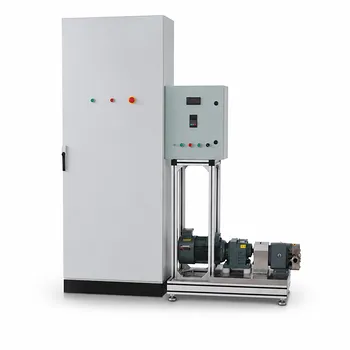
The most dangerous moment for any educational pilot plant is not during normal operation—it’s during an unexpected failure. The 'fail-safe' design principle is crucial because it solves a fundamental human limitation: when a component fails, power is lost, or a sensor stops communicating, you cannot rely on a student operator to react correctly and quickly enough to prevent a disaster. Under this principle, the system is hardwired to automatically and autonomously transition to a predetermined state of safety—shutting off heating elements, closing reactant feed valves, or opening cooling lines—without any human intervention. This acts as the last line of automated defense, protecting both the trainees who are still learning and the expensive equipment from runaway reactions or hazardous releases.
The core problem in an educational setting is that students are statistically more prone to operational errors and slower to diagnose system failures. Fail-safe design flips this vulnerability on its head: it assumes failure will happen and automatically places the plant in its most harmless configuration (typically unpowered and chemically isolated), turning a potentially catastrophic mechanical or human failure into nothing more than an orderly, and safe, system shutdown.
Beyond the Basics: A Protective Mindset
The surface-level answer is about automatic shutdown. The deep need is about understanding why this principle is the non-negotiable bedrock of a safe learning environment.
The Student Operator: The System’s Greatest Variable
An educational pilot plant is fundamentally different from an industrial one. In industry, operators are trained veterans with years of experience. In a university, they are students who are cognitively overloaded, learning the theory of the process in real-time while also trying to control it.
When a critical alarm sounds during a noisy, stressful experiment, a student freezes, hesitates, or makes an incorrect decision. Fail-safe design removes this panic from the equation. It doesn't wait for a student to identify that a thermocouple has died and manually shut a valve—it does so automatically, in milliseconds.
Hardwiring Safety Into Component Selection
The principle isn't just a software logic; it's a physical design choice, most clearly seen in the selection of control valves. Every valve in a pilot plant must be chosen not just for its function during normal operation, but for its physical position upon losing power or instrument air.
This is why a steam or heating fluid control valve on a reactor jacket is always specified as fail-closed (FC) . A power outage would cut the heat source immediately, preventing a thermal runaway that could cause an explosion. Conversely, a cooling water valve on that same reactor is always specified as fail-open (FO) . When power fails, the valve physically springs open, ensuring a continuous flow of cooling water to absorb residual heat and prevent a pressure spike. A small arrow on a P&ID represents a life-saving physical reality.
Integrating Theory with Industrial Reality
Using fail-safe principles in a pilot plant serves a dual educational and protective purpose. It protects the institution from accidents while simultaneously teaching students the correct, non-negotiable industrial standard. When students encounter a fail-closed steam valve on a P&ID during a lab exercise, they are learning the single most important loss-prevention lesson: that faith should never be placed in a control system's ability to function during an emergency.
The Fail-Safe Principle in a Layered Defense
Safety engineers never rely on a single safeguard. Fail-safe logic is a critical component of a multi-layered protection model, often visualized as concentric rings of defense.
Where Fail-Safe Fits in the Safety Hierarchy
In a properly designed pilot plant, safety layers work in sequence:
- Inherently Safer Design: First, we aim to eliminate the hazard entirely, perhaps by diluting a reactant stock.
- Basic Process Control System (BPCS): This actively maintains temperature, pressure, and flow. It is the first line of defense during normal operation.
- Critical Alarms: If the BPCS fails to control a deviation, an alarm alerts the student.
- Safety Instrumented System (SIS) / Automatic Interlocks: This is the primary domain of the fail-safe principle. When an alarm is ignored or a sensor fails, robust, hardwired logic steps in. It performs a pre-programmed emergency shutdown, de-energizing the system to a safe state by isolating feeds, cutting heat, and often initiating an inert nitrogen purge.
- Passive Physical Protection: If the interlock fails, a fully mechanical rupture disc or relief valve opens to vent the overpressure catastrophically but safely, preventing the reactor from breaching.
The fail-safe interlock is the final "smart" decision-maker before purely reactive physical protections take over. You must demonstrate to students how to calculate vent sizes for those passive devices, acknowledging that the preceding fail-safe layer is designed to make its use extremely rare.
Understanding the Critical Trade-off
This principle is powerful, but it’s not without its operational downsides that must be carefully considered during plant design.
The Nuisance Trip and Trust Erosion
A fail-safe system is exceptionally conservative. A momentary glitch in a communication cable or a transient power spike can trigger a full emergency shutdown, dumping the entire reactor's contents and wasting days of student lab time. These "nuisance trips" are a significant trade-off. If they happen too often, it erodes the very trust you’re trying to build, and students may start to view the safety system as an unpredictable annoyance rather than a critical protector. The solution is not to make the system less safe, but to invest in high-quality, shielded instrumentation and robust power supplies to minimize false positives.
The Hazards of "Fail-Locked"
The configuration of a specific valve requires meticulous thought. A valve set to fail-locked in position (remaining in its last place on power loss) might seem safe. However, this can trap hazardous chemicals under pressure in a vessel with no active cooling or heating, creating a latent danger. A clear default state—energetically and chemically isolated—is almost always the safer choice over a locked status quo, especially when you cannot predict when power will be restored or who will approach the apparatus next.
Balancing Educational Visibility Against Absolute Safety
Industrial plants often bury the logic of a Safety Instrumented System in black-box controllers. In an educational plant, you should avoid this. The trade-off is between simplifying the system for ultimate reliability and making its function transparent for learning. You need a design where students can visually trace the fail-safe wiring and see the physical position of the fail-closed valve, allowing them to understand why the plant just shut down. Great safety in an educational context is not invisible—it’s demonstrative.
Engineering a Protected Learning Environment
The application of the fail-safe principle must be tailored to your specific educational goals and the hazards you’re managing.
- If your primary focus is maximizing safety for novice learners: Design every energy input (steam, electricity, reactant flow) to fail to the off/closed state upon any signal loss. Require positive, continuous signals for activation rather than deactivation. This creates an environment where a mistake or equipment failure halts the process instead of accelerating it into danger.
- If your primary focus is on teaching core chemical engineering principles: Use the P&ID itself as a primary teaching tool. Explicitly map every control valve’s fail-safe mode (FC, FO) to its function in mitigating a specific runaway scenario, such as the rapid gas generation from a runaway reaction that demands a sized emergency vent.
- If your primary focus is on specific unit operations like exothermic oxidation: Implement a fail-safe that goes beyond isolation. Design the interlock to automatically trigger a high-flow nitrogen purge upon shutdown. This inert gas blanket directly neutralizes an ongoing explosion hazard inside the reactor vessel, a step that goes from simply stopping the process to actively killing the danger.
Ultimately, the fail-safe principle is an engineering philosophy of profound humility, and there is no better place to instill that humility than in an educational setting. It teaches your students that a well-designed process doesn't just perform a function—it actively protects people when things inevitably go wrong.
Summary Table:
| System Component | Fail-Safe State | Safety Benefit |
|---|---|---|
| Heating Fluid Valve | Fail-Closed (FC) | Cuts heat source to prevent thermal runaway |
| Cooling Water Valve | Fail-Open (FO) | Ensures continuous cooling to absorb residual heat |
| Reactant Feed Valve | Fail-Closed (FC) | Isolates chemical feeds to stop reactions |
| Signal/Power Loss | Emergency Shutdown (ESD) | Automatically de-energizes system to a safe state |
Secure Your Lab with LABPARK's Safe-by-Design Pilot Plants
At LABPARK, we understand that student safety and equipment longevity are paramount. We engineer premier Educational and Vocational Unit Operations Pilot Plants for chemical engineering, bioprocess & biotech, and environmental & water treatment, specifically tailored for universities, research institutes, and enterprises.
Our systems integrate industrial-grade fail-safe protocols—including fail-closed heating, fail-open cooling, and automated interlocks—ensuring a secure, hands-on learning environment without compromising on safety.
Ready to upgrade your laboratory with industry-standard safety features? Contact LABPARK today to discuss your project requirements and receive a customized solution.
Related Products
- Carbon Dioxide Hydrogen Methanol Synthesis Educational Unit Operations Pilot Plant
- Multi-Reactor Educational Pilot Plant for Reaction Engineering Unit Operations
- Tubular Reactor Flow Characteristics Determination Educational Unit Operations Pilot Plant
- Fixed-Bed Chemical Reaction and Gas Dust Tar Removal Unit Operations Pilot Plant
- Multi Pump Fluid Transport Process Piping Unit Operations Training Pilot Plant
People Also Ask
- How do temp & pressure affect methanol synthesis pilot plants? Optimize equilibrium and catalyst performance.
- Why is a purge system necessary when operating a gas recirculation loop in a methanol synthesis pilot plant? (Guide)
- Why do modern methanol pilot plants operate at lower pressures? Catalyst & Feed Requirements Explained
- What are the operational requirements for catalyst activation? Safe Methanol Pilot Plant Operation
- Why is the chemical plant startup schedule crucial? De-risk scale-up with pilot plants.