The distinction is not academic—it’s the linchpin of economic process design and the primary reason you build a pilot plant in the first place.
Reaction yield tells you only how much reactant turned into anything—including waste. Overall plant yield tells you how much of that precious raw material actually left the facility as sellable product. In a pilot plant, conflating these two numbers leads to disastrous overestimates of process profitability and masks the true cost of downstream separation. The distinction is demonstrated by deliberately operating a pilot reactor across a range of conversion levels, then physically measuring material losses in every downstream unit—from distillation columns to vacuum systems—revealing the stark, non-linear relationship between pushing for high single-pass conversion and bleeding value in the purification train.
Core Takeaway: Reaction yield measures your chemical efficiency in the reactor alone, but overall plant yield is the true measure of a viable business. The gap between them—created by physical losses in separation—dictates whether you optimize your reactor for high conversion or invest in a world-class recycle loop. Any pilot plant campaign that only tracks reactor performance is asking the wrong question.
The Two Numbers That Define Your Process Economics
The chemical engineering curriculum drills the calculation of reaction yield, but the pilot plant teaches why it’s rarely the number that matters for scale-up. Understanding the hierarchy of these metrics is the first step toward designing a process that actually makes money.
What Reaction Yield Actually Tells You
Reaction yield—or chemical yield—is a reactor-only metric. It accounts for the fraction of a key reactant that is consumed by the desired reaction pathway versus side reactions.
This number is dominated by catalyst selectivity, temperature control, and mixing quality. A 95% reaction yield means you’re very good at minimizing byproduct formation inside the vessel, but it says nothing about what happens next.
The Brutal Honesty of Overall Plant Yield
Overall plant yield—or process yield—is the product of all unit operations. It multiplies your reaction yield by the efficiency of every downstream separation, drying, and material-handling step.
Physical losses are relentless: a puff of solvent from a vent, a thin film left in a wiped-film evaporator, a breakthrough in an adsorption bed. Overall yield accounts for them all, and in a real plant, it’s often 10–30 percentage points lower than your pristine reactor data.
The Conversion-Recovery Axis
A pilot plant’s central design variable is where you choose to operate on the conversion-recovery axis. If you push the reactor to near-100% single-pass conversion, you minimize the need for separation and recycling, simplifying the flowsheet dramatically.
However, catalysts often punish extreme conversion with lower selectivity, generating byproducts that are harder to separate. At lower, gentler conversion rates, you maintain high selectivity but now have a massive stream of unreacted raw material that must be recovered and recycled—a capital and energy cost.
Demonstrating the Gap in a Pilot Plant
The distinction between these yields is not taught with a PowerPoint slide; it’s beaten into a young engineer by the hum of pumps and the sight of a unexpected drip leg. Demonstration requires running the plant as an integrated system and measuring at every boundary.
Staged Sampling Transforms Theory into Intuition
The demonstration begins by turning the pilot plant into a live mass balance laboratory. Operators collect simultaneous samples at the reactor outlet, after the primary separator, after each polishing step, and from any vent or waste stream.
Flow rates and concentrations at each node are measured, not assumed. When the calculated overall plant yield based on product collection is compared against the reaction yield measured at the reactor outlet, the missing mass is no longer an abstraction—it has a location and a magnitude. Students and researchers see, for example, that a 3% drag-out in a phase split translates directly to a 3-point drop in overall yield, a connection that no textbook can make visceral.
Observing the Recycle Loop’s True Cost
A pilot plant with a recycle loop reveals the most critical lesson. When the team runs the reactor at 70% conversion with high selectivity, they must operate a separation unit to recover the 30% unreacted feed.
By measuring the separation efficiency of that recovery column, they calculate a recovery yield of, say, 95%. The overall plant yield now becomes the reaction yield multiplied by recovery yield. More importantly, they observe the energy cost of that distillation and the accumulation of trace impurities that poison the catalyst over time. The pilot plant transforms the trade-off from a theoretical optimization equation into a noisy, heat-leaking, trouble-shooting reality.
Fueling Yield Reactor Models with Real Data
When kinetic models are too complex to build, engineers rely on yield reactor models, and these models are starved without pilot plant data. A yield reactor model directly specifies product distributions based on empirical correlations.
To build those correlations, the pilot plant is run across a matrix of temperatures, pressures, and residence times. The resulting data set captures both the reactor’s chemical performance and the downstream reality, providing a lumped but trustworthy foundation for scaling to production. This is the pragmatic demonstration that while science wants a kinetic rate equation, an engineer with a deadline wants a yield curve that actually predicts what comes out of the final tank.
Understanding the Trade-offs
The distinction between these yields is a tribute to the fact that there is no free lunch in process synthesis. Optimizing one metric without understanding its partner leads directly to a plant that is technically brilliant but economically doomed.
The High-Conversion Trap
Pushing reactor conversion to the absolute maximum can decimate overall plant yield. High conversion often forces harsh conditions that degrade catalyst life and promote side reactions.
The byproducts generated can contaminate downstream units, fouling heat exchangers or poisoning recycle streams. A pilot plant demonstrates that a slightly lower single-pass conversion, coupled with a highly efficient separation and recycle loop, often delivers a higher overall plant yield and a more robust operation.
The Separation Capital Sink
On the other extreme, running a reactor at low conversion to preserve selectivity offloads the burden onto separation. The pilot plant shows that a massive recycle stream requires large-diameter columns, huge reboilers, and significant solvent-handling capacity.
This capital investment can outweigh the savings from higher raw material selectivity. The demonstration lies in measuring the utility consumption—steam and cooling water—directly on the pilot unit and scaling that cost, making the economic trade-off concrete.
When Recycle Is Not an Option
Some processes cannot economically recycle unreacted feedstock due to the formation of reactive impurities or the presence of difficult-to-separate components. In these cases, the pilot plant experiment demonstrates that the reaction yield must be driven as high as possible, because the overall plant yield will be severely limited by the physical losses in the once-through separation.
This is the scenario where reactor selectivity becomes the overriding target, and the pilot campaign focuses entirely on catalyst screening and temperature profiling rather than on optimizing a recycle loop.
Making the Right Choice for Your Pilot Plant Campaign
Your focus should dictate which metric you obsess over during the critical piloting phase. The plant’s final design—and its profitability—depends on aligning your experimental objectives with the economic driver of the full-scale facility.
- If your primary focus is minimizing raw material cost (the dominant cost driver): Prioritize the overall plant yield as your key performance indicator, and design experiments that map separation efficiency as intensely as reactor selectivity.
- If your primary focus is reducing capital expenditure for a simpler flowsheet: Aim for a high single-pass reaction yield to eliminate the need for a recycle loop and large separation units, even if it means sacrificing some raw material efficiency.
- If your primary focus is managing catalyst deactivation from recycle impurities: Run the pilot plant in closed-loop mode for extended campaigns to observe the impact of trace buildup on reaction yield over time, validating that your separation train is fit for purpose.
- If your primary focus is building a simulation model without detailed kinetics: Collect overall plant yield data across a broad operating envelope to feed a yield reactor model, ensuring your design basis includes the harsh reality of physical losses.
Mastering the distinction between reaction yield and overall plant yield is what turns a collection of unit operations into an economically coherent process. The pilot plant is where that mastery is earned, not assumed.
Summary Table:
| Metric | Focus | Key Influencing Factors | Process & Economic Impact |
|---|---|---|---|
| Reaction Yield | Reactor only (Chemical efficiency) | Catalyst selectivity, temperature, mixing | Measures chemical efficiency and byproduct minimization in the vessel. |
| Overall Plant Yield | Entire process (System-wide efficiency) | Downstream separation, drying, recycling, physical losses | Dictates actual product output, process profitability, and true scale-up viability. |
Optimize Your Process Scale-Up with LABPARK
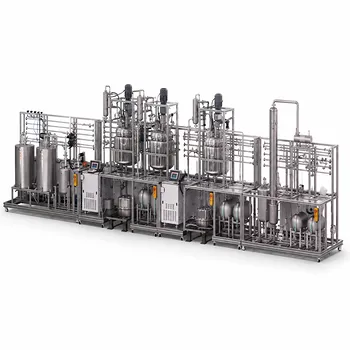
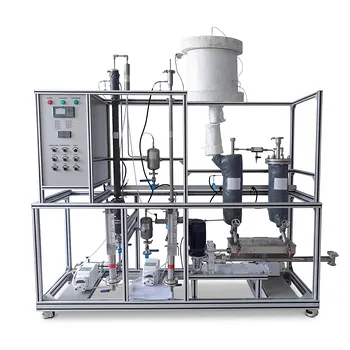
Bridging the gap between reactor chemistry and overall plant yield requires robust, real-world validation. LABPARK provides premium Educational and Vocational Unit Operations Pilot Plants in chemical engineering, bioprocess & biotech, and environmental & water treatment.
Specially designed for universities, research institutes, and enterprises, our pilot plants allow engineers and students to hands-on analyze mass balances, optimize recycle loops, and master downstream separation dynamics.
Ready to elevate your research and training capabilities? Contact LABPARK today to find the perfect pilot plant solution for your lab!
Related Products
- Fixed Bed Gas Solid Catalytic Reaction Educational Pilot Plant
- Multi Pump Fluid Transport Process Piping Unit Operations Training Pilot Plant
- Carbon Dioxide Hydrogen Methanol Synthesis Educational Unit Operations Pilot Plant
- Ethyl Acetate Synthesis Unit Operations Pilot Plant for Practical Training
- Natural Product Extraction Unit Operations Training Pilot Plant
People Also Ask
- How do reactor pilot plants safely study gas-solid reactions? Master kinetics with thermal & flow control.
- How does the Mears criterion evaluate transport resistance? Key Guide to Intrinsic Kinetics
- Why is a multibed configuration necessary for exothermic reactions? Optimize your pilot plant trajectory.
- Fluidized vs. Fixed Bed Reactors: Comparing Heat & Complexity in Pilot Plants
- How is the friction factor determined for fixed-bed pilot plants? Select the best pressure drop correlation.