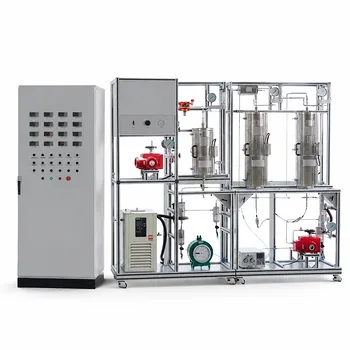
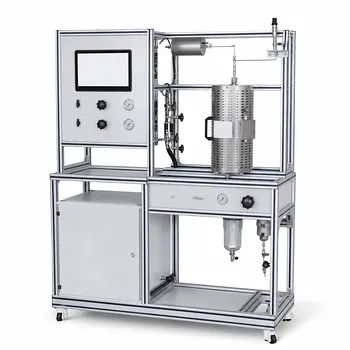
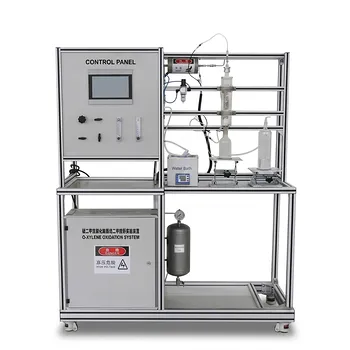
Direct crude-to-chemicals cracking is a training application that doesn’t just teach a process—it forces students to confront the future of low-carbon manufacturing head-on. It earns this central role in modern pilot plants because it demonstrates how bypassing the traditional refining sequence and cracking whole crude oil directly into ethylene and propylene can lift chemical yields to 50% or higher. The hands-on experience translates an ambitious industry goal—slashing energy consumption and carbon emissions by shortening the process flow—into measurable unit operations decisions.
The true power of a crude-to-chemicals pilot plant as a training tool is that it compresses the industry’s most critical challenge into a single, observable system: producing high-value base chemicals with the smallest possible energy and carbon footprint. It forces a shift from abstract sustainability targets to concrete control-room actions.
Why Sequential Refining Paths Are Falling Behind
The Hidden Energy Toll of Separation-First Thinking
Traditional petrochemical routes treat crude oil as something to be fractionated and purified before any molecule sees a cracking furnace. Crude distillation, hydrotreating, and naphtha separation all consume massive amounts of heat and electricity. Each step adds to the cumulative carbon debt before the first pound of ethylene is made. Training on a crude-to-chemicals pilot reveals that skipping those steps is not just a conceptual shortcut—it directly eliminates the largest embedded energy sinks in the value chain.
Process Intensification in a Single Step
Direct cracking represents a move toward process intensification: combining multiple unit operations into one high-severity thermal step. Instead of isolating the right boiling-range cuts, the crude-to-chemicals approach challenges the whole barrel in a single furnace, relying on temperature profile, residence time, and advanced metallurgy or catalytic coatings to maximise light olefins. Trainees see how that one bold step can halve the number of rotating equipment items and fired heaters required, a profound simplification with direct sustainability payoffs.
The Unique Laboratory of a Unit Operations Pilot Plant
Bridging the Lab-to-Factory Scale Gap
Chemical engineering principles teach us that heat transfer, mass transfer, and fluid dynamics behave differently as vessel diameters grow. A unit operations pilot plant sits at the sweet spot between a lab-scale microreactor and a commercial furnace. For crude-to-chemicals, that middle ground is indispensable. Trainees observe how cracking severity, residence time distribution, and quench efficiency change under conditions that closely mimic a real plant, without incurring the capital risk of a full-size facility.
De-Risking a Low-Carbon Future
Moving directly from a bench-scale concept to a commercial crude-to-chemicals plant is financially terrifying. A pilot plant allows operators to validate chemical economics—raw material utilisation, by-product handling, and coke formation rates—under commercially relevant conditions. That validation is exactly what management needs before approving a multi-billion dollar project. Students trained on these units learn to identify the specific design and construction requirements that will keep a larger-scale facility safe, efficient, and profitable.
What Trainees Take Away from a Crude-to-Chemicals Pilot
Optimising Yield and Energy in One Loop
In a conventional naphtha cracker, the feedstock is predictable and the control strategy revolves around a narrow severity window. Crude-to-chemicals training flips that script. Students discover that every adjustment to furnace outlet temperature simultaneously influences light olefin yield, fuel gas make, and thermal efficiency. They develop the operational intuition to chase a moving optimum where a 2% yield gain that requires 5% more fuel may not actually be a win—and they see that trade-off in real-time data.
Tracing Carbon Footprint to Control Actions
One of the most valuable training outcomes is the ability to link a control-room decision directly to an emissions metric. By measuring furnace fuel flow, steam export, and overall conversion, a pilot plant makes carbon intensity visible. Trainees learn that reducing excess air to the burners or optimising the transfer line exchanger duty isn’t just an efficiency exercise—it’s the operational levers that will define their company’s ability to meet net-zero pledges.
Managing the Foulant and Byproduct Complexity
Direct cracking introduces a heavier, dirtier feed to the furnace, which accelerates coke formation and creates challenging pyrolysis fuel oil. On a pilot scale, students experience the impact of asphaltenes and metals on coil skin temperatures and on run lengths. They learn how to balance the need for high conversion against the risk of premature decoking cycles—a balancing act that doesn’t exist in the cleaner world of naphtha cracking.
Understanding the Trade-offs
The Thermal Severity Tightrope
Higher severity boosts olefin yields but pushes the reaction toward thermal cracking of valuable products into methane and coke. On a crude-to-chemicals pilot, students see that the optimal furnace outlet temperature is narrower and more feedstock-dependent than in conventional cracking. There is no universal setpoint, only a range that must be re-validated for each crude slate, teaching a powerful lesson in operational humility.
Feedstock Flexibility vs. Process Stability
One promise of direct crude cracking is the ability to process opportunity crudes at advantaged prices. The training reality is messier. Swinging from a light sweet crude to a heavier sour grade forces changes in coil steam-to-oil ratio, quench oil viscosity, and downstream fractionation load. The pilot plant becomes a testbed for how often you can realistically switch feeds without eroding availability—a debate that follows the technology into every boardroom.
Not a Perfect Mirror
Even the best pilot plant cannot replicate every large-scale phenomenon. Radiant coil geometries, firebox dimensions, and quench system dynamics will always differ from a commercial reactor. Trainees must learn to separate the fundamental chemistry from scale-dependent hydrodynamics. That skill—knowing what to trust and what to extrapolate with caution—is perhaps the most sophisticated capability a pilot plant can teach.
Making the Right Choice for Your Training or Research Goal
How you position a crude-to-chemicals pilot plant depends on the learning outcome you need most. Use this guide to align the experimental scope with your strategic objectives.
- If your primary focus is developing operational intuition for low-carbon manufacturing: Design training runs that make carbon intensity the most visible KPI on the operator screen, reinforcing the link between small fuel adjustments and overall sustainability performance.
- If your primary focus is validating the economic case for a direct cracking investment: Run extended campaigns with a specific crude basket to collect the reliable yields, coke rates, and utility consumption numbers that will anchor a full-scale feasibility study.
- If your primary focus is upskilling the workforce for a technology transition: Use the pilot plant to simulate feedstock switches and severe fouling events, forcing operators to manage the unfamiliar trade-offs that a naphtha cracker would never present.
- If your primary focus is academic research on next-generation catalytic coatings: Keep the pilot plant as a flexible platform, but be honest about its scale limitations when reporting kinetic constants and heat transfer coefficients for the open literature.
The crude-to-chemicals pilot plant trains every stakeholder in the same hard truth: the shortest path to high-value chemicals is also the one that demands the deepest understanding of fundamentals. That clarity is exactly why it has become an irreplaceable training application.
Summary Table:
| Comparison Metric | Conventional Refining & Cracking | Direct Crude-to-Chemicals Cracking |
|---|---|---|
| Process Complexity | Multiple steps (distillation, hydrotreating, separation) | Process intensification (single-step thermal cracking) |
| Base Chemical Yield | Lower yields (typical refinery limits) | 50% or higher yield of high-value light olefins |
| Energy Consumption | High cumulative thermal/electrical debt | Significantly reduced by bypassing separation steps |
| Operational Controls | Predictable feedstocks, low-risk fouling | High-severity trade-offs, dynamic fouling, feedstock flexibility |
Accelerate Your Transition to Sustainable Chemical Engineering
At LABPARK, we design and manufacture high-performance Educational and Vocational Unit Operations Pilot Plants in chemical engineering, bioprocess & biotech, and environmental & water treatment. We help universities, research institutes, and enterprises bridge the gap between academic theory and real-world industrial practice.
Whether you are researching next-generation catalysts or upskilling your workforce for low-carbon operations, our pilot plants deliver the scalability and data precision you need.
Contact LABPARK today to discuss your pilot plant requirements!
Related Products
- Methane Cracking Educational Unit Operations Pilot Plant
- Natural Product Extraction Unit Operations Training Pilot Plant
- Crude Benzene Hydrogenation Educational Unit Operations Pilot Plant
- Multi-Modal Distillation Unit Operations Training Pilot Plant
- Electrolyte Distillation Purification and Formulation Educational Pilot Plant
People Also Ask
- How do ethane vs naphtha cracking influence teaching pilot plant analytical configurations? Key Design Guide
- How can flow-NMR be integrated with pilot plant reactors to monitor kinetics? A Complete Guide
- How do cracking temperature and residence time affect olefin yield? Pilot Plant Guide
- How are utility consumption rates integrated into chemical pilot plant economic evaluations?
- How should OSBL investments be estimated? Key Steps to Avoid Budget Overruns in Pilot Plant Projects