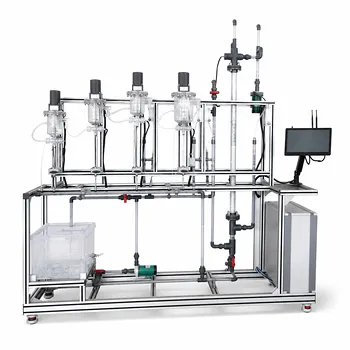
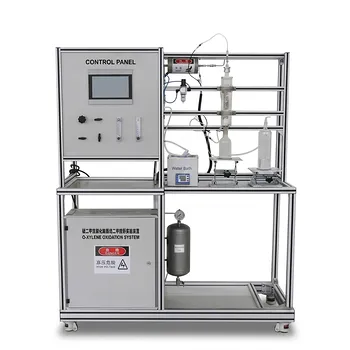
Steady-state multiplicity isn't just a theoretical quirk—it's the defining safety and control challenge of exothermic reactors. Demonstrating it in a pilot plant gives operators and students physically grounded, actionable insight into how a single set of input conditions can produce multiple stable operating states. This hands-on experience directly teaches the identification of ignition and extinction points, the prevention of thermal runaway, and the design of control strategies—bridging the gap between clean mathematical models and the unforgiving reality of industrial production.
A reactor that can sit at different stable temperatures for the exact same feed composition and flow rate isn't a lab curiosity; it’s a blueprint for disaster if not understood. The pilot plant makes this invisible risk visible, teaching you to avoid catastrophic transitions before they appear on a plant's DCS screen.
Why a Single Set of Conditions Can Give Multiple Stable States
A pilot plant reactor can physically settle into a low-conversion, low-temperature state, a high-conversion, high-temperature state, or even oscillate—all without changing the feed. This happens because the heat generation curve (sigmoidal, driven by reaction kinetics) and the heat removal line (linear, driven by cooling and flow) can intersect at more than one point.
The Heat Balance Core
The reactor's energy balance creates a competition. Exothermic reactions generate more heat as temperature rises, but the cooling jacket and flow remove heat at a roughly linear rate. When these curves cross more than once, each intersection is a candidate steady state.
Stable vs. Unstable Intersections Are the Real Lesson
Not all intersections are equal. The van Heerden stability criterion tells us that a state is stable only when the slope of the heat generation curve is less than the slope of the removal line. The middle intersection—where the generation curve steepens past the removal line—is unstable. A tiny nudge sends the reactor spiraling toward ignition or extinction.
Direct Observation of Ignition and Extinction Builds Safety Intuition
Simply changing a flow rate slightly can cause a reactor to "jump" from a low-activity state to a furious high-temperature state (ignition) or, conversely, to quench entirely (extinction). These transitions are what cause industrial accidents. Seeing the reaction mass temperature leap by tens of degrees in a controlled, safe pilot unit permanently changes how an operator treats process limits.
Mapping the Bifurcation Points
By manipulating residence time—which alters the Damköhler number—students can trace the S-shaped hysteresis curve in real time. They note the exact flow rate where a single steady state splits into three, and where two of them vanish. This physical mapping of static bifurcations teaches that safe operating windows have hard edges, not gentle slopes.
Visible Hysteresis Is a Crash Course in Process Control
If you increase and then decrease the flow rate, the reactor’s conversion doesn’t retrace its path. It follows a hysteresis loop, hanging on to a higher state long after the condition that created it has passed. Demonstrating this in a pilot plant reveals, with absolute clarity, why standard linear control tuning fails and why specific startup and shutdown sequences are mandatory.
Preventing Thermal Runaway Requires Hands-On Parameter Sensitivity Analysis
Runaway isn’t just about a high temperature; it’s about an uncontrolled, self-accelerating transition past the point of no return. Pilot plants let users safely probe parametric sensitivity—how small changes in feed temperature, flow velocity, or jacket coolant flow can push the system over the stability boundary.
The Autothermal Fixed-Bed Demonstration
In a catalytic reactor with feed-effluent heat exchange, instructors can show how a tiny reduction in feed preheat temperature suddenly extinguishes the reaction, or an increase triggers runaway. The demonstration physically enforces the lesson that what looks like a safe margin on a spreadsheet can be a hair-trigger in reality, underscoring Inoue’s criterion for stability limits.
From Math to Catastrophe Surfaces
Researchers use singularity theory to map "catastrophe surfaces"—the exact parameter combinations where the number of steady states changes. In a pilot plant, they can step across those boundaries and watch the reactor’s behavior qualitatively flip. That visceral confirmation of a mathematical prediction is what transforms a theoretical researcher into a pragmatic process designer.
Understanding the Trade-Offs and Common Pitfalls
Demonstrating steady-state multiplicity is powerful, but it comes with its own set of limitations that must be openly addressed to build genuine expertise.
The Curse of Idealized Systems
Pilot plant reactors are often perfectly mixed or have well-defined plug flow with simplified kinetics. Real industrial reactors operate under imperfect mixing, catalyst fouling, and non-uniform flow distributions. The beautifully clear bifurcation diagram from a CSTR training unit therefore represents a baseline behavior, not the full messy truth.
The Danger of Overconfidence
A successful run mapping multiplicity can create a false sense of security. Students may mistakenly believe they can extrapolate a few stable points into a full operating plan, ignoring that the presence of Hopf bifurcations (leading to oscillatory states) and the influence of impurities can shift the entire stability landscape unpredictably.
Resource and Time Constraints
Runaway experiments—even in a safe pilot unit—require careful planning and long periods of steady-state verification. There’s always a trade-off between the depth of dynamic exploration and the available lab time, leading to a risk that the curriculum skims the surface without truly embedding the decision-making skills required for abnormal situation management.
Making the Right Choice for Your Learning or Development Goal
How you use a steady-state multiplicity demonstration depends entirely on what problem you’re trying to solve.
- If your primary focus is operational safety: Prioritize experiments that deliberately approach extinction and ignition points, while practicing the emergency shutdown sequence that reverses those transitions without damaging the catalyst or equipment.
- If your primary focus is process control design: Focus on building hysteresis loops by varying residence time, then design and test a nonlinear model-predictive controller that can manage the inherent bistability.
- If your primary focus is fundamental research: Use singularity theory to map the full catastrophe surface of a model reaction, and then physically validate the predicted boundaries where the number of steady states changes.
- If your primary focus is workforce training: Combine a clear S-curve demonstration with a "blind" scenario where the instructor triggers a runaway and evaluates the operator’s real-time diagnostic and corrective response.
The true value of demonstrating steady-state multiplicity lies not in the data collected, but in the mental model it engrains—one where every operating point is felt, not just calculated, so safety becomes instinct.
Summary Table:
| Key Learning Point | Physical Manifestation | Practical Value |
|---|---|---|
| Ignition & Extinction | Sudden temperature jumps or reaction quenching | Identifies safe operational boundaries |
| Thermal Runaway | High parametric sensitivity to feed/coolant changes | Prevents catastrophic industrial accidents |
| Hysteresis Loops | Non-retracing pathways when changing flow rates | Guides nonlinear process control design |
| Bifurcation Points | Single operating state splitting into three states | Validates theoretical mathematical models |
Elevate Your Engineering Education and Research with LABPARK
Bridge the gap between complex reactor theory and safe industrial execution. LABPARK provides premium Educational and Vocational Unit Operations Pilot Plants in chemical engineering, bioprocess & biotech, and environmental & water treatment tailored for universities, research institutes, and enterprises.
Our advanced pilot units allow students and researchers to safely explore critical safety phenomena like steady-state multiplicity, parametric sensitivity, and thermal runaway.
Equip your lab with the tools to train the next generation of process safety experts. Contact LABPARK today to discuss your project requirements!
Related Products
- Fixed-Bed Chemical Reaction and Gas Dust Tar Removal Unit Operations Pilot Plant
- Fixed Bed Gas Solid Catalytic Reaction Educational Pilot Plant
- Multi-Reactor Educational Pilot Plant for Reaction Engineering Unit Operations
- Residence Time Distribution and Reactor Flow Characteristics Determination Educational Pilot Plant
- Tubular Reactor Flow Characteristics Determination Educational Unit Operations Pilot Plant
People Also Ask
- When to transition from PID to adaptive control in pilot plants? Key process indicators.
- How do deviations in estimating latent heat impact pilot plant thermal systems? Avoid hardware mis-sizing.
- Why Compare Predicted and Experimental Excess Enthalpy? Key to Accurate Pilot Plant Scale-up
- How to study gasification in pilot plants? Compare exit gas composition & efficiency
- Why Use PTFE & Hastelloy in Chemical Pilot Plants? Prevent Corrosion & Ensure Safety