The core value of residual properties is that they provide a direct, calculable bridge between the messy, real-world behavior of gases in your pilot plant and the clean, mathematically perfect world of the ideal gas model. This concept isn't just a textbook abstraction; it's the essential tool for extracting meaningful thermodynamic data from the pressure gauges and thermocouples in your experimental setup. By defining a residual as the difference between a real molar property and its ideal-gas counterpart at the same temperature and pressure, you isolate the very deviations caused by molecular interactions, allowing you to quantify non-ideality and make your experimental data usable for rigorous process modeling.
When analyzing pilot plant data, residual properties transform raw measurements of non-ideal gas behavior into direct, quantitative tests of the equations of state you're trying to validate. They isolate the impact of molecular forces, turning observed deviations from a problem into the primary source of actionable information.
The Fundamental Problem: Why "Ideal" Isn't Enough
In a pilot plant, you are rarely working with gases at near-ambient conditions where the ideal gas law is a safe assumption. High-pressure reactions, cryogenic separations, and compression cycles force you into a regime where the assumptions of zero molecular volume and zero intermolecular forces completely break down.
Using the ideal gas law on a high-pressure reactor stream isn't just inaccurate—it's thermodynamically inconsistent. It fails to predict the correct density, which cascades into errors in enthalpy balances, equilibrium constants, and, ultimately, a flawed scale-up design. You need a systematic method to handle this failure.
Defining Your Baseline with the Ideal Gas State
The power of the residual approach comes from its choice of baseline. The ideal gas state ($M^{ig}$) is not a physical reality for these conditions; it's a mathematically precise, hypothetical reference point. Its properties are purely a function of temperature and composition, calculable with absolute certainty from well-established standard values and heat capacity correlations.
This creates a fixed anchor. Any ambiguity in your calculation chain resides entirely within the residual term. You know the ideal part is correct, which means the residual property becomes an uncompromised proxy for the real fluid's molecular complexity.
Calculating the Deviation
A residual property ($M^R$) is formally defined as $M^R = M - M^{ig}$ at the same temperature and pressure. Take the most intuitive example: residual volume, $V^R = V - \frac{RT}{P}$. For an ideal gas, $V^R$ is zero. In your pilot plant, a non-zero $V^R$ is a direct, experimentally accessible measure of how compressible the real gas is, quantified in familiar volumetric units. This is the first screening metric for non-ideality.
Connecting Pilot Plant Data to Fundamental Theory
The leap from measuring a simple volume deviation to unlocking deep thermodynamic analysis happens via the residual Gibbs energy. This single property is the master key because it serves as a generating function from which all other residual properties can be derived through mathematical manipulation.
The Central Role of Gibbs Energy
Residual Gibbs energy ($G^R$) is not measured directly. Its power lies in its relationship to an equation of state and to fugacity. The link is a fundamental principle in applied thermodynamics: $\frac{G^R}{RT}$ is directly calculable from the integral of an accurate pressure-explicit equation of state.
More critically, the residual Gibbs energy directly defines the fugacity coefficient ($\phi_i$), with the relationship $ln(\phi_i) = \frac{G^R}{RT}$. Fugacity is the "corrected pressure" concept that makes non-ideal thermodynamic calculations for phase and chemical equilibrium rigorous. A pilot plant experiment measuring phase compositions is, at its core, validating a fugacity-based model that is built upon $G^R$.
What Residual Properties Are Not: A Common Pitfall
It is critical to distinguish residual properties from the closely related but separate concept of excess properties. This confusion can completely derail a data analysis.
- Residual properties ($M^R$) compare a real fluid (pure or mixture) to an ideal gas at the same temperature and pressure.
- Excess properties ($M^E$) compare a real liquid mixture to an ideal solution at the same temperature and pressure.
For example, mixing ethanol and water in a pilot plant shows a measurable volume contraction—an excess property caused by complex hydrogen bonding in the liquid phase. This is fundamentally different from analyzing the non-ideality of the high-pressure steam generated above that mixture, which requires a residual property framework. Using the wrong baseline leads to a meaningless model.
Understanding the Trade-offs and Practical Limitations
The residual property framework is mathematically rigorous, but its practical implementation in a pilot plant setting is not immune to error. Its accuracy is captive to the quality of the chosen model.
The Danger of Model Lock-In
The Achilles' heel of this method is that you must integrate an equation of state to get $G^R$. If you choose a simple cubic equation like the Soave-Redlich-Kwong, you are implicitly baking in its functional limitations for polar or associating molecules. A beautifully calculated residual enthalpy value is worthless if the underlying equation cannot capture the dominant physics of your system. The precision of your derived data creates a dangerous illusion of accuracy.
Navigating the Reference State
The power of the framework is that the ideal-gas path is clearly defined. The challenge is that constructing this path for a complex mixture requires meticulous averaging of pure-component ideal-gas heat capacities. A small error in the gas-phase heat capacity correlation is amplified when you use it to calculate a reference state that is then subtracted from a high-pressure measurement. The residual property, by design, will absorb this reference-state error and misrepresent the physical molecular forces.
Making the Right Choice for Your Goal
Your decision to use the residual-property framework depends on what you are trying to achieve with your pilot plant data. Here is how to focus your analysis:
- If your primary focus is compressing a gas or testing a new turbine design: Prioritize the calculation of residual enthalpy and entropy. These directly give you the shaft work and heat duty corrections that distinguish a real compressor from an idealized model.
- If your primary focus is validating a new equation of state for a novel working fluid: Center your entire analysis on the residual volume. This is the most direct, model-free residual property you can measure with high-quality density data from your pilot plant.
- If your primary focus is modeling a high-pressure reactor or separator: Your entire workflow must revolve around the accurate calculation of residual Gibbs energy and the subsequent fugacity coefficients. Your experimental validation is a test of the $G^R$ model’s ability to predict phase equilibrium.
The concept of residual properties is not just a theoretical convenience—it is the intellectually honest framework for separating what you know for certain (the ideal-gas baseline) from what you are trying to model (the complex molecular reality) in every piece of data your pilot plant produces.
Summary Table:
| Property Type | Definition | Key Pilot Plant Application |
|---|---|---|
| Residual Volume ($V^R$) | $V - V^{ig}$ | Quantifies non-ideality & gas compressibility |
| Residual Gibbs Energy ($G^R$) | $G - G^{ig}$ | Derives fugacity coefficients for phase equilibrium |
| Residual Enthalpy & Entropy | $H^R, S^R$ | Corrects shaft work and heat duty calculations |
Accelerate Your Thermodynamic Research with LABPARK
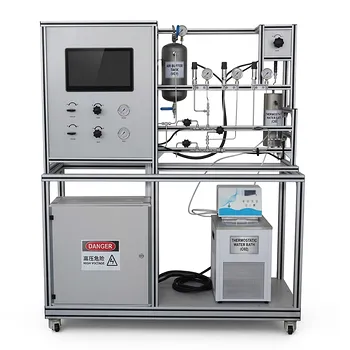
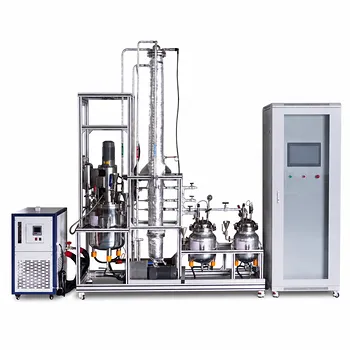
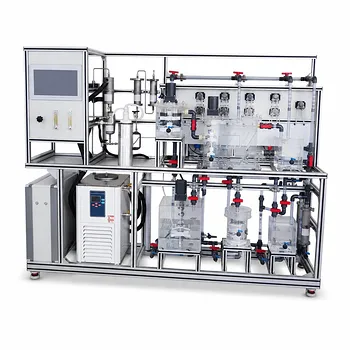
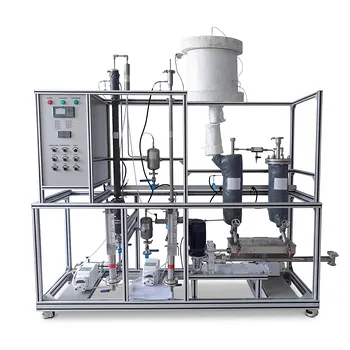
Accurate real-gas modeling requires high-precision experimental data. LABPARK provides state-of-the-art Educational and Vocational Unit Operations Pilot Plants in chemical engineering, bioprocess & biotech, and environmental & water treatment.
We help universities, research institutes, and enterprises bridge the gap between thermodynamic theory and real-world process performance with reliable, scalable equipment.
Contact us today to discuss your pilot plant needs!
Related Products
- Natural Product Extraction Unit Operations Training Pilot Plant
- Multi-Reactor Educational Pilot Plant for Reaction Engineering Unit Operations
- Ethyl Acetate Synthesis Unit Operations Pilot Plant for Practical Training
- Throttling Effect Determination Educational Unit Operations Pilot Plant
- Fixed Bed Gas Solid Catalytic Reaction Educational Pilot Plant
People Also Ask
- How to Demo Solubility Sensitivity in SFE Pilot Plants? Practical Thermodynamics
- How do pilot plants differentiate physical vs chemical extraction? Enhance Chemical Engineering Training
- How are HTU and NTU applied to determine extraction column height? Guide to Pilot Plant Scaling
- How can Hotelling's T² & Q statistics detect pilot plant abnormalities? Optimize Safety
- Why use split-plot designs in pilot plants instead of CRD? Optimize process parameters effectively.