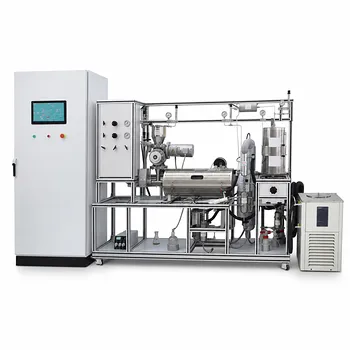
Suspension polymerization is the workhorse of educational unit operations labs because it tames a potentially dangerous reaction. By dispersing monomer droplets in water, the system converts the bulk fluid into an excellent heat-transfer medium, keeping viscosity low and preventing the thermal runaway that plagues bulk polymerization. The core chemistry requires just four components: a liquid monomer, a monomer-soluble initiator, water, and a dispersing agent—but a functional lab plant equally depends on precise agitation and temperature control to turn these ingredients into consistent polymer beads.
Suspension polymerization’s safety and controllability come from using water as a heat sink, which allows students to safely explore an exothermic reaction without the risk of a runaway. The minimal chemical recipe includes monomer, initiator, water, and a dispersing agent, but a successful educational plant must pair these with reliable agitation and tight temperature management.
Why Suspension Polymerization Is the Gold Standard for Teaching Labs
The choice isn’t just about safety—it’s about transforming a hazardous bulk reaction into a transparent, manageable unit operation that students can observe, measure, and troubleshoot. The water phase does the heavy lifting, creating a forgiving environment that still teaches fundamental engineering principles.
Taming the Heat: Water as a Safety Shield
In bulk polymerization, heat generated by the reaction has nowhere to go. Viscosity skyrockets, stirring becomes impossible, and the temperature can spike dangerously.
Suspension polymerization solves this by dispersing the monomer as tiny droplets in a continuous water bath. The water acts as an enormous heat sink, absorbing the exotherm and conducting it away evenly. This prevents hot spots and keeps the entire system at a stable, predictable temperature—a direct lesson in heat transfer for students.
Low System Viscosity from Start to Finish
Because the polymer forms inside discrete, water-suspended droplets, the overall mixture remains a low-viscosity slurry from the first droplet to the final bead. Stirring stays efficient, and the agitator doesn’t stall.
This consistency lets students run the reaction for extended periods without losing mixing performance. It also makes sampling and visual observation far easier than in a sticky bulk melt, turning theory into tangible beads they can filter and examine.
A Live Demonstration of Droplet Stabilization
The dispersing agent offers a direct window into interfacial engineering. Students see how a carefully chosen stabilizer prevents the monomer droplets from coalescing during the “sticky phase,” when the forming polymer is tacky enough to fuse into a single useless mass.
This sticky-phase challenge is a classic scale-up problem. Watching it play out in a transparent lab reactor teaches the critical role of surface chemistry and mixing—lessons that carry straight into industrial design.
The Core Components of a Suspension Polymerization Setup
An educational lab plant doesn’t require an exotic inventory. The fundamental chemical recipe is lean and the equipment straightforward, making it easy to assemble and safe to operate.
The Four Essential Chemical Ingredients
The primary reference defines the minimal chemistry with clarity:
- Monomer: The liquid building block that will become the polymer (e.g., styrene, methyl methacrylate, or vinyl chloride).
- Monomer‑soluble initiator: An organic-soluble free-radical source that starts the reaction inside each droplet, not in the water.
- Water: The continuous phase that surrounds and isolates the droplets, serving as both heat sink and dispersing medium.
- Dispersing agent: A water-soluble polymer or fine particulate that adsorbs at the droplet interface, creating a steric or electrostatic barrier against coalescence.
Together, these four components create the controlled droplet micro-reactors that define the process.
The Dispersing Agent: The Unsung Hero
In a pilot-scale or educational rig, the dispersing agent doesn’t just prevent initial coalescence—it must hold the protective layer through the entire reaction, particularly during the tacky partially polymerized stage. Without it, the stirring fluid can turn into a solid clump in minutes.
This sensitivity makes the dispersing agent a powerful teaching tool. Students can vary its concentration and observe direct consequences on bead size, size distribution, and even reactor fouling—linking chemical formulation to particle engineering.
Beyond Chemistry: Essential Equipment for the Lab Plant
While the four chemical components are the core, no educational unit operations plant works without a handful of engineered additions. The supplementary reference, which focuses on PVC pilot plants, highlights non-negotiables that apply broadly:
- Variable-speed agitator with optimized baffles: Provides the shear needed to break monomer into droplets and keep them suspended without allowing coalescence. Without proper agitation and baffle geometry, the droplets will settle or merge.
- Precise temperature control: The reaction is highly exothermic. For sensitive products like PVC, control accuracy of ±0.2 °C is standard to maintain a consistent molecular weight distribution. Even in basic labs, a jacketed reactor with a circulating bath is mandatory to prevent thermal swings.
For a complete unit operations demonstration, a lab may also include a simple filtration or centrifugation step to recover the polymer beads, and perhaps a drying station. These downstream units are not required for the polymerization itself but are valuable if the learning objective extends to solids handling and separation.
Understanding the Trade‑offs and Limits
Suspension polymerization is not a one-size-fits-all solution. Its strengths come with constraints that educators must acknowledge.
Added Complexity from the Water Phase
Introducing water means introducing an emulsifier-like dispersing agent, and the process becomes sensitive to ionic impurities and oxygen. The water must be of consistent quality, and some monomers require pH buffering. This extra layer of chemical preparation can be a distraction if the core lesson is purely about kinetics.
Post‑Reaction Separation and Cleaning
The product comes out as a slurry of polymer beads in water, not a ready-to-use bulk plastic. Students must filter, wash to remove the dispersing agent, and dry the beads—adding unit operations that extend a single lab session. While this mirrors real industrial production, it can complicate a short demonstration if the goal is only to show the reaction mechanism.
Scale‑Up Sensitivity to Agitation
The droplet size and stability are strongly linked to stirrer speed and baffle design. In an educational setting, a poorly tuned agitator can produce fine particles or fused lumps instead of uniform beads. This makes the experiment an excellent but sometimes fickle teaching moment: students must learn to respect the link between fluid dynamics and product quality.
Making the Right Choice for Your Educational Lab
The decision to use suspension polymerization should align with what you want your students to learn. Tailor the plant complexity to the learning outcomes.
- If your primary focus is demonstrating exothermic reaction safety: Start with the minimal setup—monomer, initiator, water, and a reliable dispersing agent—in a well-controlled stirred reactor. This highlights heat transfer and runaway prevention.
- If your primary focus is teaching full unit operations: Add filtration, washing, and drying steps to the reactor train. This transforms the experiment into a complete solids‑handling sequence that mirrors industrial practice.
- If your primary focus is particle engineering and scale‑up: Invest in a variable‑speed agitator, interchangeable baffles, and a reactor with visual access. Let students vary the dispersing agent level and stirrer speed to map out how process conditions control bead size and morphology.
- If your primary focus is molecular weight and kinetics: Incorporate precise temperature control (±0.2 °C or better) and sampling ports to track conversion and molecular weight distribution over time, turning the plant into a live kinetics lab.
A well-implemented suspension polymerization rig transforms a potentially hazardous bulk reaction into a safe, versatile, and visually instructive unit operation that students will remember long after the lab report is filed.
Summary Table:
| Component / Equipment | Role in the Process | Educational Learning Objective |
|---|---|---|
| Water & Dispersing Agent | Serves as a heat sink & prevents droplet coalescence | Heat transfer & interfacial engineering |
| Monomer & Initiator | React inside suspended droplets to form polymer beads | Polymerization kinetics & organic chemistry |
| Agitator & Baffles | Provide shear to break monomer & maintain dispersion | Fluid dynamics & scale-up principles |
| Temperature Control | Maintains precise reaction temperature (±0.2 °C) | Thermal runaway prevention & quality control |
Bring Industrial-Scale Chemical Engineering Safely into Your Classroom
Teaching complex chemical reactions requires reliable, safe, and robust pilot systems. LABPARK provides state-of-the-art Educational and Vocational Unit Operations Pilot Plants in chemical engineering, bioprocess & biotech, and environmental & water treatment for universities, research institutes, and enterprises.
Our custom-engineered polymer reactors feature precise temperature control and optimized agitation systems, allowing students to safely explore thermodynamic principles and polymerization kinetics firsthand.
Ready to upgrade your laboratory with industry-grade teaching equipment?
👉 Contact LABPARK today to discuss your laboratory plant requirements!
Related Products
- Polymerization Granulation and Pellet Processing Educational Unit Operations Pilot Plant
- Ethyl Acetate Synthesis Unit Operations Pilot Plant for Practical Training
- High-Gravity Emulsification and Mass Transfer Educational Pilot Plant
- Methanol Synthesis and Catalyst Performance Evaluation Educational Unit Operations Pilot Plant
- Natural Product Extraction Unit Operations Training Pilot Plant
People Also Ask
- How do educational unit operations pilot plants bridge theory and design? Bridge the Engineering Gap
- How do educational unit operations pilot plants address safety and waste management when scaling up?
- Why Compare Predicted and Experimental Excess Enthalpy? Key to Accurate Pilot Plant Scale-up
- When to transition from PID to adaptive control in pilot plants? Key process indicators.
- How do deviations in estimating latent heat impact pilot plant thermal systems? Avoid hardware mis-sizing.