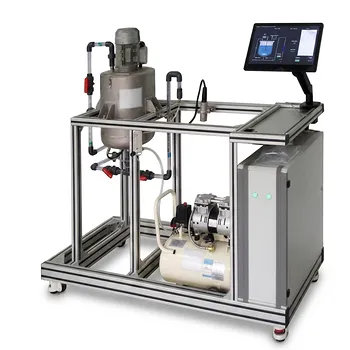
Choosing an appropriate calculation basis is critical because it turns pilot plant data into a consistent, solvable material balance. A basis such as 1 hour of operation, 100 kg of feed, or 100 mol of gas establishes the reference amount for every stream. It reduces conversions, limits arithmetic errors, and makes it easier for students to compare inputs, products, waste, and process efficiency.
A calculation basis is the common reference point for the entire material balance. When it matches the available data and process type, it simplifies the equations, clarifies assumptions, and supports reliable evaluation of pilot plant performance.
Why the Calculation Basis Matters
It Establishes a Consistent Reference
A material balance compares material entering a system with material leaving it, including products, byproducts, waste, and accumulation. Every stream must therefore be expressed relative to the same reference quantity.
For a continuous pilot plant, the basis may be 1 hour of steady-state operation. For a batch unit, it may be one complete charge of raw materials or a specified batch yield.
It Reduces the Number of Unknowns
Selecting a basis assigns a known value to one stream or flow rate. This effectively eliminates at least one unknown and gives the remaining calculations a stable starting point.
For example, if no feed rate is provided but the feed composition is known, assuming 100 kg of feed allows all component quantities to be calculated directly.
It Makes Results Easier to Scale
Pilot plant experiments are often performed at one operating rate but used to understand other capacities. Results calculated on a clear basis can be scaled proportionally when the process behavior remains comparable.
A balance based on 100 kg of feed can be converted to a larger or smaller feed rate. A continuous balance based on kg/h or mol/h can be compared across different operating periods.
Matching the Basis to the Available Data
Use a Mass Basis for Mass Compositions
A mass basis is usually the most convenient choice for liquid and solid mixtures, especially when compositions are given as mass percentages.
Using 100 kg or 100 lb of total feed makes the numerical values of the component masses equal to the stated mass percentages. A feed containing 35 wt% solids, for instance, contains 35 kg of solids on a 100 kg basis.
Use a Molar Basis for Mole Compositions
A molar basis is appropriate when gas compositions or other stream data are supplied as mole fractions or mole percentages.
For gas absorption or scrubber systems, a basis of 100 mol of gas allows the component mole quantities to be read directly from the composition data. This avoids unnecessary conversion between mole and mass quantities during the initial balance.
Use a Known Flow Rate When Available
If the pilot plant data specify a feed or product flow rate, that value is generally the best basis. It reflects the actual operating condition and avoids introducing an unnecessary assumption.
For a continuous unit operating at 250 kg/h, using 250 kg/h of feed as the basis connects the calculation directly to logged equipment data.
Use Moles When Stoichiometry Controls the Process
Reaction-based pilot units should generally be analyzed on a molar basis because chemical reactions follow stoichiometric molar relationships.
Mass balances can still be written around a reacting system, but molar balances make reactant consumption, product formation, conversion, and limiting-reactant behavior more transparent.
How the Basis Improves Pilot Plant Analysis
It Simplifies Student Calculations
Educational pilot plants expose students to real process data, which may include incomplete measurements, mixed units, and several process streams. A well-chosen basis reduces the amount of calculation that is unrelated to the underlying engineering concept.
This allows students to focus on interpreting separation efficiency, recovery, yield, or material losses rather than managing avoidable unit conversions.
It Improves Data Logging
A documented basis gives operators and students a common format for recording measurements. Feed, product, recycle, purge, and waste streams can all be reported against the same time period or reference quantity.
This makes repeated pilot runs easier to compare and helps identify inconsistent measurements.
It Reveals Missing Material
At steady state, the total material entering the system should approximately equal the total material leaving it. A discrepancy may indicate unmeasured waste, emissions, leaks, accumulation, or an unrecognized reaction.
Because the calculation basis standardizes all streams, it becomes easier to locate and quantify these discrepancies.
It Supports Efficiency and Scale-Up Decisions
Pilot plant balances provide the foundation for calculating recovery, conversion, yield, raw material consumption, and waste generation.
These results help engineers estimate commercial feed requirements, product output, waste treatment needs, and operating costs. The basis does not replace scale-up analysis, but it provides the consistent reference required for it.
Choosing the Basis for Different Pilot Operations
Batch Operations
For a batch process, use one complete material charge or a defined batch output as the basis.
This approach aligns the calculation with the way the equipment operates and makes it possible to account for all material added, recovered, retained, or discarded during the batch.
Continuous Steady-State Operations
For continuous operation, use a time basis such as 1 hour, provided the process is operating at steady state.
A mass or molar flow basis can also be used when an inlet flow is known. The important requirement is that every stream uses the same time basis.
Integrated Multi-Unit Systems
For a plant containing several connected units, choose a boundary and starting stream that reduce the number of simultaneous unknowns.
A subsystem with a specified output or a closed degree-of-freedom structure may allow the balances to be solved sequentially. This is particularly useful for educational demonstrations involving mills, screens, evaporators, crystallizers, or other linked units.
Systems With Unknown Composition
When composition is unknown but density and volume are available, a volume basis may be useful for liquids. The volume must be converted to mass using a valid density value.
If density is unavailable or uncertain, a mass basis is usually more defensible than assuming a volume-to-mass relationship.
Understanding the Trade-offs
An Assumed Basis Does Not Create New Process Information
Choosing 100 kg or 100 mol makes the calculation easier, but it does not provide missing measurements. The assumed basis must be clearly labeled, and the final results must be scaled or reported consistently.
An arbitrary basis cannot compensate for an unknown composition, unmeasured stream, or insufficient process data.
Mass and Molar Bases Are Not Interchangeable Without Conversion
A gas stream reported in mole fractions cannot be treated as though its percentages were mass percentages. Molecular weights are required to convert between molar and mass quantities.
The same issue arises when combining gas and liquid streams or when comparing component balances across different units.
Time-Based Balances Require Steady-State Care
Using 1 hour as a basis is useful for continuous systems only when the operating condition is appropriately represented by that period. Startup, shutdown, fluctuations, or material accumulation can make a simple steady-state balance inaccurate.
For non-steady operation, accumulation must be included explicitly in the balance.
A Convenient Basis Can Hide Poor System Boundaries
Even a mathematically convenient basis may produce a difficult balance if the process boundary is poorly selected. Recycles, multiple unknown streams, and unmeasured losses can create dependent or insufficient equations.
The basis should therefore be chosen alongside a clear system boundary and a degree-of-freedom check.
How to Apply This to Your Pilot Plant
The most reliable basis is the one that matches the process data, composition units, and operating mode.
- If your primary focus is simplifying liquid or solid balances: Use a total mass basis such as 100 kg, especially when compositions are given in mass percentages.
- If your primary focus is analyzing gas absorption or scrubbing: Use a molar basis such as 100 mol when gas compositions are given as mole fractions.
- If your primary focus is evaluating continuous operation: Use a measured flow rate or a defined time period such as 1 hour, with consistent units for every stream.
- If your primary focus is analyzing a batch unit: Use one complete raw-material charge or one specified batch yield as the reference.
- If your primary focus is evaluating reactions: Use a molar basis so conversion and stoichiometric relationships remain direct.
- If your primary focus is comparing pilot runs or planning scale-up: Document the basis and system boundary so results can be scaled and compared consistently.
A clearly selected calculation basis makes material balance analysis more accurate, transparent, and useful for learning, troubleshooting, and scale-up.
Summary Table:
| Pilot plant situation | Recommended basis | Main benefit |
|---|---|---|
| Liquid or solid mixtures | 100 kg of feed | Matches mass percentages directly |
| Gas absorption or scrubbing | 100 mol of gas | Matches mole fractions and simplifies conversions |
| Continuous steady-state operation | Measured flow rate or 1 hour | Aligns calculations with operating data |
| Batch operation | One complete material charge | Accounts for all batch inputs and outputs |
| Reaction-based processing | Molar basis | Clarifies stoichiometry, conversion, and yield |
| Scale-up or run comparison | Documented mass, molar, or time basis | Enables consistent comparison and proportional scaling |
Build stronger pilot plant learning and process analysis with LABPARK. Our Educational and Vocational Unit Operations Pilot Plants support practical training and research in chemical engineering, bioprocess and biotech, and environmental and water treatment. Designed for universities, research institutes, and enterprises, LABPARK systems help users collect reliable operating data, perform accurate material balances, evaluate efficiency, and develop scale-up insight. Contact LABPARK to discuss your teaching, research, or industrial training needs and find the right pilot plant configuration for your applications.
Related Products
- Multi-Reactor Educational Pilot Plant for Reaction Engineering Unit Operations
- Multi-Functional Membrane Separation Educational Pilot Plant for Unit Operations Lab
- Electrolytic Hydrogen Production Educational Unit Operations Pilot Plant
- Comprehensive Fluid Mechanics Educational Unit Operations Pilot Plant
- Multi-Functional Drying Educational Unit Operations Pilot Plant
People Also Ask
- How do reactor pilot plants define QbD design space? Master chemical process scale-up.
- When configuring a reactor unit operations pilot plant for highly exothermic reactions, how to prevent thermal runaway?
- How do metal ion-catalyzed reaction mechanisms inform chemical engineering pilot plant design? From kinetics to scale-up
- What are the barriers to process intensification & how do pilot plants help?
- What role do educational pilot plants play in scaling green chemistry? Bridging the Lab-to-Industry Gap