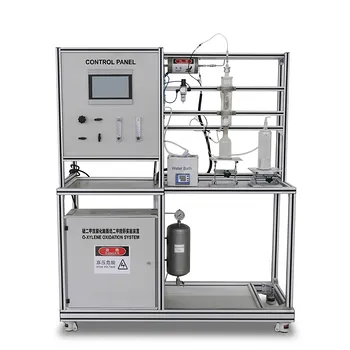
Here’s the inescapable physical reality: Without precise temperature control, a polymerization pilot plant is not a research tool—it’s a bomb with a variable timer. The core reason is the staggering amount of heat released, where an uncooled reaction can theoretically self-heat by over 1,600 K, instantly triggering a secondary, more dangerous decomposition that leads to catastrophic thermal runaway.
Precise temperature control in a polymerization pilot plant is a dual-purpose, non-negotiable imperative. It is the primary defense against a deadly thermal runaway cascade, and it is the fundamental requirement for obtaining any meaningful kinetic, thermodynamic, or product-quality data. The essential safety mechanisms form a layered defense of prevention, monitoring, and emergency relief, with high-integrity bursting disks providing the critical last line of defense.
The Thermodynamic Ticking Clock: Why Runaways Happen
The danger begins with the chemistry itself. Polymerization is highly exothermic, and the heat must be removed as fast as it is generated. The failure of this heat balance is the root cause of all thermal runaway events.
The Domino Effect of Adiabatic Temperature Rise
The initial polymerization reaction releases immense energy. For a common monomer like ethene, this reaction alone can cause a theoretical temperature spike of around 1,600 K if the cooling fails. This isn't just a temperature increase; it's a transition into a new and far more dangerous chemical regime.
Once the bulk temperature exceeds a critical threshold—570 K for ethene—the monomer itself begins to decompose exothermically. This secondary decomposition releases even more energy and generates gases like hydrogen and methane, creating a pressure surge that can rupture the reactor in milliseconds. This two-stage explosion is what makes polymerization uniquely hazardous.
The Kinetic Vicious Cycle
A runaway isn't just about total heat; it's about the accelerating rate of heat release. According to the kinetic relation (\lg k = A + B/T), a temperature rise is not a linear problem. It exponentially increases the reaction rate constant, (k). A small temperature excursion from poor control or fouled heat transfer surfaces increases the rate, which generates more heat, which further increases the rate, creating an unstoppable cycle that reaches its maximum rate in moments.
Beyond Safety: Control as the Key to Scientific Validity
While safety is paramount, precise control is also the bedrock of any useful experimental data. A pilot plant with poor temperature control produces results that are, at best, irrelevant and, at worst, dangerously misleading for scale-up.
Deciphering Kinetic and Thermodynamic Laws
The goal of a research pilot plant is to derive parameters that predict industrial-scale behavior. This is impossible without tight temperature control. You cannot accurately calculate the activation energy ((E_a)) or the standard Gibbs free energy change ((\Delta G^\circ)) if the reaction temperature is a moving target. For instance, a shift from 373 K to 423 K can increase an equilibrium constant nearly tenfold, fundamentally changing product distribution and yield.
The Product Quality Imperative
The temperature history of a reaction directly dictates the polymer's molecular architecture. In processes like PVC suspension polymerization, the entire grade of the product is determined by controlling the temperature within an incredibly narrow band of ±0.2°C. A deviation doesn't just risk safety; it destroys the product quality, invalidating the experiment and wasting resources.
Engineering a Layered Safety Defense
Managing these risks requires an engineered hierarchy of controls, not a single device. The layers work in concert to prevent excursions, detect them early, and safely terminate an event.
Layer 1: Fundamental Prevention Systems
The first and most critical layer actively prevents an excursion from ever starting. This relies on a dynamic heat balance. Highly precise PID controllers must modulate cooling water flow through a reactor jacket based on feedback from high-accuracy thermowells. In semi-batch operations, metered initiator dosing is a powerful safety lever. Limiting the reaction rate, especially with an initial reagent charge often capped at 20%, allows the cooling system’s capacity to be verified before the reaction reaches full scale.
Layer 2: Intelligent Monitoring and Early Warning
Physical systems can fail, so the next layer involves sophisticated monitoring to catch a runaway in its incipient stage. Sensitive temperature alarms set just a few degrees above normal operating conditions provide the first alert. More advanced setups integrate online Fourier Transform Infrared (FTIR) spectroscopy to track reactant and product concentrations in real-time, identifying a delayed exotherm or an unexpected reaction pathway before a temperature probe would even register a change.
Understanding the Trade-offs
Choosing a safety architecture is a deliberate compromise between experimental flexibility and inherent protection.
Overpressure Relief: The Last and Non-Negotiable Line
When prevention layers fail, the overpressure protection system must work with absolute certainty. The choice of device involves clear trade-offs. Rapid-acting pressure relief valves can be complex and may not react fast enough for a deflagration. The definitive solution for high-hazard polymerization is a bursting disk.
- For autoclave reactors, a bursting disk mounted directly into the reactor wall provides unrestricted, millisecond-level relief of the entire contents.
- For tubular reactors with smaller internal volumes, multiple bursting disks and externally controlled dump valves are placed along the tube length. This segmented approach prevents a localized pressure spike from transitioning into a full reactor detonation, safely quenching decomposition products at multiple points.
Summary Table:
| Safety Layer | Primary Function | Key Mechanisms / Equipment |
|---|---|---|
| Prevention | Actively maintains reactor heat balance | PID controllers, cooling jackets, metered initiator dosing |
| Monitoring | Detects thermal deviations early | High-accuracy thermowells, online FTIR spectroscopy |
| Relief | Safe, instant pressure discharge | High-integrity bursting disks, rapid-acting dump valves |
Ensure the safety, precision, and reproducibility of your chemical engineering research. LABPARK provides premium Educational and Vocational Unit Operations Pilot Plants in chemical engineering, bioprocess & biotech, and environmental & water treatment tailored for universities, research institutes, and enterprises.
Ready to equip your facility with advanced temperature control and robust safety mechanisms? Contact us today to discuss your project requirements with our engineering team!
Related Products
- Polymerization Granulation and Pellet Processing Educational Unit Operations Pilot Plant
- Methanol Synthesis and Catalyst Performance Evaluation Educational Unit Operations Pilot Plant
- Fixed-Bed Chemical Reaction and Gas Dust Tar Removal Unit Operations Pilot Plant
- Multi-Reactor Educational Pilot Plant for Reaction Engineering Unit Operations
- Carbon Dioxide Hydrogenation Methanol Synthesis Educational Unit Operations Pilot Plant
People Also Ask
- How to configure a polymerization pilot plant for molecular weight control? Key Setup Guide
- How do educational unit operations pilot plants address safety and waste management when scaling up?
- How do unit operation requirements differ between traditional chemical processes and bioprocesses? Build Better Pilot Plant Curricula
- How do educational unit operations pilot plants bridge theory and industrial process development? Hands-On Learning
- How do educational unit operations pilot plants bridge theory and design? Bridge the Engineering Gap