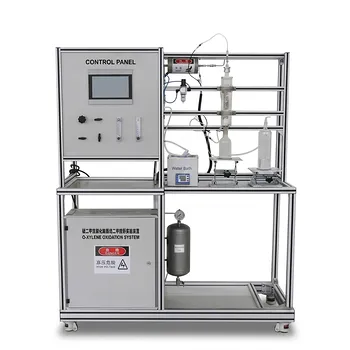
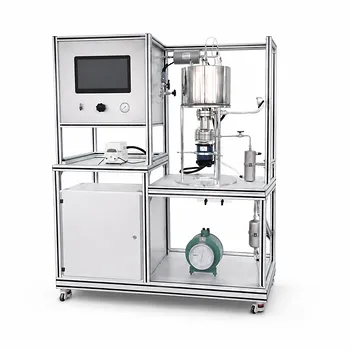
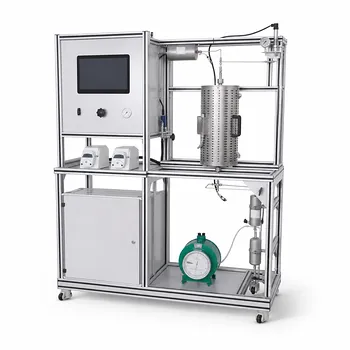
Understanding the critical role of precise control is not about the equipment's features; it's about what those features allow you to teach. In university and vocational training labs, a chemical reactor pilot plant with precise pH and temperature control is not a luxury—it is the fundamental instrument that transforms theoretical principles from a textbook into observable, measurable, and safe physical reality. Without this precision, the core lessons of reaction kinetics, thermodynamics, and process safety become abstract and unprovable.
The value of a pilot plant for education lies in its ability to make invisible molecular events visible through data. Precise pH and temperature control is the only way to decouple variables, allowing students to prove that a specific change in a condition causes a specific, predictable outcome, while also learning to manage the inherent safety risks of uncontrolled reactions.
The Foundation of Observable Scientific Principles
A chemical reaction is a complex interplay of energy and matter. To teach it effectively, you must be able to manipulate the fundamental levers that govern it. Precise control is the tool that makes this possible.
Isolating Kinetic Variables for Clear Learning
The rate at which a reaction proceeds is the first thing a student must learn to quantify. This cannot be done with unstable equipment.
A reaction's rate constant (k) is not a static number; it is a direct function of temperature, as described by the Arrhenius equation. If a reactor's temperature fluctuates, the value of k is constantly changing, and the kinetic data students collect becomes meaningless noise.
Precise jacket temperature control, managed by a PID controller, creates a stable thermal environment. This allows students to run an experiment where temperature is the only variable. They can then directly calculate the activation energy (Ea) of a reaction, witnessing a fundamental chemical property emerge from their own accurate data.
Making Thermodynamic Equilibrium Concrete
The concept of equilibrium is often taught as a static endpoint. Precise control proves it is a dynamic, responsive state.
The equilibrium constant (K) is highly sensitive to temperature. A textbook might state that K for a reaction changes from 0.36 to 3.2 over a 50-degree temperature increase. A precisely controlled pilot plant allows a student to perform that exact experiment, measure the shift in product distribution, and then calculate the standard Gibbs free energy change (ΔG°).
This transforms ΔG° from a mathematical abstraction on a homework assignment into a tangible quantity they’ve derived from a physical system they operated. The lesson becomes unforgettable.
Demonstrating Selectivity in Complex Chemistry
In the real world, reactions rarely involve a single pure reactant. The power to control pH is the power to teach selectivity.
Many key industrial processes, like liquid-liquid extraction or pharmaceutical synthesis, rely on pH-dependent coordination chemistry. Consider EDTA, a common chelating agent.
EDTA will bind to both zinc and calcium ions, but with different stability constants. By using the pilot plant’s precise pH dosing system to maintain a pH of 4-5, students can force EDTA to selectively bind to zinc while leaving calcium untouched. This is a powerful, visual demonstration of thermodynamic vs. kinetic control and is the direct basis for separation and purification unit operations they will encounter in industry.
The Critical Bridge to Industrial and Biological Reality
Teaching only idealized chemistry in glass beakers does not prepare students for the chemical industry. Pilot plants bridge this gap, and precise control is the bridge’s keystone.
De-risking Industrial Scale-Up and Process Intensification
An uncontrolled exothermic reaction at a lab scale causes a broken beaker. At an industrial scale, it causes a disaster. Teaching robust control is teaching fundamental safety.
Advanced pilot plants, such as those with microchannel reactors, demonstrate process intensification. In a multi-step fuel processing reaction, a temperature gradient is not an error but a deliberate design choice. Students learn that a Water-Gas Shift reaction can be optimized by starting hot for kinetics and ending cooler for favorable thermodynamics.
This teaches them to think like process engineers, managing complex trade-offs rather than just following a recipe. Learning to control an exotherm in a preferential oxidation (PROX) reaction on a pilot scale ingrains the thermal management principles that are critical for safe industrial reactor design.
Safeguarding the Fragile Machinery of Bioprocessing
For biotechnology and bioengineering students, the reactor’s environment is not just a chemical parameter; it's the habitat for a living catalyst.
The functional activity of an enzyme or a whole cell is entirely dependent on the precise three-dimensional structure of its proteins. This structure is fragile. A temperature spike or a pH swing outside the narrow optimal window causes denaturation, instantly destroying the biological catalyst and ending the process.
A pilot plant equipped for bioprocessing must have automated control loops for pH dosing and jacket cooling. This allows students to study the direct correlation between a stable environment and metrics like the maximum specific growth rate (μ_max) of a microorganism. They learn that their job is to maintain the perfect artificial "home" for the biology, a lesson that’s impossible to teach with fluctuating, manual controls.
Understanding the Trade-offs
While precision is paramount, the educational design of a pilot plant involves key trade-offs that shape the learning experience.
The "Black Box" Risk
A fully automated, push-button system can achieve perfect control but deliver a poor education. If students simply load a recipe and press start, they fail to understand the underlying engineering.
The best training systems balance precision with transparency. Students should be able to manually tune a PID controller, observe the effect of changing gain parameters, and understand the feedback loop. The pedagogical goal is not automation, but a deep comprehension of the control logic itself.
Robustness vs. Sensitivity
An industrial sensor is optimized for longevity in a harsh, single-purpose process. An educational sensor must withstand student error and a wide variety of chemicals.
Lab-grade sensors and glass-lined reactors are often more appropriate than their heavy-industry counterparts, as they offer broader chemical compatibility and the sensitivity needed for diverse experiments. The trade-off is that they require more careful handling, which is itself a crucial lesson in lab protocol and care for instrumentation.
Making the Right Choice for Your Educational Goal
Selecting a pilot plant requires matching the system’s control architecture to your specific pedagogical mission. The objective is not to buy the most expensive system, but the most instructive one.
- If your primary focus is teaching fundamental chemical engineering principles: Choose a system with PID controllers that students can manually tune. The system should allow them to induce and then correct temperature gradients and pH swings, making the control loop a central part of the experiment.
- If your primary focus is applied biotechnology and bioprocessing: Prioritize a system with robust, fail-safe automated control loops and sterilization-in-place (SIP) capability. The key lesson here is maintaining a completely aseptic, stable environment for a living catalyst over days or weeks.
- If your primary focus is vocational and operations training for industry: Select an automated system with a DCS-style interface that mimics a plant control room. The educational value is in learning batch records, alarm management, and the disciplined adherence to a standard operating procedure in a simulated industrial environment.
The goal is not to have a reactor that works perfectly every time, but one that accurately and safely reveals the profound, invisible, and dynamic consequences of chemical and biological laws.
Summary Table:
| Educational Focus | Key Control Requirement | Pedagogical Value |
|---|---|---|
| Chemical Kinetics | Precise PID Temperature Control | Isolates variables to calculate activation energy ($E_a$). |
| Thermodynamics | Stable Jacket Temperature | Demonstrates dynamic equilibrium shifts and standard Gibbs free energy. |
| Selectivity & Synthesis | Precise Automated pH Dosing | Proves thermodynamic vs. kinetic control in separation operations. |
| Bioprocess & Biotech | Fail-safe pH & Temp Loops | Prevents enzyme denaturation to study biological catalyst growth. |
| Vocational Training | DCS-Style Automation Interface | Teaches alarm management, industrial SOPs, and plant control room operations. |
Bring Industrial Precision to Your Engineering Lab
Bridge the gap between theoretical textbook chemistry and real-world industrial operations. LABPARK designs and manufactures state-of-the-art Educational and Vocational Unit Operations Pilot Plants for universities, research institutes, and enterprises.
Whether your curriculum focuses on chemical engineering, bioprocess & biotech, or environmental & water treatment, our systems offer the precise pH and temperature control loops necessary to teach process kinetics, scale-up safety, and automation logic.
Ready to elevate your training facilities? Contact LABPARK today to discuss your laboratory's custom requirements!
Related Products
- Fixed-Bed Chemical Reaction and Gas Dust Tar Removal Unit Operations Pilot Plant
- Fixed Bed Gas Solid Catalytic Reaction Educational Pilot Plant
- Multi-Reactor Educational Pilot Plant for Reaction Engineering Unit Operations
- Residence Time Distribution and Reactor Flow Characteristics Determination Educational Pilot Plant
- Tubular Reactor Flow Characteristics Determination Educational Unit Operations Pilot Plant
People Also Ask
- When to transition from PID to adaptive control in pilot plants? Key process indicators.
- How do deviations in estimating latent heat impact pilot plant thermal systems? Avoid hardware mis-sizing.
- Why Compare Predicted and Experimental Excess Enthalpy? Key to Accurate Pilot Plant Scale-up
- How to study gasification in pilot plants? Compare exit gas composition & efficiency
- Why Use PTFE & Hastelloy in Chemical Pilot Plants? Prevent Corrosion & Ensure Safety