Temperature changes wreak havoc on volume-based concentration measurements. In a chemical engineering pilot plant, where thermal processes like distillation, evaporation, or crystallization cause significant temperature swings, using molarity (moles of solute per liter of solution) introduces a fundamental error—the solution’s volume expands and contracts, altering the very concentration you’re trying to measure. Molality, defined as moles of solute per kilogram of solvent, sidesteps this entirely because it’s anchored to mass, not volume. Mass simply doesn’t change with temperature, so molality remains a stubborn constant, making it the preferred choice for thermodynamic modeling when temperature varies.
The core issue is that thermodynamic models demand consistent composition data to accurately predict phase equilibria, chemical potentials, and mass balances. Molarity drifts with every degree of temperature change, while molality stands still. In a pilot plant, that stability translates directly into trustworthy calculations, robust scale-up parameters, and fewer hidden errors in your energy and material balances.
The Fundamental Flaw of Molarity in Thermal Processes
Chemical engineering pilot plants rarely operate at a single, constant temperature. Thermal unit operations deliberately raise, lower, and cycle temperatures to test separations, kinetics, and energy efficiency. In that dynamic environment, molarity becomes a moving target.
Why Volume Changes with Temperature
Liquids are not rigid—they behave like a dense collection of molecules bouncing around. As temperature increases, the average kinetic energy rises, pushing molecules slightly farther apart. That microscopic dance causes thermal expansion: the same mass of liquid now occupies a larger volume.
For a solution, the effect is measurable. The supplementary data shows that a 10% NaCl solution’s density drops from 1.07411 g/cm³ at 10°C to 1.07074 g/cm³ at 20°C. That tiny density shift means the same amount of solute is now spread across a slightly larger volume. Molarity (mol/L) directly depends on that volume, so the numerical concentration decreases, even though you haven’t added a drop of solvent or removed a single molecule of solute.
The Ripple Effect on Pilot Plant Data
This volume drift creates a cascade of problems in a pilot plant setting. You’re not just measuring a number; you’re feeding that number into rigorous thermodynamic models to predict boiling points, vapor-liquid equilibrium, crystallization yields, and reaction kinetics.
A molarity-based concentration recorded at a cold sampling point will not match the true composition inside a hot reboiler or a steam-heated evaporator. Your mass balance will appear to gain or lose mass, not because of a leak or reaction, but because the measurement unit itself changed. For a pilot plant that exists to generate accurate scale-up data, that kind of uncertainty can lead to over-designed safety margins, misinterpreted kinetic constants, or flawed process control strategies.
Why Molality Provides the Stable Foundation
Molality steps in as the invariant reference that thermal processes demand. By tying the concentration to the mass of the solvent—a quantity unaffected by temperature or pressure—it removes an entire class of systematic errors.
The Physics of Invariant Mass
A kilogram of solvent is a kilogram of solvent, whether it’s at 5°C or 95°C. The number of solvent molecules in that kilogram doesn’t change, and neither does the amount of dissolved solute relative to it. Molality (mol/kg solvent) is therefore a true intensive property that reflects the composition of the mixture, not the fleeting volume the mixture happens to occupy at a given moment.
This isn’t just a convenience; it’s a necessity for accurate thermodynamic modeling. Chemical potential, activity coefficients, and fugacity all depend on the relative amounts of the species present, not on the momentary expansion of the container. Molality aligns with that reality, while molarity carries a phantom temperature signal.
Direct Link to Thermodynamic Principles
When you apply models like UNIQUAC, NRTL, or electrolyte equations to a pilot plant, you’re solving for equilibrium states based on composition. If that composition is temperature-dependent, you’re effectively trying to hit a target that moves every time the temperature changes.
Molality provides a stable thermodynamic frame of reference. A 1 mol/kg salt solution has the same energetic landscape at any temperature, so the model’s parameters stay physically meaningful. This is especially critical when validating a model against pilot data collected across a temperature ramp. You can directly compare data points without having to back-calculate what the volume might have been. The result is a consistent, defensible dataset that translates cleanly to full-scale design.
Understanding the Trade-offs
Adopting molality isn’t without its practical headaches, and a senior engineer must weigh them honestly. The decision to use molality is a trade-off between sampling convenience and long-term data accuracy.
The Lab-Scale Inconvenience
In a pilot plant control room, most analytical methods give you a volume-based readout. Density meters, flow meters, and online spectrometers might report in g/L or % w/v. Converting these to molality requires knowing the solvent mass, which often means measuring the solution density and subtracting the solute contribution. That extra step adds time, potential conversion errors, and demands more frequent density measurements if temperature varies continuously.
This is why many teams fall back on molarity—it’s the path of least resistance at the sample collection stage. However, that short-term convenience is bought at the cost of long-term model fidelity.
When Molarity Might Still Be Acceptable
If your pilot plant operates a truly isothermal process—say, a constant-temperature stirred-tank reactor held within a tight 0.5°C band—the volume changes are negligible, and molarity can work fine. Even then, you’d want to verify that temperature truly stays uniform across all sampling ports.
Similarly, for very dilute solutions where the solvent’s density approaches that of pure water, the difference between molarity and molality can be extremely small. In those narrow scenarios, the convenience of volume-based measurements might outweigh the theoretical benefit of molality. But the moment you introduce a temperature gradient, a boiling step, or a steam-heated vessel, molality becomes the only scientifically rigorous choice.
Making the Right Choice for Your Pilot Plant
Your decision should be driven by the thermodynamic demands of the data and the ultimate destination of that data—scale-up to production, model validation, or regulatory filing. Use the following goal-based guide to direct your approach.
- If your primary focus is accurate mass and energy balances that feed into scale-up: Prioritize molality. The extra sampling effort pays for itself by eliminating temperature-induced composition errors that would otherwise distort your design margins.
- If your primary focus is rapid, high-frequency process monitoring in a tightly isothermal system: Molarity can be acceptable, provided you confirm temperature stability and track density changes. But remain alert for any thermal drift that could silently skew your data.
- If your primary focus is validating a thermodynamic model against pilot plant data: Insist on molality. Model parameters are calibrated to mass-based composition—force-fitting them to drifting volume-based data will produce fitting parameters that are physically meaningless and fail to extrapolate.
- If your primary focus is complying with regulatory guidelines that demand unambiguous composition reporting: Default to molality or mass fraction. These mass-based quantities leave no room for interpretation about temperature conditions, giving auditors and reviewers a clear, unchanging reference point.
By anchoring your concentration data in mass, you insulate your pilot plant’s modeling from the one variable that changes constantly yet has nothing to do with chemical identity: temperature.
Summary Table:
| Parameter | Molarity (mol/L) | Molality (mol/kg) |
|---|---|---|
| Definition | Moles of solute per liter of solution | Moles of solute per kg of solvent |
| Temperature Effect | Dependent (changes with volume) | Independent (mass remains constant) |
| Data Reliability | Drifts during thermal cycles | Remains stable across temperatures |
| Best Used For | Isothermal processes | Dynamic thermodynamic modeling |
Optimize Your Pilot Plant Operations with LABPARK
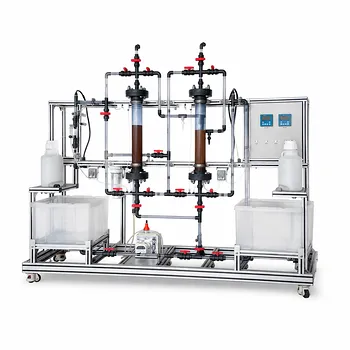
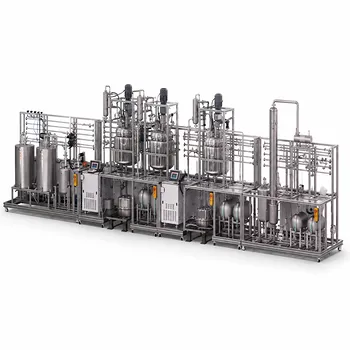
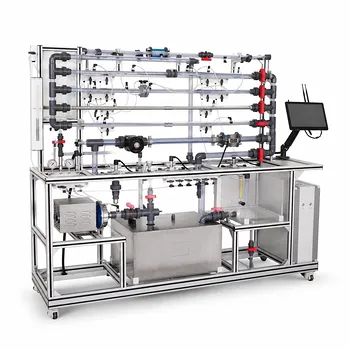
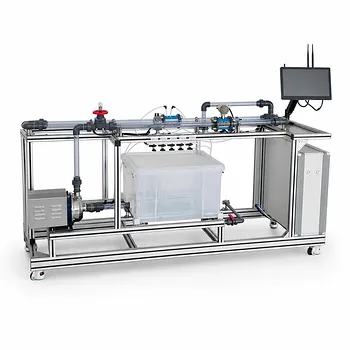
Accurate thermodynamic modeling starts with reliable data and precision-engineered systems. LABPARK provides state-of-the-art Educational and Vocational Unit Operations Pilot Plants in chemical engineering, bioprocess & biotech, and environmental & water treatment. Specifically designed for universities, research institutes, and enterprises, our pilot plants enable students and researchers to master heat transfer, phase equilibria, and process control under varying temperatures.
Ready to upgrade your laboratory capabilities? Contact us today to explore our custom pilot plant solutions!
Related Products
- Fixed-Bed Chemical Reaction and Gas Dust Tar Removal Unit Operations Pilot Plant
- Electrolytic Hydrogen Production Educational Unit Operations Pilot Plant
- Ethyl Acetate Synthesis Unit Operations Pilot Plant for Practical Training
- General Purpose Cosmetics Production Unit Operations Training Pilot Plant
- Continuous Batch Extractive Distillation Educational Pilot Plant
People Also Ask
- When to transition from PID to adaptive control in pilot plants? Key process indicators.
- How do deviations in estimating latent heat impact pilot plant thermal systems? Avoid hardware mis-sizing.
- Why Compare Predicted and Experimental Excess Enthalpy? Key to Accurate Pilot Plant Scale-up
- How to study gasification in pilot plants? Compare exit gas composition & efficiency
- Why Use PTFE & Hastelloy in Chemical Pilot Plants? Prevent Corrosion & Ensure Safety